










































Sanitation and Hygiene Advocacy and Communication Strategy Framework 2012-2017
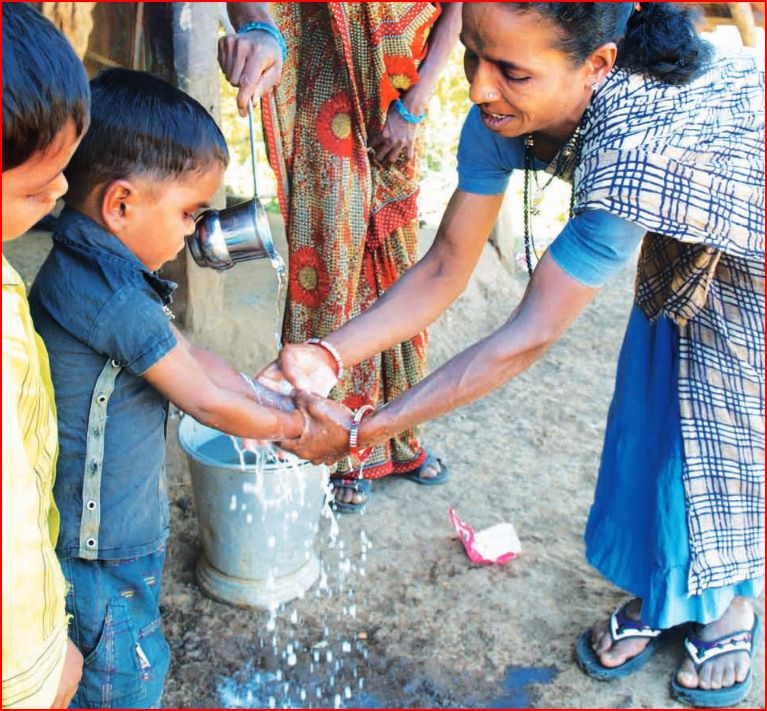
"The strategy focuses on increasing knowledge and perceived importance of sanitation and hygiene practices, with the long term objective of changing the way society thinks so that open defecation is no longer acceptable in India."
With the goal of helping India meet the Millennium Development Goal (MDG) for sanitation (#7), the Ministry of Drinking Water and Sanitation (MDWS), Government of India and the United Nations Children's Fund (UNICEF) carried out a consultative process to create the Sanitation and Hygiene Advocacy and Communication Strategy 2012-2017, which is a framework to guide the execution of advocacy and communication efforts related to toilet construction and use and key critical sanitation and hygiene behaviours at the national, state and district level. Specifically, it focuses on 4 sanitation and hygiene behaviours: building and use of toilets; the safe disposal of child faeces; handwashing with soap after defaecation, before food, and after handling child faeces; and safe storage and handling of drinking water. The communication strategy is divided into 3 phases, each with specific communication objectives. It clearly defines:
- The audience receiving the information (the who);
- The content of the information (the what)
- The methods to be used to convey the information (the how); and
- The approaches to promote action for change (the action).
The document is divided into these main sections, each with sub-sections (selected excerpts are included below):
- Why a Sanitation and Hygiene Advocacy and Communication Strategy Framework - One section focuses on challenges and misconceptions - For example: "Construction of toilets is still seen as a government responsibility, rather than a priority that individual households should take responsibility for. As such people prioritise buying a mobile phone or TV rather than investing in, using and maintaining a toilet. The challenge is to motivate people to see a toilet as fundamental to their social standing, status and well-being."
- What is the focus of the Sanitation and Hygiene Advocacy and Communication Strategy Framework
- Changing an individual's behaviour - "Evidence shows that the most effective approach leading to behaviour change is a combination of efforts at all levels – individual, interpersonal network, community and societal. For effective communication, different levels are reached with different communication approaches."
- Communication objectives - "The long term objective is to change social norms making open defecation unacceptable and internalizing the practice of safe disposal of child faeces, handwashing with soap and safe storage and handling of drinking water among all."
- Communication approaches - These include advocacy, interpersonal communication, community mobilisation, entertainment education, and social marketing, with overall multimedia support including folk media, mass media, digital media, and social media.
- The three phases of the Advocacy and Communication Strategy
- Communication activities at the national level, national and state level, and district, block, village/Gram Panchayat (GP) level - For example: "Budaun district in Western Uttar Pradesh, was a polio 'hotspot' and headed the list of 25 worst-affected districts in India with a staggering 52 cases reported during 2009. A survey by the district administration in Budaun revealed 49,000 dry toilets as the main source of poor sanitation in the district. Converting dry latrines was also seen as an urgent priority in elimination of transmission of wild polio virus (WPV) in Budaun. A campaign to convert dry latrines into flush latrines was launched in October 2009 under the leadership of the District Magistrate and more than 47,000 dry toilets were converted to pour flush toilets in less than one year and 2,200 manual scavengers (mostly women) were rehabilitated. The core elements of the strategy were:
- Interpersonal communication and community mobilisation: Polio's Social Mobilisation Network, block & village level motivators and village pradhans engaged to build awareness using interpersonal communication which raised awareness on the purpose of the initiative, the need for the initiative and the associated health hazards; explained the technology of the new toilets and addressed the concerns of the community. Regular village level meetings conducted by district and block level officials.
- Role model initiatives: All Government functionaries - at grass root level ...asked to convert or build sanitary toilets in their houses.
- Convergence of Govt. Departments: Health, Panchayati Raj, Sanitation, Education and Food and Civil Supplies.
- Championing the cause by the District Magistrate and strong commitment of the district administration.
- Involvement of media: Information sharing with local media resulting in large number of stories and articles being printed in the local newspapers like Dainik Jagran and Amar Ujala.
- Awareness building on Employment of Manual Scavengers and Construction of Dry Latrines (Prohibition) Act, 1993.
- Formal Ceremony to Celebrate Stoppage of Dry Latrines in the Village by burning manual scavenger baskets.
- Funding and linkages with other sanitation schemes..."
- Communication activities at the national level, national and state level, and district, block, village/Gram Panchayat (GP) level - For example: "Budaun district in Western Uttar Pradesh, was a polio 'hotspot' and headed the list of 25 worst-affected districts in India with a staggering 52 cases reported during 2009. A survey by the district administration in Budaun revealed 49,000 dry toilets as the main source of poor sanitation in the district. Converting dry latrines was also seen as an urgent priority in elimination of transmission of wild polio virus (WPV) in Budaun. A campaign to convert dry latrines into flush latrines was launched in October 2009 under the leadership of the District Magistrate and more than 47,000 dry toilets were converted to pour flush toilets in less than one year and 2,200 manual scavengers (mostly women) were rehabilitated. The core elements of the strategy were:
- How to implement the Sanitation and Hygiene Advocacy and Communication Strategy Framework
- Implementation framework (Annex-1)
- Guidance note for developing state-specific advocacy and communication strategies
- District Communication Plan Template (Annex-2)
- Monitoring and Evaluation Framework
- Suggested monitoring and evaluation framework (Annex-3)
Water Supply & Sanitation Collaborative Council website, February 5 2014. Image credit: UNICEF