










































Technology Outlook for Brazilian Primary and Secondary Education 2012-2017
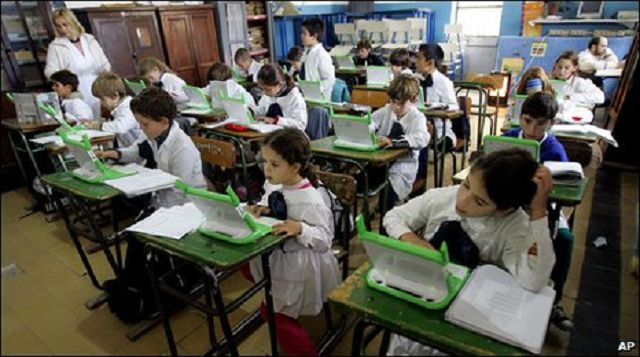
"...online learning and workspaces are entering mainstream use in schools. Collaboration is increasingly perceived as a fundamental skill worldwide, which has sparked a growing demand that students, teachers, and schools find creative ways to develop those skills within learning activities."
This report reflects a collaborative research effort between the New Media Consortium (NMC) and Sistema FIRJAN to help inform Brazilian educational leaders about significant developments in technologies supporting teaching, learning, and creative inquiry in primary and secondary education. For the Technology Outlook for Brazilian Primary and Secondary Education 2012-2017, in an effort that ran from August through October 2012, a group of 30 experts considered hundreds of relevant articles, news clippings, blog posts, studies, and project examples as part of the preparation that ultimately pinpointed notable emerging technology topics, trends, and challenges for schools in Brazil over the next five years.
The 12 "technologies to watch" presented in the report reflect the advisory board's opinions as to which of the nearly 60 technologies considered will be most important to Brazilian primary and secondary education following the publication of the report. There was an agreement that collaborative environments, game-based learning, mobile phones, and tablet computing are only a year or less away from mainstream adoption; cellular networks, geolocation, mobile apps, and open content are poised within the two- to three-year horizon; and collective intelligence, mobile laboratories, personal learning environments, and semantic applications are four to five years out. Each of the 12 key technologies is profiled on a single page that opens with a definition of the highlighted technology, outlines its educational relevance, points to several real-life examples of its current use in schools, and ends with a short list of additional readings for those who wish to learn more.
The report notes that access to broadband internet is not yet pervasive in Brazil, especially outside urban areas. While much of the country's population owns a smartphone, "the infrastructure to support web browsing, social networking, and beyond is insufficient. Cellular broadband networks are seen as the fastest, most efficient way to achieve adequate levels of broadband penetration across much of the country. In this regard, substantial advances in infrastructure are anticipated due to the placement of both the next World Cup and the next Summer Olympics in Brazil, and these events, to be held in 2014 and 2016, respectively, are important context in interpreting these findings. Mobile phones and tablet computing devices are in the near-term, while network-dependent extensions of those devices are further away from widespread adoption. Notably, cloud computing, a group of technologies clearly dependent on broadband to be used effectively, is placed in the near-term in the comparison reports, yet did not make the list this year in Brazil at all."
"Among the top trends was also the expectation that people should be able to work, learn, and study from wherever they want. This notion very much depends on mobile technologies and also reflects their prominence in the report because devices such as smartphones and tablets enable users to access and share information on the go."
The advisory board members saw doors opening in Brazilian primary and secondary schools to more online, hybrid, and collaborative learning models. These emerging models foster teamwork, communication, and informal and peer-to-peer leaning. They also acknowledged the evolving role of teachers. The need to improve teacher training, for example, continues to dominate conversations in Brazil; there is a common recognition that merely placing technology in schools is not adequate, but that pre-service teachers must be digitally literate and be able to produce and manage media before they enter the classroom. Similarly, in-service teachers must engage in ongoing professional development to learn new skills as technology evolves.
According to the report, the Brazilian advisory board views games and gaming consoles as a natural bridge between students and information, and incorporating gaming mechanics into learning has proven to improve logic, reasoning, and other skills. Though there are not many prominent examples of educational or serious games in Brazil, especially Portuguese-based games, there are a growing number of organisations and groups that are exploring opportunities for developing games specifically for schools.
Discussions about the need to shift to more student-centred paedagogies were prominent throughout the project; the main challenge the experts saw was the need for teaching methodologies to connect with how students learn naturally. According to the report, this newly conceived approach would be challenging because traditional teacher-centred classrooms and lectures remain the norm in Brazilian schools. "Beyond classroom approaches, the advisory board agreed that the core curriculum itself is in need of transformation. There was a consensus among the experts that students benefit from learning material and working on assignments that have concrete applications to their lives, and especially those that can involve them in solving community-based problems that they know need attention."
This report is designed to constitute a reference and straightforward technology-planning guide for educators, researchers, administrators, policymakers, and technologists. View the work that produced the report at this wiki.
NMC website, December 14 2012. Image credit: BBC/Brazil: One Laptop Per Child