










































Nutrition Guidelines for Care and Support of People Living with HIV and AIDS
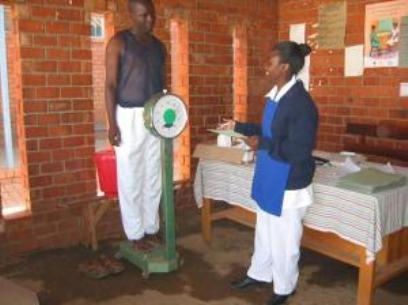
This set of guidelines and the accompanying flip chart (see the Related Summaries section below) are training and outreach resources used by Zambia’s Ministry of Health, the National AIDS/AIDS/STI [Sexually Transmitted Infection]/TB[Tuberculosis] Council, and the National Food and Nutrition Commission as a point of reference for all their partners involved in nutrition support activities for people living with HIV/AIDS (PLHIV). They are intended for a wide variety of health service providers, as well as policymakers, training institutions, and for PLHIV and their families. With slight adaptations, according to the creators of the materials, social welfare development workers, interest groups, churches, politicians, non-governmental organisations (NGOs), extension workers, and teachers can also use them.
The handbook focuses on the nutritional care aspect of AIDS treatment and care for PLHIV in Zambia. Chapter 9 in particular discusses communication strategies such as community outreach and mobilisation, which are helpful to making the recommendations relevant to PLHIV.
The nutrition guidelines are divided into 10 chapters, followed by references and annexes.
- Chapter 1 introduces the HIV/AIDS epidemic in Zambia.
- Chapter 2 gives an overview of the relationship between nutrition and HIV.
- Chapter 3 covers the components of nutrition care and support for non-pregnant, non-lactating adults with HIV.
- Chapters 4 and 5 describe recommended nutrition interventions for HIV-positive pregnant and lactating women and infants and young children of HIV-positive women, respectively.
- Chapter 6 explains how to manage the interaction between food and the drugs used to treat HIV.
- Chapter 7 covers the issue of hygiene and sanitation for PLHIV with weakened immune systems.
- Chapter 8 describes the impact of HIV on food security and suggests approaches to help PLHIV and their households in this area.
- Chapter 9 discusses community outreach and mobilisation as components of the care and support of PLHIV and the management of malnutrition.
- The final chapter discusses monitoring and evaluation (M&E) of nutrition interventions in HIV services.
Communication strategies and tools to improve the effectiveness of services include:
- Nutrition education and counselling - Annex 11 has specific recommendations for counselling PLHIV on nutrition and antiretroviral drugs;
- Tools to explain counselling points, such as posters, counselling flip charts, and flowcharts;
- Counselling strategies for HIV-positive adults on how to disclose their HIV status to sex partners and offer their partners and children confidential HIV testing;
- Prevention messages and strategies that can be included in counselling, support groups, peer-led interventions, and home-based care (HBC).
98
FANTA website, November 9 2011.
- Log in to post comments