










































Focus on Disability: 'Zika babies' need support now
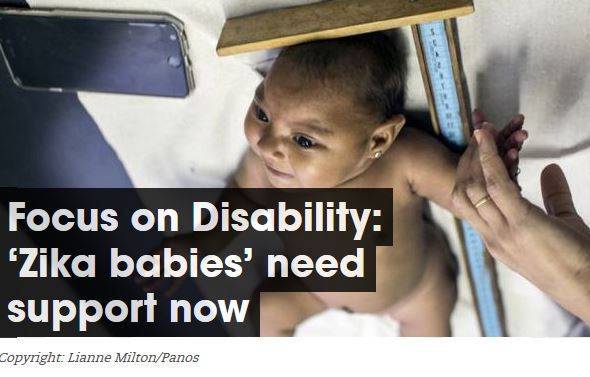
From Hannah Kuper: About 4,000 babies have now been born with microcephaly - abnormally small heads, often with underdeveloped brains in Brazil alone. Evidence is mounting that this is because of infection during pregnancy by the mosquito-borne Zika virus. Media attention on the epidemic has mainly focused on how to stop babies being born with microcephaly, whether by killing mosquitoes, finding a vaccine or easing abortion laws. Similarly, the WHO strategic response to Zika focuses on preventing outbreaks and controlling them when they occur. [1]
But what are the implications for the thousands of babies born with microcephaly? This is barely considered within the WHO response: disability is mentioned just twice.
Microcephaly has many different causes, all with varying impacts. This means the implications for babies with what appears to be Zika-related microcephaly are not yet clear. But we do know that microcephaly can cause wide-ranging physical and mental disabilities, including learning difficulties, hearing problems and physical impairments. There is already evidence from Brazil that Zika-related microcephaly is linked to eye disease. [2]
So the support babies need will vary. But some basic steps will benefit all of them. Firstly, intervening within the first year of life improve things for babies at risk of disabilities. [3] Programmes should ideally target both the baby’s motor and cognitive skills, as these are intertwined and reinforce each other: interventions such as physiotherapy or playing games will stimulate the child’s overall development.
These programmes should take place within the community, rather than at central clinics, to minimise dropout rates. Information and communications can help too: one programme in India for children with disabilities uses community workers and mobile tech to deliver interventions - how to best feed the child, for example - informed by evidence.
Despite Brazil’s strong primary healthcare service, support services for children with disabilities are limited. Philanthropic national organisations, such as APAE, fill some of the gaps. But essentially it will be parents, in particular mothers, will be mainly responsible for caring for children with microcephaly. Interventions are therefore needed to teach parents to better stimulate their child or pick up on cues from their children about what they need.
The parents of these babies will also need emotional support, particularly as a lot of stigma and discrimination is reported around childhood disability in Brazil. Evidence shows that parents of children with disabilities can suffer acute anxiety and may feel socially isolated. [4] Parents may also face financial pressures as they forego work to look after their child or pay for extra healthcare.
Establishing support groups for parents will help provide emotional and practical support. [4] Such groups have been set up around the world for the parents of children with cerebral palsy, providing a forum for parents to come together and learn skills but also share experiences. Schemes like these could work in Brazil.
Children have many fundamental rights, including the right to an education. [5] Schools and teachers must adapt so they can give children with microcephaly an effective education. The Beyond Boundaries in India does this by training teachers in inclusive methods and providing services — such as resource centres stocked with special equipment and adaptive devices - for children with special needs.
Governments and international health campaigners must act now to ensure these kids aren’t forgotten, so they and their families can have the best lives possible.
Hannah Kuper is codirector of the International Centre for Evidence in Disability at the London School of Hygiene & Tropical Medicine, United Kingdom. The centre is on Twitter as @ICED_LSHTM, and Kuper can be contacted on hannah.kuper@lshtm.ac.uk
References
[1] Zika strategic response framework & joint operations plan (WHO, February 2016)
[2] Bruno de Paula Freitas and others Ocular findings in infants with microcephaly associated with presumed Zika virus congenital infection in Salvador, Brazil (JAMA Ophthalmology, 9 February 2016)
[3] Alicia Spittle and others Early developmental intervention programmes provided post hospital discharge to prevent motor and cognitive impairment in preterm infants (Cochrane Database of Systematic Reviews 2015, 24 November 2015)
[4] Sarah Nakamanya and others Maternal experiences of caring for an infant with neurological impairment after neonatal encephalopathy in Uganda: a qualitative study (Disability and Rehabilitation, 17 October 2014)
[5] UN convention on the rights of persons with disabilities (UN, 2006)
Click here to access this SciDev.net blog and related links.
Image credit: Lianne Milton/Panos (c.)
As with all of the blogs posted on our website, the content above does not imply the endorsement of The CI or its Partners and is from the perspective of the writer alone. We do not check facts and strive to retain the writer's voice, as is detailed in our Editorial Policy.
Comments

Advocate for support for infants affected by Zika
How Zika Presents a Teachable Moment for Caring for Children with Disabilities04/25/2016 11:30 am ET
- Deborah Klein Walker Vice President, Abt Associates
Co-authored with Donald Wertlieb
The Zika virus epidemic, first observed in Brazil in Spring of 2015, has spread to 43 countries and territories in the Americas. Although Zika has relatively mild clinical symptoms in adults and children, scientists have recently confirmed that the disease can cause microcephaly, Guillain-Barre syndrome and other neurological disorders. The growing number of cases of microcephaly, caused by congenital Zika infection, has been declared a “Public Health Emergency of International Concern” by the World Health Organization (WHO). Officials from the U.S. Centers for Disease Control and Prevention (CDC) have warned that “everything we look at with this virus seems to be a bit scarier than we originally thought.”
Thousands of infants with microcephaly have been reported throughout the Americas. Infants with this birth malformation have smaller head circumferences and significant developmental and learning difficulties. Many of them will need health and social supports such as specialized health services, early childhood intervention, special education instruction, and family respite care throughout their lifetime. Will the families and communities of these children be prepared to care for them in all the affected countries?
Zika Underscores Importance of Disability Rights
As a recent editorial in the American Journal of Public Health highlighted, this tragic epidemic offers an opportunity to the global community—that is, the recognition of supports needed by infants and children with disabilities and their families. How communities and countries respond to this epidemic of infants with microcephaly and other Zika-associated-disabilities will reveal their approach and commitment to inclusion of individuals with disabilities in their communities. These children should not be placed in institutions, as they once were in the United States before the passage of state and federal legislation that gave children with disabilities the right to inclusion and participation in their community.
This tragedy also points out the importance of the Convention on the Rights of Persons with Disabilities, which recognizes “the inherent dignity and worth and the equal and inalienable rights of all members of the human family” and “the importance of mainstreaming disability issues as an integral part of relevant strategies of sustainable development.” All countries that have signed and ratified the convention document have made a commitment against placing children in institutional settings in favor of community settings. We recognize, however, that this is a major financial commitment for some low- and middle-income countries, which will likely need assistance from wealthier countries.
From Tragedy to Awareness: Connecting the Dots for Disability, Children’s Rights
This is a time for the global community to embrace and assert the rights of infants with disabilities and eliminate stigmas often associated with disability. We recommend that the WHO, Pan American Health Organization, CDC, USAID, and others encourage and prioritize inclusive early childhood development services and programs for the care and support of infants with disabilities and their families. Nongovernmental organizations such as CARE, PLAN International and Save the Children that have done so much to advance human rights and foster investment in early childhood development must now ensure that their programs and policies adapt and respond to this new group of children with disabilities and forge the way for a truly inclusive and cross-sectoral approach to health, education, and social protection. The Early Childhood Development Task Force of the Global Partnership on Children with Disabilities is working to assure children with disabilities are included.
Now is the time for individuals, communities, and nations to seize this opportunity to connect the dots between the Convention of the Rights of the Child and the Convention on the Rights of People with Disabilities to affirm the rights of all children, including those with disabilities. This is the moment to catalyze the capacity for inclusive early childhood development services and to make individuals, communities and countries more aware of disabilities. We must provide the needed supports so that these children can be cared for at home and in their communities, as is their right. Children and families should not be shamed or shunned but embraced and supported with compassion as they cope with the impact of a terrible disease acquired in utero. Let us turn a tragedy into an awareness and action campaign that will change how the world accepts millions with disabilities. .
Deborah Klein Walker is a Vice President and Senior Fellow at Abt Associates. She is the current president of the American Orthopsychiatric Association, a global alliance for behavioral health and social justice. She is a former president of the American Public Health Association and the Association of Maternal and Child Health Programs. The opinions expressed are her own and do not reflect those of Abt Associates.
Donald Wertlieb is Professor emeritus at Tufts University and President of the Partnership for Early Childhood Development and Disability Rights. He is a past president of the American Orthopsychiatric Association. The opinions expressed are those of the authors and do not reflect those of their affiliations.
Follow Deborah Klein Walker on Twitter: www.twitter.com/DKWpublichealth
Please reconsider the terminology in the blog post headline - "Zika babies" provokes stigma, marginalization, etc
- Log in to post comments