










































Kyunki...Jeena Issi Ka Naam Hai
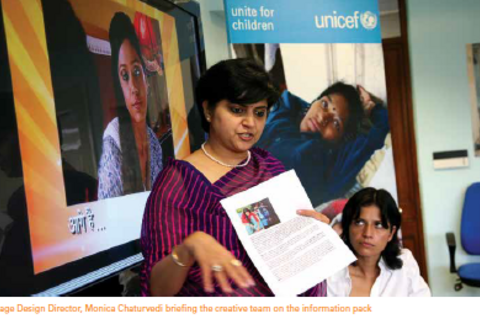
"Promoting messages that encourage positive behavior change, be it awareness about HIV/AIDS, educating the girl child, gender equity, safe motherhood, hygiene and sanitation or other key social and health behaviors, Kyunki...is proving to be a beacon of change that is paving a brighter path for the women and children of India."
Launched on World Health Day, April 7 2008 and broadcast until the end of 2011, the soap opera Kyunki...Jeena Issi Ka Naam Hai (Because...That's What Life Is) was a Hindi entertainment-education (EE) serial that aired on television in India in connection to the handbook, Facts for Life (FFL) (see Related Summaries, below), which "provides messages and information for mothers and caregivers to use in changing behaviours and practices that can save the lives of children and help them develop and grow to their full potential." The goal of the EE endeavour was to reach women and frontline workers in underserved communities in order to attain social and behavioural change objectives related to the welfare and survival of children and mothers.
Conceptualised in December 2004 during a polio intervention in Uttar Pradesh by a communication for development (C4D) specialist at the United Nations Children's Fund (UNICEF) and aired on the national service broadcaster, Doordarshan, Kyunki...Jeena Issi Ka Naam Hai featured a rural setting with characters reflecting the large majority of Indians who reside in rural areas. In an entertaining yet also educational format, it addressed socially sensitive issues such as the ill effects of child marriage and early pregnancy, gender equality, proper use of contraceptives, and prevention of HIV/AIDS; it also simply provided information about the importance of education, motivating children to stay in school, immunising children, and regularly washing hands with soap. It portrayed "the trials and tribulations of six unique heroes through multiple engaging plot lines..." It was based in a fictional village called Rajpura, where audiences learned about the following protagonists (described in detailed character portraits included in the first of the Related Links below, starting on page 76 of the full document):
- an ASHA (Accredited Social Health Activist) who conducts home visits to ensure that pregnant women have access to health services, including registration of births and ensuring visits to the local health centres by mothers and children;
- an ANM (Antenatal Midwife) who conducts deliveries, provides help and guidance on antenatal and post-natal health, and is responsible for routine immunisation and other aspects of health and family welfare;
- an AWW (Anganwadi Worker) who informs women on issues such as the importance of nutritious food, personal hygiene, care during pregnancy, nutrition of infants and children, and the importance of immunisation. (This character's name is Shabnam, a married woman in her early twenties, chided by her parents for standing up to her violent husband when he accuses her of being infertile. "Showing unconventional autonomy, Shabnam decides to end the abusive relationship and start her own life by training to become an Anganwadi (nutrition) worker in her village...Shabnam's story is representative of Kyunki...Jeena's pro-social modelling strategy. Where the Indian - and very popular - soap genre typically thrives on regressive portrayals of its female protagonists as ill-fated victims who must suffer in silence, Kyunki... promotes rights-based empowerment, exemplifying self-efficacy through characters who must navigate and negotiate the same goals and value systems that viewers grapple with in real life.");
- a teacher who is a positive role model encouraging children's education, especially girls' education, and creating a child-friendly environment in schools while also advocating social inclusion among the children and the community;
- a Sarpanch (elected village head portrayed by a woman in this serial so as to promote women's role in local governance) who provides information regarding government schemes related to health, education, and sanitation; and
- Meena, a spirited village girl who promotes the need for children's education and, in particular, girls' education. (See Related Summaries, below.)
Further information about the communication strategies and the production process that informed Kyunki...Jeena Issi Ka Naam Hai can be found at the Related Summaries area, below. But one insight about messaging is: "[I]n the Safe motherhood track - the Primary messaging was around nutrition of pregnant women, recognizing the danger signs and institutional delivery. The primary messaging became the main plot in the thematic track. The secondary messaging in the track was breastfeeding. And, tertiary messages formed an indirect or subtler form of messaging. Tertiary messages could be in the form of specific actions enacted by the protagonists without making a direct reference to it in dialogue. Or they were in the form of posters and printed slogans in the background. For instance, hand washing with soap and drawing water with a ladle was a way of habit for the main protagonists, irrespective of the messaging track. Similarly, posters, slogans, wall paintings etc. would be strategically placed in the background. For instance, in a health centre scene the ANM would be talking to a mother about immunization. To reinforce the message, there would be a poster on immunization on the wall behind her. The camera work in such scenes was done strategically to highlight and reinforce through tertiary messaging."
According to UNICEF, "the drama elements in Kyunki...Jeena's messaging tracks were a representation of real life barriers faced by individuals, families and communities. These barriers were critical in each and every storyline, because it was through unravelling the barriers that the messages were realized. It also made the show realistic and relatable to the audience." For example, one of the protagonists, Kamla, a village lass who is simple, resilient, and virtuous, is widowed on the first day of her marriage. "Broken and shattered, donning a widows white saree she battles societal taunts of being inauspicious. One hand she bears the burden of being a widow and on the other, lecherous advances from Prabhu, Badaghar's slimy accountant. With moral support and constant encouragement from Shabnam, Kamla finds her life mission as an ASHA worker. With a renewed sense of purpose and zeal, Kamla goes home-to-home spreading awareness about maternal and child health."
Children, Democracy and Governance, Education, Gender, Health, HIV/AIDS, Immunisation and Vaccines, Nutrition, Rights
According to sources cited in "An Entertainment-Education Initiative on Television: A Glimpse into the Production Process" [PDF], nearly 153 million households in India own TV sets (2013), and it is estimated that TV programming reaches over 45% of the rural population in India, making it by far the most widespread form of communication. "Finding the most engaging, popular and entertaining format in television programming was key for UNICEF." ("The publication or parts of it may be reproduced for educational or non-profit purposes without permission from the copyright holder, providing acknowledgement of the source is made. Permission in writing is required to use this publication for any commercial purposes.")
Kyunki...Jeena Issi Ka Naam Hai was watched by over 145 million viewers. "Research showed it had definite impact in increasing knowledge, awareness and self-efficacy; bringing about positive attitudes, behaviours and challenging social norms." For further evaluation data as well as excerpted impact data, please see the Related Summaries, below.
Kyunki...Jeena is now being re-broadcast in several states on local Doordarshan Kendras. Ten thematic one hour movies edited from the show are being used by frontline workers for small group discussions. These are also being adapted for mobile phone viewing.
Created and produced by UNICEF, with research partners Johns Hopkins University Center for Communication Programs (JHUCCP) and a local research agency, Centre for Media Studies (CMS). Partly funded by government ministries such as National Rural Health Mission (NRHM) and National Aids Control Organization (NACO).
"An Entertainment-Education Initiative on Television: A Glimpse into the Production Process" [PDF]; UNICEF India website, accessed November 20 2014; and email from Alka Malhotra to The Communication Initiative on December 1 2014.
- Log in to post comments