










































The Right to Play: Early Childhood in Focus 9
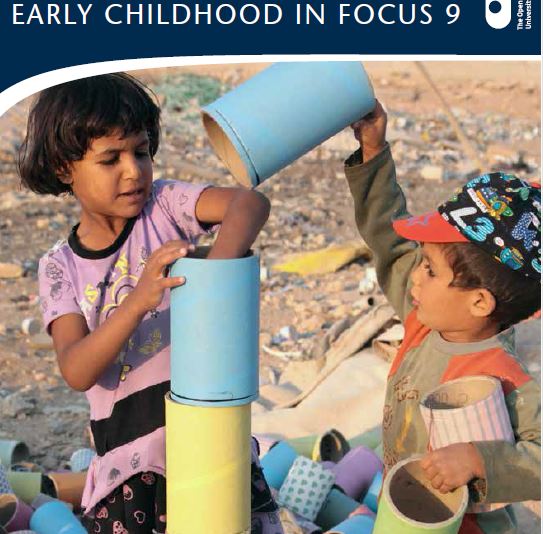
"Recognising that play is a feature of early childhood should be a good starting point for answering some key questions: What is play? What is the role of play in children’s lives and learning..."
This issue of Early Childhood in Focus: 'The Right to Play' offers short summaries of theory, research, and policy issues that can inform the implementation of Article 31 of the United Nations Convention on Children's Rights. It is an Open University publication in cooperation with the Bernard van Leer Foundation.
Section 1 is about the concept of play, the ways culture defines play in children's lives, the role of play within early childhood pedagogy, and children's own views on play. Policy questions include the following:
- "How can the full implications of respecting children’s right to play become more widely understood?
- What is an appropriate balance between proactive planning for children’s play and respecting children’s autonomy to play without interference?
- How can the necessary ‘conditions’ for play be made more widely available to children through effective national policies, child-friendly urban planning, school and playground design etc.?
- What should be the role of adults in supporting, partnering or regulating young children’s play activities in different contexts?
- How far are play theories and educational practices that originate in relatively affluent Western contexts applicable in diverse, low resource contexts?
- How can an awareness of cultural diversity in play be used to inform play provision in early childhood education and care settings?
- What can be learned from young children themselves about the importance and meaning they attach to their play, and how can this inform policies and practices?"
Section 2 looks more closely at the function of play in supporting children's development, including social, emotional and cognitive benefits. Policy questions include:
- "What steps are required to embed understanding about the importance of play in national curriculum guidelines, design for early childhood centres and professional training for all who work with young children?
- How can mothers and other early caregivers be encouraged to understand their crucial role in supporting play from the earliest months, including through parenting courses and more informal sources of support?
- How can the social dimensions of learning through play be protected and fostered in school contexts that increasingly emphasise individual learning achievement?
- Is there a risk that the importance of play will be underestimated because it is by definition most often 'playful', 'imaginative' and 'fun'?
- What further research is needed to fully understand the role of play in children's cognitive, social and emotional development, including the function of early years play as a foundation for later abstract scientific reasoning?"
Section 3 is about the opportunities and challenges for realising children's right to play, including the pressures of early schooling as well as child work, and the implications of commercialisation and the growing place of new technologies in young children's lives. Policy questions include:
- "What are the different interventions required to ensure the right to play for all children (girls and boys, children with disabilities, children in institutions, minority groups, etc.) within an overarching commitment to equal rights for all?
- What are the risks to children’s well-being in situations where they have little space for rest, leisure and play, due to the pressures on their time from school attendance as well as after-school coaching, or their need to combine school with agricultural work or other economic activity and domestic chores?
- How can the potential of ‘play as pedagogy’ be applied within classrooms in ways that maintain a balance between children’s freely chosen activities and educators’ wish to plan and structure play towards specific goals?
- How far and in what ways can early childhood policies and services contribute to extending opportunities for children’s play in natural, outdoor environments?
- How far is the growth of the commercial toy industry a threat to children’s play and how far an opportunity for children to incorporate new possibilities into their play?
- What steps are required to protect children from potentially detrimental effects of modern technologies while encouraging the potential for extending their imagination and skills?"
34
The Bernard van Leer website, October 29 2013. Image credit: The Open University