










































Storefront Library
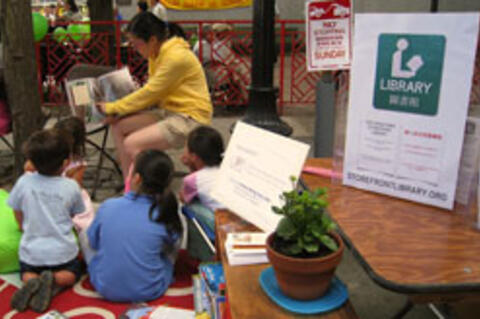
"This project is an experiment on many fronts - about libraries, and about community advocacy," according to Leslie Davol, project producer from Boston Street Lab and resident of Chinatown. "It's also an experiment about how to realize more cultural and civic spaces like this - spaces where people can learn, be inspired, and grow, in the heart of a bustling downtown." The library will offer:
- a collection of books for children and adults, chosen specifically for the community,
- newspapers and magazines,
- internet access on desk-mounted computers and via WiFi,
- areas for homework or private laptop use,
- children's area (read aloud, story hour, picture books), and
- a physical and electronic community bulletin board.
The Storefront Library will also offer a variety of events. Organisers have invited partners, ranging from the US Census to local community groups, to offer programmes in the space as a way to highlight their own work and the civic and cultural resources that already exist in the neighbourhood, as well as to show support for this temporary cultural and civic use of vacant space. A few selected examples of scheduled events include:
- Storefront Library Radio Theater - a class for kids to learn about the tradition of radio theatre programmes. Participants will plan, produce, and star in an adaptation of a Chinese folk tale, to be recorded in the library. They will explore the art of radio sound effects by gathering materials from local shops to create sounds for the production.
- Exhibition: Chinese-American Women Oral History Project.
- Storefront Library Audio Books - volunteers will read public domain Chinese literature classics into the microphone. These stories will be archived and made available via the Storefront Library website.
- A weekly Chinese Language Film Series.
"For architects, educators and students, the project represents a different way to get involved in community efforts, by working with members of a particular neighborhood instead of for them, to collaboratively and creatively address a particular issue together," commented Marrikka Trotter, founder of the Department of Micro-Urbanism and Harvard University's Graduate School of Design (GSD) graduate. Students and architects from GSD have designed what is intended to be a visually and tactilely engaging space that anticipates and responds to the needs of Chinatown residents. To reduce the need for furniture, the design incorporates work spaces and surfaces, reading areas, newspaper storage racks, and lighting, into modular, reconfigurable, elements that can be disassembled, reassembled, and reused in another space. Elements have been designed to have minimum impact on the commercial space into which they will be installed. For a closer look at the design process, visit the students' blog.
Children, Community and Cultural Connection.
Per Wikipedia (accessed September 24 2009), Chinatown, Boston, is "[t]he only historically Chinese area in New England....Chinatown remains a center of Asian-American life in New England, hosting many Chinese, Japanese, Cambodian, and Vietnamese restaurants and markets."
For the first few decades of the 20th century, Boston's Chinatown had a branch of the Boston Public Library on Tyler Street. The library's early patrons were of Chinese, Syrian, Greek, Jewish, Italian, Polish, French, Spanish, and German descent, reflecting the ethnic communities in downtown Boston at the time. When the branch closed in 1938, over 200 children protested, carrying placards that read "Closed Library - Closed Minds." In 1951, the library opened again, only to close for good in 1956.
Boston Street Lab, Department of Micro-Urbanism, and Friends of the Chinatown Library.
Storefront Library website, accessed on September 23 2009.
- Log in to post comments