










































International Children's Digital Library (ICDL)
- to create a collection of more than 10,000 books in at least 100 languages that is freely available to children, teachers, librarians, parents, and scholars throughout the world via the internet;
- to collaborate with children as design partners in the development of computer interface technologies that support children in searching, browsing, reading, and sharing books in electronic form;
- to better understand the concepts of rights management and "fair use" in a digital age;
- to evaluate the impact that access to digital materials may have on collection development and programming practices in school and public libraries; and
- to develop a greater understanding of the relationship between children's access to a digital collection of multicultural materials and children's attitudes toward books, libraries, reading, technology, and other countries and cultures.
This research initiative uses information and communication technology (ICT) in the quest to support the world's children in becoming effective members of the global community - who exhibit tolerance and respect for diverse cultures, languages, and ideas - by making children's literature available online free of charge. The collection's focus is on materials that help children understand the world around them and the global society in which they live and that promote tolerance and acceptance. The materials in the collection, all presented in the original languages in which they were published, reflect similarities and differences in cultures, societies, interests, and lifestyles of peoples around the world.
ICDL is working to support communities of children and adults in exploring and using this literature through technology designed in close partnership with children for children. Members of the College Park Kidsteam, a group of six children, ages 7-11, are contributing to the research by working regularly with the adults in the lab in a process called cooperative inquiry. Other close collaborators are volunteer translators, who work to ensure that "metadata" - details about a book, such as title, author, publishing company, and summary - are available for each book, in both English and the language(s) in which it was published. (ICDL does not translate the text of the books into other languages; it contains books in their original, physically published form only).
Amongst the various ways of engaging with ICDL are the following (for further details, visit the ICDL website, which is available in English, French, Spanish, Bulgarian, and Russian):
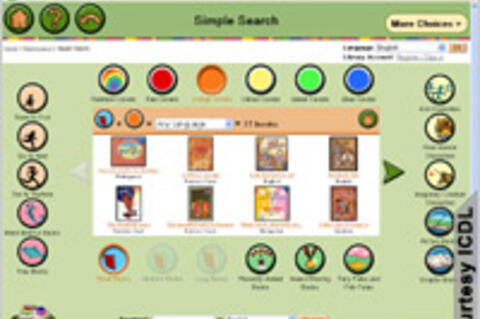
- Read a book - pick one of the featured books from the home page, search books, and/or visit "ICDL exhibitions" - small collections of books from around the world with similar themes, such as "Strong Women and Girls Make the World Go Round" and "Everyone Needs Water and Water Needs Everyone"). The exhibitions include an overview of the theme, links to the exhibition books, descriptions of why the books were included, and related activities.
- Create "Digital Story Time" - "If you have a standard computer projector, then try using it the next time you read a book to children (whether in a library's story time hour, in school, or at home). Simply hook up the projector to your computer, find a book in the ICDL and read with the large projected display. This has the advantage of making illustrations (and words) large enough for everyone to see - and the technical nature of the display is often engaging."
- Set up a scavenger hunt: "It can be fun to learn how to navigate the ICDL and search for books....[C]onsider finding a few favorite books, pull out some particular tidbits from those stories - and then ask kids you are teaching to try and find those books based on those tidbits. Or ask more basic questions such as how many books there are in the ICDL from Africa..."
- "Complete the Story" - Read the first portion of the book together, then ask children to envision how the story ends by drawing pictures.
- "If you really want to push your creativity, try looking at a picture book in a language you don't understand at all. Then write a story to go along with the pictures."
- "Use the Advanced Search screen to search for books in two or more languages. Then try reading in the language you are studying. If you aren't sure you understand the page completely, switch that page to the language you do know with the popup menu underneath the page."
ICDL engages in collaborations designed to spread the reach of the collection. For example, ICDL joined with the government of Mongolia and the One Laptop Per Child Foundation (OLPC) on a World Bank-funded literacy project. The government of Mongolia had published 200 new Mongolian children's picture books and distributed them throughout the country on paper but also wanted to have digital access to help investigate the potential of digital learning technologies in rural areas. ICDL facilitated a Mongolian version of the digital library.
ICDL has developed a teacher training manual [PDF] to explain digital libraries and how the ICDL might be used by teachers in their classroom.
As technology has advanced, ICDL has expanded its reach. ICDL is now available for iPhone and iPad. In addition, ICDL's StoryKit is a family-friendly, free iPhone app which children can use to create stories on their phone (or iPod Touch) with text, pictures, and other story elements.
Children, Education.
According to a paper published in 2005 by the United Nations Educational Scientific and Cultural Organization (UNESCO) in preparation for the second meeting on the World Summit on the Information Society, "[d]enial to access to information in one's mother tongue is equivalent to a denial of a human right." The report also concludes: "In terms of pedagogy, how do children learn best? In their mother tongue."
As of November 15 2012, the ICDL collection includes 4,643 books in 61 languages. Over 3 million unique visitors have used ICDL, hailing from 228 different countries.
The project was introduced at an international celebration at the Library of Congress in Washington, D.C., US, in November 2002. ICDL won the American Library Association President's 2010 Award for International Library Innovation. The ICDL was also named one of 25 Best Websites for Teaching and Learning by the American Association of School Librarians.
The ICDL was created by an interdisciplinary research team at the University of Maryland in cooperation with the Internet Archive. Funded primarily by the National Science Foundation (NSF), the Institute for Museum and Library Services (IMLS), and Microsoft Research.
ICDL website, October 2 2009 and November 15 2012.
- Log in to post comments