










































Using Participatory Action Research to Engage Children with Disabilities and their Families in Developing Health Initiatives to Improve their Access to Health and Social Services
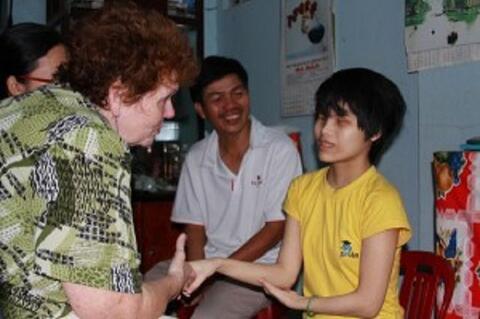
This project sought to engage the community in the development of health initiatives to improve access to health and social services for children with congenital anomalies or disabilities and their families in Aluoi district, Thua Thien Hue province, Vietnam - an area heavily affected by the use of Agent Orange during the Vietnam-American War. Specific objectives were to: 1) raise awareness about community's perceptions of and experiences with congenital anomalies and disabilities; 2) engage children with disabilities, their families, and their communities in research that addresses their unmet needs for health and social services; 3) promote dialogue between health researchers, children with disabilities, their families, and their communities on health initiatives designed to improve access to and the quality of health and social services; and 4) raise awareness of and challenge stigma and discrimination toward youth/children with disability and their families.
The public engagement project, carried out by Center for Promotion of Advancement of Society (CPAS) with Wellcome Trust funding, employed a participatory action research (PAR) approach that involved the intended populations in the entire research process, including selection of research topics, data collection and analysis, and generation of policy and practice recommendations or action. PAR was used as a strategy to empower mothers and children/youth to communicate with health researchers, local authorities, communities, and media about their problems and their needs - to be treated as normal children, to be provided with educational opportunities, and to have access to healthcare services.
To begin, a team of 15 local investigators were recruited and trained who then worked collaboratively with researchers in the conduct of the research. A participatory qualitative research method was employed to involve youth with disabilities, mothers of child/children with disability, and other community members in focus group discussions (FGDs). In each commune, one FGD (each including 6-8 participants) was held, totaling 3 in the 3 study communes. FGDs were facilitated by 2 CPAS researchers and 2 local investigators (one of whom is a member of the Thua Thien Hue Province Women's Union and one of whom is a member of the A Luoi District Women's Union). Click here to view a video (in Vietnamese) about the communication events in the study communes. CPAS notes that, in order to engage local community members in health research, it is important to consider the level of education of potential audiences. As the majority of children with disability and their family are from a low socioeconomic background, they often have limited communication ability, especially when communicating with people coming from outside as health researchers. Also, language barriers are an issue when working with populations belonging to minority ethnic groups.
Originally, CPAS planned to conduct interactive drama with the involvement of disabled children and their family members. However, it proved to be too difficult for the disabled children and their family members to speak and perform in front of many people. Following discussion and consultation with disabled children and their families, the media team and CPAS researchers decided to develop video clips as the form of media to document real-life stories reported by disabled children or their family from each selected commune. The video clips were meant to engage health researchers and various stakeholders in communicating and discussing childhood disability and its social and economical impacts. In doing so, this strategy was designed to serve as a platform for community engagement, stimulating open dialogue and interaction between disabled children and their community on issues identified in the research findings.
Based on the findings from the research, a manuscript entitled: "Voices from Vietnam: Experiences of Children and Youth with Disabilities and Their Families from an Agent Orange Affected Rural Region" was submitted and peer-reviewed by Disability and Society. Also, a dissemination workshop was carried out to share project findings and present to interested parties and organisations this approach to public engagement with the areas of childhood disability among ethnic minorities in Vietnam. Forty participants attended, including representatives from A Luoi District and Thua Thien Hue Provincial Women's Union, as well as Hanoi-based academic institutions and non-government organisations and media agencies, such as Voice of Vietnam National Radio.
Children, Youth, Health, Rights
According to CPAS, youth and mothers who were filmed on the story telling video clips "expressed their delightedness for being involved in process to produce the clip. For all of them, this was the first time they see themselves on the documentary film, sharing their experience or their child/children's experience in living with disabilities. They were able to raise their voice on how their disabled children were treated by their friends, neighbors, or school teachers. They reported that their lives are emotionally better-off after they were able to speak out their problems and their voices were heard and discussed by not only community but also commune local authorities and local government. The following quotes illustrate this observation":
"What I like most [about the video clip] is that people learned about my disability and my desire to integrate." (Child)
"Previously, there were only our neighbors or people in my village knew (about my problems), but now more people are aware of these. I am happy because I receive more care and attention from people surrounding. People in my village talked to me and shared both happiness and sadness." (Mother)
"Other friends did not look down on me any more (since I was on the documentary film). They did not speak to me an insulting way as they did before." (Youth)
News about the workshop was broadcast on the programme "For Children" on the Voice of Vietnam national radio channel on December 18 2011.
Funded by the Wellcome Trust.
Dr. Anh Ngo's webpage, September 25 2012; emails from Ha Phan to The Communication Initiative on November 17 2012 and November 21 2012; and "International Engagement Awards: Projects funded in 2010" [PDF], November 19 2012. Image credit: Children of Vietnam
- Log in to post comments