










































Using Behavior Change Approaches to Improve Complementary Feeding Practices
Alive & Thrive, FHI 360
This paper applies an implementation framework, based on a behaviour change model, to compare four detailed case studies of complementary feeding programmes carried out in Bangladesh, Malawi, Peru, and Zambia. The paper examines commonalities and differences in the design and implementation of social and behaviour change approaches, use of programme delivery platforms, challenges encountered, and lessons learned. A central conclusion is that complementary feeding practices - in particular, dietary diversity - can be improved rapidly in a variety of settings if interventions focus on specific constraints to food access and use effective strategies to encourage caregivers to prepare and feed appropriate foods. A 5-step process is presented that can be applied across a range of complementary feeding programmes to strengthen their impacts.
As is explained in the introduction, the use of behaviour change strategies with or without the provision of food supplements to improve infant and young child feeding (IYCF) practices has been estimated to reduce child mortality and improve nutrition. The purpose of this paper is to provide, using actual field experiences, more detail on how successful programmes were designed and implemented, especially: (a) the use of formative research to focus programme interventions on locally relevant barriers and motivations for improving specific complementary feeding practices, and (b) reliance on an explicit logic model or programme impact pathway explaining how interventions would lead to results.
The primary sources of information on the four selected programmes included reports provided by non-governmental organisations (NGOs), conference presentations, the published literature, and in-depth interviews. Applying a widely recognised behaviour change framework (see Figure 1 on page 3) that is based on the socio-ecological model of behaviour change, the researchers examined the interventions in the four case studies, which addressed the following determinants of complementary feeding practices:
- At the mothers' level: knowledge, beliefs, skills and self-efficacy or confidence, workload
- At the household level: food/water/soap availability, family roles
- At the community level: social norms, connectivity to media/markets/services/resources
- At the programme delivery level: coverage/scale/quality of support and information
- At the policy level: guidelines and incentives available in food and agriculture, cash transfer, health services programmes.
The programmes selected were 2-5 years in duration, and programme scale ranged from one district (Zambia) to the whole country (Bangladesh). Some were implemented through NGOs and others through government. See Table 1. All programs were evaluated through randomized controlled trials; one used a cohort design and three used pre- and post- cross-sectional surveys. None of the evaluations has a pure control (or non intervention areas). The evaluations compare exposures to less intensive and more intensive interventions.
Among the selected programmes, the design process included several rounds of quantitative and qualitative studies that involved identifying and prioritising a few key behaviours and their determinants. All the design work engaged mothers and family members directly on a one-to-one basis to understand their perceptions, motivations, barriers, and preferred channels of communication. Methods included individual in-depth and semi-structured interviews with mothers, observations, and dietary assessments. See Table 2 on page 4 for details.
Approaches developed for reaching key audience segments in one or more of the programmes included: interpersonal counseling, community mobilisation, women's empowerment, mass communication, provision of handwashing stations, food production inputs, national and sub-national advocacy, coalition/alliance building to harmonise messages, and cross-sectoral coordination. The use of different channels of communication to reach different categories of audiences was determined by media habits studies in Bangladesh, where mass media emerged as a major programme component for achieving national scale rapidly, changing the household perceptions of social norms, reaching multiple key audiences, and as a way of reminding and lending credibility to frontline workers. Interpersonal communication with mothers was the most common approach used by the four programmes (see Tables 3 and 4, pages 6-7 and page 8). This included counseling/coaching/demonstrations by community volunteers, health workers, and agricultural extension workers. Feeding bowls with specific markings on quantity and diversity were given to families in Bangladesh.
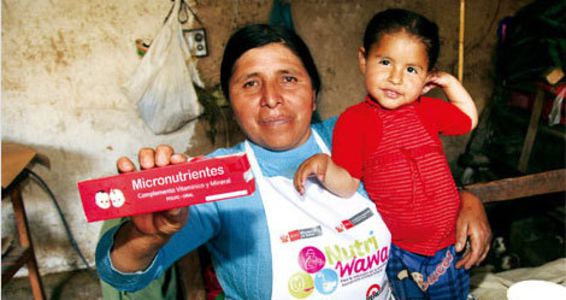
In three of the programmes, interactions with mothers and family members took place during home visits or places close to the homes of families with young children. In Peru, interactions took place at primary health care centres. Substantial efforts in all programmes went into building the capacity and motivation of frontline workers to engage mothers directly. Malawi and Peru gave priority to team training to strengthen consistency of messages among different categories of workers. Peru initially faced the problem of inconsistent, incomplete, or confusing messages delivered by workers associated with three separate child health services (well-baby care, paediatric care for sick children, and nutrition). Malawi faced the challenge of coordinating and aligning activities by the agricultural and nutrition workers in health. Joint health/nutrition and agricultural extension worker trainings were conducted with government and NGO community workers in Malawi and Zambia.
Community mobilisation received major emphasis in three of the four programmes. Bangladesh, Malawi, and Zambia designed activities and developed materials to engage key members of the family and the wider community in supporting improved complementary feeding. Fathers were found to play a key role in gaining access to diverse foods for children, and mothers felt they needed the endorsement of new practices by grandmothers (Malawi, Zambia, and Bangladesh).
In the programmes studied, mothers and caregivers were willing to go outside community norms for the benefit of their child's health and brain development, particularly if recommendations were perceived as being convenient for mothers and caregivers, aligned with family and community norms, and the child appeared to like the food and feeding experience.
All four programmes documented improvements in dietary diversity attributable to their respective interventions. Selected findings:
- In Bangladesh, the greatest improvements took place in areas where coverage was above 90% for home visits combined with 60% for mass media. Changes were also documented in the timely introduction of specific foods, number of meals, and in reduced consumption of unhealthy snacks.
- In Malawi, a comparison of baseline and endline surveys showed that dietary diversity in children improved in the food production plus behaviour change communication intervention areas but not in food production areas with no behaviour change. Qualitative results from focus group discussions with grandmothers and caregivers in Malawi suggested that improved complementary feeding was facilitated through: (a) increased maternal knowledge; (b) children enjoying the taste of enriched porridges; (c) perception of improvements in the child's health; and (d) having supportive grandmothers, fathers, and other community members.
- In Peru, the evaluation showed that improved counseling at government health centres was effective in changing behaviours; 52% of caregivers in intervention areas reported receiving nutrition advice from the government health service as compared with 24% of caregivers in control health facilities. A significantly higher proportion of children in the intervention group received chicken liver, fish, or egg than did controls at both 6 months and 8 months of age. More children in intervention areas met their dietary requirements for energy, iron, and zinc than did controls. More mothers in the intervention area were able to name three important foods (i.e., chicken liver, eggs, and fish).
- In Zambia, a comparison of baseline indicators in 2011 and results of a process evaluation survey in 2014 found that dietary diversity rose from 25-30% at baseline to 75-80% in intervention areas; the control areas also improved to 50%. At endline, the knowledge of timely introduction of complementary foods was significantly higher in the areas where agriculture plus nutrition communication was implemented, compared to the control arm; this was most notable for animal source foods. The consumption of legumes/nuts was higher in both intervention arms (agriculture alone and agriculture plus nutrition communication) compared to control.
Looking at these findings, the researchers outline 5 steps for strengthening behaviour change interventions:
- Select a few priority complementary feeding behaviours.
- Focus on underlying determinants (including food access) and key influencers of those behaviours.
- Test concepts, recipes, messages, tools for feasibility/acceptability and clarity.
- Select programme channels to achieve desired coverage, intensity, and scale.
- Note: To achieve intensity, the Peru programme focused on timely and repeated contact with mothers of children 6 months to 24 months of age. To carry out multiple direct contacts with mothers and families required reaching and maintaining adequate coverage by skilled and motivated frontline workers who maintained individual listings of mothers and children. The Malawi and Zambia programmes mobilised multiple sectors and types of workers, registering individual eligible families and following them up in a timely way, tracking each catchment area, building teamwork among multiple workers and across administrative levels, recognising good performance to sustain intensity, and maintaining frequent contact with frontline workers through field visits and monthly meetings with managers. Mass media and community mobilisation to reinforce interpersonal contacts with individual families accelerated and heightened the impact of programmes. Bangladesh used TV spots to emphasise specific practices and to motivate fathers. Ethiopia's ENGINE project used recorded voices to facilitate group discussions. Participant groups in rural communities engaged in "Enhanced Community Conversations" featuring games, role plays, and music on topics that covered complementary feeding and handwashing. Alive & Thrive and ENGINE have also been working with religious leaders in Ethiopia to sensitise them to the importance of dietary diversity, particularly for children under age 2, and providing support to they can communicate with families about desirable child feeding practices, even during community fasting days.
- Sustain exposure for at least 2 years while continually monitoring and adjusting the programme.
"While we have shown that results are possible in diverse settings, additional human resources, prioritization of nutrition (particularly preventive nutrition), and realistic planning are needed for coordination and alignment across health, agriculture, and sanitation/hygiene sectors. Within the health sector in particular, setting standards of quality and monitoring them, ensuring consistency in IYCF communication across health services, and making time for adequate counseling by health providers can lead to improvements in complementary feeding indicators."
Maternal & Child Nutrition, Volume 13, Issue S2, pages 1-11. Image credit: Ministerio de Salud del Perú