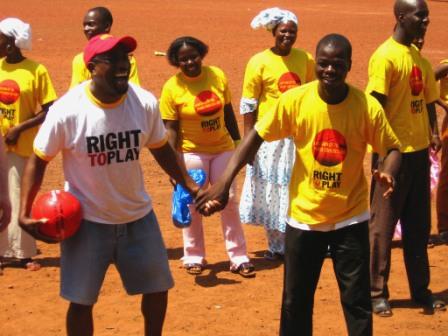
Right to Play
Right To Play is built on the belief that sport has the power to help create healthier children and safer communities. The belief is that, in addition to the physical benefits they can deliver, well-designed sport and play programmes can enhance holistic development, foster resilience, and create meaningful connections between young people and adults. RTP also holds that sport and play can be used to teach values and life skills including optimism, respect, conflict resolution, compassion, courage, leadership, inspiration, self-confidence, teamwork, discipline, fair play, and joy.
RTP's central programmes include:
- SportWorks - focuses on child and community development.
- Red Ball Child Play Program - each ring symbolises an aspect of healthy child development: mind, spirit, body, social cooperation and health. Specific play activities have been developed to promote each aspect of development.
- Live Safe, Play Safe - a health education programme designed to give children knowledge about personal health and the skills to make the decisions needed to maintain their health. (Basis: sport and play can awaken an interest in one's body, especially among girls).
- In the area of community development, RTP works to build skills and confidence, as well as connections, among adults. For example, Coach2Coach is a training module for local adults and young adults that emphasises practical methodologies to teach theory. Coaches are encouraged to implement regular programmes for children (e.g., instituting Red Ball Child Play in schools; coaching a team; training other coaches; managing special events). In addition, SportWorks Coaches help establish groups of men, women, and young people that strategise about how to get the community actively involved in implementing regular sport and play programmes with children.
- SportHealth uses sport to provide health education and encourage healthy lifestyle behaviours by stressing the importance of vaccinations, HIV/AIDS, TB, and malaria prevention. Coordinators are based in urban centres and, in addition to running sport and play programmes through schools, youth groups and other outlets, are responsible for implementing social mobilisation campaigns based on RTP's "Look After Yourself, Look After One Another" philosophy and using the red ball as a symbol, teaching aid, and awareness tool.
To carry out these programmes, Right To Play engages and trains international and local volunteers who work with communities to implement projects. Among others, these volunteers include an international team of Olympic and professional athletes who donate their time to give back through sport. Led by 4-time Olympic gold medalist (and RTP President and CEO) Johann Olav Koss, these athlete ambassadors include Wayne Gretzky, Dikembe Mutombo, Anni Friesinger, Summer Sanders, Haile Gebrselassie, Silken Laumann, Tegla Loroupe, and Ian Thorpe.
RTP draws on various types of media to communicate its messages to young people and adults in a position to reach them. For example, in August 2004, Canada's CTV broadcast an exploration about a specific RTP programme: a group of pre-adolescent soccer players, half of them Palestinian, half of them Israeli, were put together to play on an all-star team - The Peace Team - and to compete in the world's largest international youth soccer tournament, the Norway Cup in Oslo. "A Team for Peace" asked such questions as: "Can mutual respect and understanding be discovered on the soccer field? More important, can it be translated to off-field life in the tinderbox of the Middle East?"
RTP aims to be community-centred in its strategy. The organisation works closely with communities to help set up the networks and infrastructure necessary to support sustainable local ownership of its sport and play programmes. Right To Play also trains local youth to be coaches, in an effort to expand the reach of the programmes and to impart leadership skills.
Based on its commitment to every child's right to play, this organisation takes an active role in research and policy development in an effort to engage leaders in the fields of development, sport, business, and media.
Children, Youth, Rights, Health, Peace.
Right To Play evolved out of Olympic Aid, the legacy project of the Lillehammer Olympic Organizing Committee. The focus of Olympic Aid during the Winter Games in Lillehammer was to show support for people in war torn countries and areas of distress. In early 2003, Olympic Aid evolved into Right To Play in order to meet the growing demands of programme implementation and fundraising.
RTP is based on the philosophy of "Sport for Development", which organisers say "evolved out of the growing evidence that strengthening the right of children to play enhances their healthy physical and psychosocial development and builds stronger communities. Sport* is now recognized by many as an effective tool in the pursuit of development and peace including international experts in the fields of development, education, health, sport, economic and conflict resolution....
* Sport programs must be crafted to uphold the values of development - equity, inclusion and sustainability."
Click here to read more about the Sport for Development philosophy, as well as the UN Interagency Task Force on Sport for Development. The report of this Task Force - "Sport for Development and Peace: Towards Achieving the Millennium Development Goals" was released on September 17 2003. Click here to view this report.
Implementing Partners: United Nations High Commissioner for Refugees, UNICEF, UNESCO, World Health Organization, Global Alliance for Vaccines and Immunization, the Vaccine Fund, the CORE Initiative, CARE International, the American Red Cross, International Labour Organization, the Global Measles Initiative, Lutheran World Federation (Kenya), INSAN Foundation (Pakistan), EMIMA (Tanzania).
Funding Partners: Canadian International Development Agency, US Department of State, United States Agency for International Development, Netherlands Ministry of Foreign Affairs, Royal Norwegian Ministry of Foreign Affairs, Norwegian Agency for Development Cooperation, Swiss Agency for Development and Cooperation, Laureus Foundation, and a variety of private sector supporters.
April 2004 newsletter, forwarded by Elias M. Banda, Communications Coordinator (Right To Play Zambia Sport Health) on May 16 2004; and RTP website.
Comments

child play
I am Agnes from Kenya.Children in Kenya need to be engaged more in play to prevent cases of indiscipline and drug abuse.I would wish to be a member of this organisation.What can I do?