










































Power Within Competency Framework for Adolescents and Youth
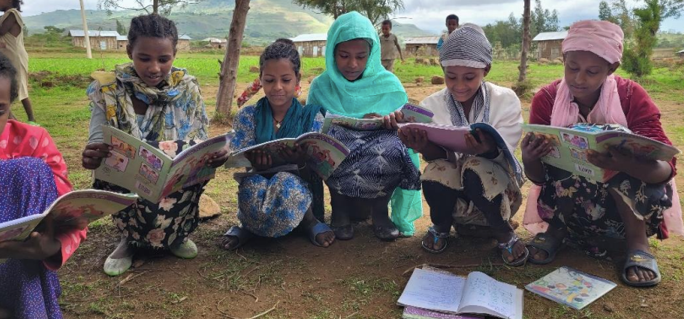
"Young people represent large proportions of the populations in many countries: one in six people are between the ages of 15 and 24 (youth) and nearly half of the world's population is under the age of 30. These formative years are both opportunity-filled and also a finite amount of time to inform the pathway of a young person's future."
This publication outlines the Power Within (PW) Competency Framework for Adolescents and Youth developed and refined by CARE International to support young people's (ages 10-24) development by building life skills that help them deal with the challenges and demands of their daily lives. The PW competency model contains three primary competency domains - strong self-image, strong mind, and strong voice - which are each achieved by building a subset of competencies or skills such as perseverance, critical thinking, and interpersonal communication skills. The competency framework, which has been implemented by CARE since 2008, underwent a review process between 2022 and 2024 that led to key recommendations and updates to the model. It is this updated competency model that is presented in this publication.
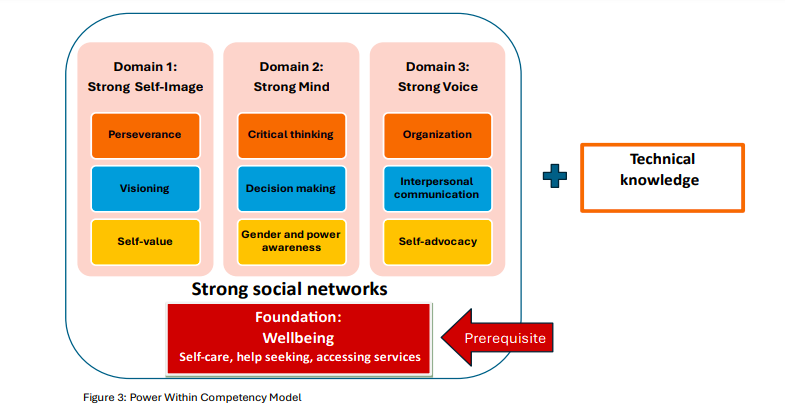
It provides background information on the model, including its origins in 2008, evidence of its impact, and influences guiding the update and refresh of the model, before looking in detail at the PW framework and the underlying theory of change. In brief, the main domains and competencies promoted in this model are as follows:
Strong Self-Image: This domain focuses on psychological empowerment, relating to a young person's positive self-concept and emotional resilience for now and in the future. Adolescents and youth with a strong self-image believe they have value. Their confidence in their worth and abilities provides the foundation for developing aspirations, envisioning possibilities in their futures, and persevering through difficulties. These young people are aware they have a right to independent thoughts and opinions. Competencies here are: self-value or self-esteem; visioning the future; and perseverance and persisting through challenges.
Strong Mind Competencies: This domain relates to cognitive empowerment and capabilities for higher-level thinking. Adolescents and youth with a strong mind are aware of how they fit into their communities and societies, including: the impact of gender barriers and other forms of exclusion; stereotypes based on class, ethnicity, or ability; and power inequities. They know how to make the decisions that are right for them and to exercise agency within options defined by their context, expanding those options when safe to do so. They think critically about new information and understand other people's motivations and biases. Competencies that fall under this domain are: gender and power awareness (understanding how gender shapes women's, men's, girls', and boys' roles, norms, expected behaviours, and assumptions about others); decision-making (choosing a course of action); and critical thinking (having the ability to evaluate information, judge its value, and interpret it with regard to existing knowledge).
Strong Voice Competencies: This domain primarily represents relational and social empowerment. The concept of "voice" captures dimensions of visibility, participation, assertiveness, and influence that can extend from individual personal relationships to collective movement building. Adolescents and youth with a strong voice communicate what they need and express their thoughts. Combined with a strong core, these young people develop healthy patterns of communication with those around them, resolving conflicts respectfully. As they grow, they increasingly participate in shaping their communities, organising peers and adults as needed. Competencies are: self-advocacy (expression of what one needs from others and negotiation to get those needs met); interpersonal communication (self-expression and listening), and organisation (the ability to bring people together with a common vision and to undertake actions to change what needs changing).
A fourth domain, which was added following the review, is Wellbeing, which is different from the other domains in that wellbeing is a foundation and prerequisite of youth psychological, physical, emotional, cognitive, and social development. Its focus is on practicing self-care, seeking help;, accessing services to ensure that young people pay attention to their physical and mental health, seeking assistance from trusted adults and peers when needed, and understanding how to access available services in health, education, protection, legal status, and other areas.
The document provides an overview of each of these domains, in-depth definitions for each of the PW competencies, and outcome statements that provide examples of how a young person may describe themselves after applying these competencies - e.g., "I understand issues and concerns of people on multiple sides of an issue." Although the document briefly lists the kinds of activities that can be used to build each competency, a separate activity toolkit has been published that provides sample activities to build each competency across sectors and ages. (See Related Summaries, below, for the Activity Toolkit.)
In terms of the Theory of Change, the document explains that CARE's global work to save lives, defeat poverty, and achieve social justice requires work at three levels: at the individual or agency level, at the relational level amongst people, and at the structural level (focused on institutionalised change at the norm or legal levels). The PW competencies provide a framework for the level dealing with building individual or group agency. Wellbeing is seen as a multiplier for PW competency development. If there is no wellbeing, the competencies cannot be developed. Change at the relational and structural levels are also multipliers for change at the individual level, so if any of these are missing, the empowerment journey of young people is likely to not take place or to stall. The model also emphasises the importance of strong social networks (such as groups or safe spaces), as well as technical knowledge that programme participants can gain in sectoral programmes, such as financial management, literacy and numeracy, or facts about human reproduction. If all levels work together and if wellbeing, technical knowledge, and social networks are present, the end result is "a young person who has the power to make their own informed choices, use their agency to plan their futures, pursue opportunities to realise their aspirations, and lead the change they desire for themselves and their communities. As young people build and practice these competencies, they are developing their Power Within."
Finally, CARE emphasises the importance of safer programming, especially when dealing with young people. The document therefore concludes by outlining actions and precautions that can be put in place to minimise risk to those who participate.
CARE International website on July 23 2024. Image credit (top): Sarah Easter/CARE
- Log in to post comments