










































Large-Scale Social and Behavior Change Communication Interventions Have Sustained Impacts on Infant and Young Child Feeding Knowledge and Practices: Results of a 2-Year Follow-Up Study in Bangladesh
International Food Policy Research Institute, or IFPRI (Kim, Nguyen, Ruel, Menon); Alive & Thrive, FHI 360 (Tran, Sanghvi, Mahmud); BRAC (Haque); University of South Carolina (Frongillo)
"With the growing evidence that BCC [behaviour change communication] interventions can achieve scale and be effective, there is also a need to determine whether these achievements can be sustained, especially once initial external donor funding ends."
Sustained improvements in infant and young child feeding (IYCF) require continued implementation of effective interventions. From 2010-2014, Alive & Thrive (A&T) provided intensive interpersonal counseling (IPC), community mobilisation (CM), and mass media (MM) in Bangladesh, demonstrating impact on IYCF practices. Since 2014, implementation has been continued and scaled up by national partners with support from other donors and with modifications, such as added focus on maternal nutrition and reduced programme intensity. This paper reports on findings from a 2-year follow-up survey to a cluster-randomised impact evaluation of A&T's BCC interventions, to assess changes in intervention exposure and whether impacts on IYCF knowledge and practices were sustained.
The researchers explain: "Given the need to maintain appropriate IYCF practices among new cohorts of infants and young children, it is important to sustain effective BCC interventions until these practices are incorporated as the norm among the target population....Optimal IYCF involves a complex set of behaviors within specific and narrow age periods that may require greater time and reinforcement to be maintained..."
Detailed descriptions of the A&T interventions have been provided elsewhere, including at Related Summaries, below. But, in brief, the community-based IPC during home visits and CM activities were delivered by BRAC, a large non-governmental organisation (NGO), in 50 rural subdistricts through an extensive cadre of frontline workers (FLWs). Standard nutrition counseling was delivered during routine home visits by BRAC health workers (called Shasthya Kormi) and community volunteers (called Shasthya Sebika) in the nonintensive intervention areas. In the intensive intervention areas, a new cadre of nutrition-focused FLWs, the Pushti Kormi (nutrition promoters), together with the community volunteers, conducted multiple age-targeted IYCF-focused visits to households with pregnant women and mothers of children 2 years of age or younger. Also, in the intensive areas, CM included sensitisation of community leaders to IYCF, as well as community video shows and theatre shows focused on IYCF. The MM component consisted of 7 nationally broadcast TV spots with messages on various aspects of IYCF; media-dark strategies such as screening of TV spots within communities where TV reach was lower were implemented. In nonintensive areas, there was standard CM through local meetings on various health topics, and there were no media dark strategies for MM.
Over the 4-year period, the combined interventions led to large significant impacts on IYCF practices. See Related Summaries, below, to access a summary of a cluster-randomised evaluation.
In 2014, external funding support from the initial donor agency (Bill & Melinda Gates Foundation) ended, but BRAC continued to deliver the IPC and CM activities with several modifications. For example, BRAC expanded delivery of IPC on IYCF to 456 out of 490 total subdistricts in the country, including the intensive and nonintensive areas. There was an added focus on maternal nutrition during IPC, less frequent training and supervision of FLWs, and there were reduced performance-based incentives for volunteer workers. Nutrition promoters were discontinued, and their functions were taken up by BRAC health workers. CM activities focused on IYCF were reduced from 5 sessions to 1 session per year. The MM campaign lapsed after 2014, but the Government of Bangladesh adopted the A&T MM materials and started broadcasting the IYCF videos again nationally in early 2016.
Using a cluster-randomised design, the researchers assessed changes in intervention exposure and IYCF knowledge and practices in the intensive (IPC + CM + MM) compared with nonintensive areas (standard nutrition counseling + less intensive CM and MM) 2 years after the termination of initial external donor support. Among the 50 rural subdistricts where BRAC implemented the programme, 20 subdistricts (clusters) were randomly selected for inclusion in the evaluation sample before baseline and then randomised to 2 intervention groups (10 intensive and 10 nonintensive). Cross-sectional household surveys were conducted at baseline (2010, n = 2,188), endline (2014, n = 2,001), and follow-up (2016, n = 2,400) in the same communities, among households with children 0-23.9 months of age.
In intensive areas, exposure to IPC decreased slightly between endline and follow-up (88.9% to 77.2%); exposure to CM activities decreased significantly (29.3% to 3.6%); and MM exposure was mostly unchanged (28.1-69.1% across 7 TV spots). Exposure to interventions did not expand in nonintensive areas.
In relation to counseling quality, there was a decrease in the duration but an increase in discussion about IYCF in the last visits made by frontline workers in the intensive areas (see Supplemental Table 1). In the nonintensive areas, more mothers reported discussing IYCF during the last visit by health workers at follow-up.
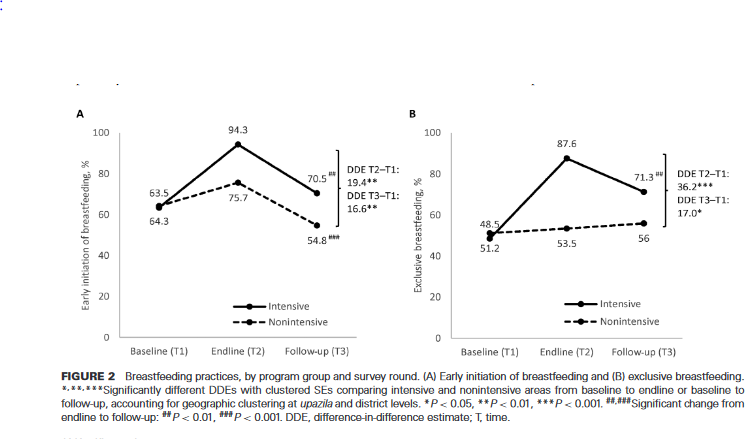
Most IYCF indicators in intensive areas declined from endline to follow-up, but remained higher than at baseline. Large differential improvements of 12-17 percentage points in intensive, compared with nonintensive areas, between baseline and follow-up remained for early initiation of breastfeeding (EIBF) and exclusive breastfeeding (EBF), timely introduction of foods, and consumption of iron-rich foods. In the nonintensive areas, levels of IYCF indicators either decreased or remained steady between endline and follow-up, except for minimum meal frequency, which increased similarly as in the intensive areas. Mothers in the nonintensive areas likely received IYCF information from sources other than BRAC FLWs and the MM intervention.
In relation to maternal IYCF knowledge, the overall BF knowledge score decreased between endline and follow-up in intensive areas, but increased in nonintensive areas. (Although BRAC workers continued to be the main source of IYCF information in intensive areas, other sources such as family members significantly increased between endline and follow-up in both intensive and nonintensive areas; other non-BRAC health workers also increased as a major source of IYCF information in nonintensive areas. Thus, wider diffusion of IYCF information through mothers' social networks in the nonintensive areas seemed to have contributed to increased knowledge and awareness.) The overall complementary feeding (CF) knowledge score remained the same between endline and follow-up in intensive areas and increased in nonintensive areas. There was a small but significant sustained impact in BF knowledge between baseline and follow-up (difference-in-difference impact estimate (DDE): 0.4 pp), but no significant sustained impact in CF knowledge. This suggests that "there is a continued need for reinforcing the behavior-change messages and supporting practices in this context."
In conclusion: "The reduced fidelity to the intervention, as compared with the intended design and outcomes..., contributed to lower benefits. Still, continued IPC exposure and sustained impacts on IYCF practices in intensive areas in 2016 indicate lasting benefits from A&T's interventions, as they underwent major scale-up and adaptations after termination of initial external donor support."
The Journal of Nutrition, Volume 148, Issue 10, 1 October 2018, Pages 1605–1614, https://doi.org/10.1093/jn/nxy147 - sourced from: IFPRI-Compact2025, News in Brief #55, November 21 2018.
- Log in to post comments