










































Investment Case for Polio Eradication
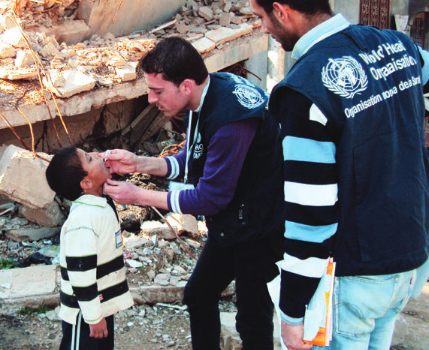
"Polio is defeated by a combination of strong country leadership and governance, effective planning, innovative approaches, community engagement and tremendous commitment from GPEI partners and front line workers."
This World Health Organization (WHO) report provides an overview of the history and status of the Global Polio Eradication Initiative (GPEI), making the case for continued investment to reach 100% of the children and eradicate the disease. It showcases the broader benefits and innovations of the polio programme, what is at stake if the job is not finished, and how the Initiative is working to ensure success.
In brief, founded in 1988, the GPEI is a public-private initiative that forged partnerships between polio-affected countries, donors, and the global immunisation stakeholders. Working with partner governments and other stakeholders, GPEI launched the Polio Eradication and Endgame Strategic Plan in 2013. Best practices gleaned over two decades, and in particular the experiences defeating polio in India and other regions, were incorporated in the new plan. "Thanks to an integrated strategy leveraging vaccine innovation and complementarity to achieve global eradication, the number of polio-endemic countries has dropped significantly in the last three decades....The programme has increasingly partnered with governments to strengthen accountability frameworks and programme performance. It has also tailored its approach to local situations with innovative outreach tactics and scaled up strategies to mobilize women in the communities to take ownership of the challenge and to vaccinate children in hard-to-reach places....Between 2013 and 2015, the number of missed children declined by more than a third."
Innovation is a pillar of the strategic plan. GPEI uses geographical information systems and mobile technology to share live independent monitoring data, which helps identify hard-to-reach populations. GPEI also increasingly relies on environmental disease surveillance, social mobilisation, and phone and SMS surveys to target efforts and check and double-check that no child misses vaccination. By 2016, the rates of missed children in the African and the Eastern Mediterranean regions were reduced to below 3%.
While the 2015 Midterm Review of the Endgame Strategic Plan validated the strategy and highlighted major progress, it also recognised the challenges of making polio vaccines accessible to every child in Pakistan and Afghanistan, the fragility of the progress in Nigeria, and the need for stronger disease surveillance. The report outlines a number of key challenges standing in the way of reaching all chronically missed children, and explains how the programme is working to address them.
"The final push combines the use of complementary vaccines, high quality campaigns and social mobilization to reach every child, together with improved disease surveillance to create a firewall to stop the virus spreading. All of this is made possible by strong country governance in each of the three endemic countries." As is detailed in the report, by reaching every last child, the programme provides an entry point for other interventions to reach some of the most vulnerable communities, such provision of vitamin A by vaccinators, and thereby contributes to health systems strengthening and universal health coverage. "The partnership's focus to achieve this is to identify, motivate, track and empower everyone, everywhere..." As the report notes, success requires adequate communications and social mobilisation, among other things.
The report shows how these strategies played a role in India, a country whose last case of polio was reported in 2011, despite its densely populated urban centres and far-flung communities in hard-to-reach areas. Success there was based on a combination of strong support from national local authorities and continually adapted strategies to reach every one of the 170 million children under five. "Detailed micro-planning and the identification of high-risk areas for targeted social mobilization and intensified campaigns made a difference. All members of communities were engaged, from religious leaders to doctors and local health practitioners, to teachers, to parents and children. To overcome the resistance to vaccinations in highly conservative communities with low literacy among women and poor school attendance rates, over 7 000 social mobilizers were recruited to lead the effort to persuade families. Ninety-five per cent of these were women." The report explores how these approaches can be applied to other contexts, such as Nigeria, Afghanistan, and Pakistan.
Based on epidemiology and risk assessment, the Polio Oversight Board (POB) concluded that the programme should intensify action in 2016 and 2017. More than half of the additional funding sought (an additional US$1.5 billion) is necessary to interrupt transmission. The remainder of the requested funding supports the risk mitigation and sustainability activities emphasised in the Midterm Review as key to maintaining a polio-free world. Also, investments in making sure that polio essential functions gradually become an integral part of countries immunisation and health systems and planning for a successful transition process are described here as critical. The report makes the case that "[t]he negative impact of not investing now is simply too great for the world's children and too costly for the world's economies." To provide accountability to its supporters, particularly at a time when more investment is required, the GPEI has "fine-tuned its governance structure, offering donors increased transparency and accountability to show that funding is spent effectively". For instance, the Polio Partners Group is a forum for all stakeholders, including polio-affected countries, donors, and other partners, to receive information and review programme progress.
The polio eradication programme has, as reported here, contributed to strengthening routine immunisation, particularly in conflict zones and fragile states where missing children's vaccinations can lead to epidemics of vaccine-preventable illnesses. "The successes are measurable and have significant impact on equity and health outcomes." Furthermore, over the course of nearly 30 years, GPEI has funded and trained millions of vaccinators, tens of thousands of social mobilisers, and thousands of skilled technical staff. "Social mobilization networks inform communities about the broad benefits of routine immunization, exclusive breastfeeding, hand washing with soap, and supplements to reduce diarrheal episodes." Thus, going forward, beyond polio, the polio programme's assets can be (and have been) mobilised to help in a variety of ways and situations (e.g., disease surveillance following an earthquake).
In conclusion: "Achieving the eradication of polio and successfully passing on the lessons learnt will mark an important milestone in the achievement of the new sustainable development goals. We have the opportunity to reduce inequality and save children's lives. We can all come together to finish the job. And make history."
Email from Ellyn Ogden to The Communication Initiative on April 21 2017; and GPEI website, April 24 2017.