










































Fighting Corruption in the Education Sector: Methods, Tools and Good Practices
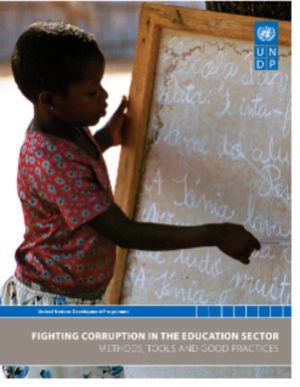
Education for Change Ltd.
Commissioned by the United Nations Development Programme (UNDP), this study presents methods, tools, and good practices to map corruption risks, develop strategies, and sustain partnerships to address challenges and tackle corruption in the education sector. It presents concrete evidence for building multi-stakeholder partnerships, including with direct beneficiaries of public education sector, to address corruption in the education sector. The study complements UNDP's MDG Acceleration Framework (MAF), which enables governments and development partners, within established national processes, to identify and systematically prioritise the bottlenecks to achieving the Millennium Development Goals (MDGs) and then devise ways to overcome them.
Most of the documents reviewed as part of this study pertain to the formal public education sector, covering primary, secondary, and post-secondary education, including reports of anti-corruption interventions from a range of agencies, academic papers and manuals, and guidelines from agencies and civil society organisations (CSOs). It begins with a review of some of the international contexts and categories of corruption risks that have framed anti-corruption work in education. The report then focuses on four main categories of interventions drawn from a review commissioned by the Norwegian Agency for Development Cooperation (NORAD):
- Rule of law (control and sanction) - "In many countries codes of conduct for educational staff have been revised or established in recent years to improve professional behaviour and performance and tackle particular issues of absenteeism, private tuition and sexual harassment. The need for consultation, involvement of teacher unions, effective dissemination and enforcement mechanisms has been acknowledged."
- Public administration and systems (corruption prevention)
- Better financial systems - "Information transparency is a critical measure, particularly concerning the funding formulae and disbursement procedures of grants."
- Independence and externality - "Audit and other external oversight bodies have a potential role in exposing cases of corruption in education."
- IT systems - "Robust information systems and the use of information technology (IT) in the areas of teacher registration and management, examination and access to university have proven efficient in some countries with regard to addressing challenges such as ghost teachers, patronage/rent-seeking in career progression and plagiarism."
- Transparency and accountability (duty bearers and rights holders, non-state actors, information, awareness)
- Anti-corruption education - "...be it delivered through projects or embedded in curricula. Measuring the results of such interventions presents methodological challenges, although it is understood that they are part of longer-term strategies to change both perceptions and behaviour."
- Open and transparent procurement processes - "...particularly around the development of integrity pacts between suppliers and commissioners."
- Participatory monitoring and social accountability initiatives - such as budget tracking and monitoring interventions undertaken by community members, sometimes children, which are coordinated by CSOs at school level.
- Scorecard methodologies - which "have been helpful in raising local awareness on service delivery issues and identifying corruption risks."
- Information and the use of media - which, by "building on information laws and free access to public information, have helped reduce leakages, particularly around school grants."
- Accountability mechanisms around teacher absenteeism, which include community monitoring and other initiatives such as the use of incentives in curbing the phenomenon.
- Surveys - including public expenditure tracking surveys and quantitative service delivery surveys. "Although they have contributed to the identification of leakages and corruption areas, they remain expensive exercises that provide limited understanding of the socio-political contexts within which corruption happens and contribute little to the elaboration of consensual solutions to tackle corruption."
- Capacity development - including organisational and individual capacity-building as part of large or specific technical assistance projects complementing donor sector support and Education for All's Fast Track Initiative funds. Training of parliamentarians on education budgeting and among parents and school management committees on basic budgeting and school management procedures are deemed useful.
The Conclusions section focuses on, first, gaps in reporting: "it appears that the majority of interventions described as anti-corruption initiatives are, in fact, about wider governance aims - such as integrity, transparency, participation, accountability and capacity - that do not explicitly discuss corruption. Is this simply a case of overlapping categories or of expectations that these important elements of good governance are implicitly considered part of the toolkit for anti-corruption? Or is the discourse of governance being used to avoid discussing 'corruption' directly?" Second, the report makes the point that "context matters", noting that: "The drivers and conditions for change are frequently overlooked in the literature, although it has been established that corruption is linked to power dynamics among groups, behaviours of elites and individuals, and the political context. Drivers and pre-conditions for change should therefore be investigated within the context in which anti-corruption initiatives take place." Amongst the contextual information explored here are these communication-related factors: the level of press freedom and journalist ethics, and the overall role of the media, as well as analysis of each risk and the power dynamics, values and cultural practices that are embedded in individuals' and groups' attitudes towards risks areas and corruption.
Annexes 1-3 include glossaries of terms, internet sources for further information, and a list of resources. Annex 4 details proposed terms of reference for country cases studies on anti-corruption in the education sector. Annex 5 of the report includes several case studies which aim to document good anti-corruption practices in the education sector in sub-Saharan Africa that can be used to inform reforms elsewhere and contribute to the acceleration of the attainment of the MDGs. The cases highlight good practices of community involvement and participation in budget monitoring in Uganda and Malawi and public expenditure tracking in Ghana as examples of good anti-corruption practice in the education sector in Africa.
UNDP website, February 9 2012.
- Log in to post comments