











































Vaccine Indicator and Reminder (VIR) Band Initiative
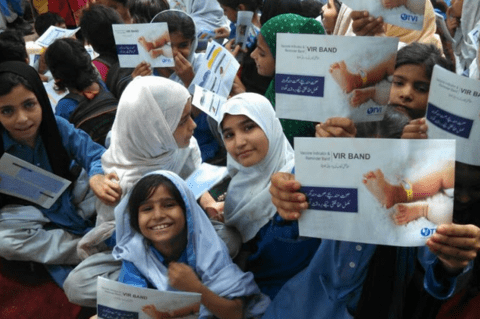
Conceptualised by a physician and public health practitioner from Pakistan, the VIR band is a low-cost device that reminds parents when it is time to vaccinate their newborn children. Constructed with a built-in "timestrip" indicator and secured to the ankle of infant, it serves as a visual clue to every member of the household and community regarding the importance of childhood routine immunisation (RI) timeliness and completion. The VIR band also serves as a record of the vaccines administered to an infant, serving the parents as well as the healthcare providers. The purpose of the VIR band is to address vaccine adherence and protect children from vaccine-preventable illnesses across Pakistan and, ultimately, as the design is replicated elsewhere, around the world.
Having worked as a primary care physician in Pakistan, the woman who invented the VIR band, Noor Sabah Rakhshani, knows that any vaccine reminder would need to be both durable and culturally acceptable. Ideally, mothers who can't read would understand it. Mobile phone-based solutions wouldn't be helpful because so many of impoverished mothers don't own one. Her unorthodox approach for a new kind of vaccine reminder is necessary, Dr. Rakhshani explains, citing studies about the gender gap in cell phone ownership in Pakistan, and reports about the technical difficulties and financial costs of generating cellphone-dependent reminders. Dr Rakhshani is testing the VIR band in Pakistan with implementing partner Trust for Vaccines and Immunization (TVI) and in Nigeria with implementing partner Health Strategy and Delivery Foundation (HSDF).
The simple, low-cost VIR band is a durable, soft, waterproof, environmentally friendly silicon band; there are no moving parts or electronics, just science helping mothers and carers follow their child's vaccination programme through a quick glance at their baby's ankle. Specifically, when a family comes into the Expanded Programme on Immunization (EPI) vaccine clinic for the first time, the vaccine administrator creates a new record for the baby in the computer database, activates the time indicator, and puts the VIR band (150 mm long and 19 mm wide) around the baby's ankle. (Each VIR band is marked with a unique number to match the child's medical records at the point of issue.) A timestrip encased in the band features a tiny blister of red food dye. Once a vaccine is administered, the band is activated by pressing the blister, which releases the dye to move along a membrane by capillary action to reach the end point. The membrane is surrounded by a paper with a window cut onto it. The spread of the dye on the white membrane is calibrated to fill the window in 6 and 4 weeks. Each infant receives a set of 3 VIR bands, one at each first, second, and third visits reminding parents to return with the baby at 6, 10, and 14 weeks of age. The ink progression gives a visual clue and serves as a reminder to parents/caregivers to vaccinate children (with doses of Bacillus Calmette-Guerin (BCG), Oral Poliovirus Vaccine (OPV), DTP containing Pentavalent vaccine (contains diphtheria, tetanus, and pertussis (whooping cough), hepatitis B and Haemophilus influenzae type b (Hib), and Pneumococcal conjugate, or PCV) in a timely and complete manner. As soon as the mother sees that the dye in the indicator has filled the window, she knows that it is time to bring her baby back to the clinic. Timestrip's patented 'liquid' technology ensures the accurate passage of elapsed time over the 6- and 4-weeks period. Each VIR band also contains the vaccine records for each visit, and this information is also stored both locally and in the cloud (so that internet outages don't prevent families from receiving their vaccines in a timely manner). A one-time button lock prevents the band's accidental removal. When the baby has received the complete series of shots, the administrator gives the mother a laminated reminder card with a hole for hanging and storage. The card includes the scheduled date for the baby's measles vaccines at 9 months and the child's unique ID number, which is linked to his/her vaccination records. The VIR band proof of concept study was completed during January 2013-June 2015. The current VIR band formative evaluation study is being carried out in Karachi, Pakistan, and Kebbi State, Nigeria (November 2015-June 2018).
VIR band community engagement and communication plan (CECP) activities were carried out May through November 2017 to facilitate the VIR acceptance and compliance in the community. The socio-ecological conceptual framework was used to develop the CECP; this model was selected, as it guides social behaviour change communication (SBCC) strategies to reach every community members and at all level of the society and healthcare system. The SBCC strategy was developed in light of baseline study findings with specific focus on creating awareness regarding the importance of vaccination initiation within one week of age. Information about 9 vaccine-preventable diseases (VPDs) and the message that "vaccination is the child's right and the parents' responsibility" was disseminated through various platforms and with members at every level of the community. Examples of stakeholder engagement and evidence uptake efforts include: VIR band brochures and BCG vaccination days and locations distributed in the community, counselling sessions in EPI vaccination centres, advocacy with public and private healthcare providers to promote timely RI initiation and VIR band introduction, engagement of religious/political/traditional leaders to build support for the VIR band intervention, recognition of families for timely completion of the RI schedule, and leadership and communication trainings among youth volunteers to promote timely initiation.
The stakeholder engagement, engaging, and training of community health workers (CHWs) for referring newborns to the VIR band enrollment, as well as advocacy with public and private healthcare providers, was completed before enrolling infants in the community effectiveness trial and distributing the VIR bands. As part of this trial, launched at four basic health units (BHUs) in Karachi, the VIR band is being evaluated for increasing: i) RI timely initiation and ii) RI timely completion through distribution of the VIR band to infants visiting EPI vaccination centres. TVI field teams recruited 497 infants up to 15 days of age to be part of the intervention (May-December 2017). Each infant was followed for up to 18 weeks to assess timeliness of 3 doses of the Penatvalent vaccine. Analysis and reporting writing will be completed in April 2018, but preliminary results out of Pakistan indicate overwhelming parental support of the VIR band concept and compliance with the device.
Funded by the International Initiative for Impact Evaluation (3ie), the VIR band formative evaluation study, November 2015-April 2018, is meant to assess the structures and process that need to be in place for rolling the intervention at scale. Simultaneous testing is taking place in Pakistan and Nigeria. In Pakistan, the study will assess the effect of encouraging community engagement and mobilisation for the distribution of VIR bands to infants. For this study, a total of 497 VIR bands have been distributed to infants through CHWs at the vaccination centres. The CHWs are encouraged to refer newborn infants to the vaccination centre and are given a monetary reward for each successful referral. In Nigeria, the study is assessing the feasibility of community-based distribution of VIR bands to infants. To reach out to infants and children who are born outside a health facility, the VIR band will be distributed to all eligible infants in the community using trained traditional birth attendants and village health workers. Trained health workers will activate the VIR band when the infant or child is taken to a health facility to initiate vaccinations. The field activities were carried out from June 2017 to January 2018 in the Kebbi state in northwestern Nigeria.
Immunisation and Vaccines.
Whilst the World Health Organization (WHO) estimates that vaccinations help save over 2.5 million lives each year globally, figures indicate that up to 60% of children in Pakistan do not complete the immunisation schedule. Those with a vaccination reminder card achieve above 80% vaccination completion, but if no card is available, or if the card is lost or damaged, the child may miss a lifesaving vaccination. As a result, preventable diseases like pneumonia, meningitis, whooping cough, and measles claim more than 100,000 lives there each year. Among children who never received a standard paper card with their immunisation history, only half completed the diphtheria-tetanus-pertussis (DTP3) vaccine's 3-shot regimen. However, among children who received all the recommended vaccinations, 90% had a paper immunisation card. How to design a vaccine reminder - one that wouldn't get lost or damaged like the standard paper cards so often do - that would bring all children into that 90%?
Naturally, there can be reasons other than forgetfulness that parents do not bring their children for vaccination. For example, during the time frame of VIR band development, in June 2014, Pakistan public health authorities faced a torrent of anti-vaccine rumours in the northwest Khyber Pakhtunkhwa province after fainting and deaths among vaccinated children. Pakistan's Express Tribune reported 36,000 refusals of child vaccinations in just one town, Charsadda. Panic led parents to refuse all vaccinations, including for hepatitis, tetanus, pneumonia, and tuberculosis. Initial reports showed that vaccines weren't to blame for the children's deaths, but parents were afraid, nonetheless.
The VIR band concept developed by Dr. Noor Sabah Rakhshani is the recipient of a November 2012 Bill & Melinda Gates Foundation Grand Challenges Explorations Award.
Trust for Vaccines and Immunization (TVI), Health Strategy and Delivery Foundation (HSDF), Timestrip UK Ltd, Daylight Design, and Precision. Funding from the Gates Foundation and 3ie.
Posting by Noor Sabah Rakhshani to The Communication Initiative Networks on January 29 2018; emails from Noor Sabah Rakhshani to The Communication Initiative on January 29 2018 (including "Vaccine Indicator and Reminder (VIR) Band Intervention: Baseline Study to Develop Community Engagement and Communication Plan for Increasing Vaccination Timeliness and Completion") and on January 30 2018; and Direct Consulting and Logistics website, Timestrip website, Daylight Design website, 3ie website, Precision website, and Johns Hopkins Public Health Magazine, fall 2015 - all accessed on January 30 2018. Image credit: Noor Sabah Rakhshani
- Log in to post comments