










































The Future of Routine Immunization in the Developing World: Challenges and Opportunities
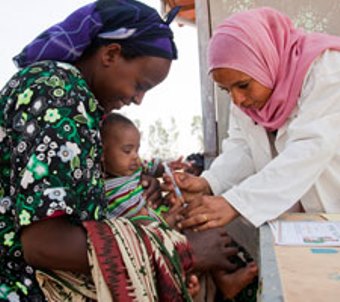
United States Agency for International Development and United States Department of Health and Human Services (Shen), Maternal and Child Survival Program (Fields), Sabin Vaccine Institute (Mike McQuestion)
"Routine immunization creates opportunities to educate parents about the benefits of vaccines and other health services. Engaging the community in planning, financing, and delivering the program can increase equity and build trust in the government's ability to deliver immunizations."
As explained in the introduction to this paper: Since 1974 when the World Health Organization (WHO) launched the Expanded Programme on Immunization (EPI), more vaccines have been added to national immunisation schedules, and the contribution of immunisation programmes to ongoing declines in infant and child mortality has increased. "The EPI blueprint laid out the technical and managerial functions necessary to routinely vaccinate children with a limited number of vaccines, providing protection against diphtheria, tetanus, whooping cough, measles, polio, and tuberculosis, and to prevent maternal and neonatal tetanus by vaccinating women of childbearing age with tetanus toxoid....As of 2014, WHO has recommended that all immunization programs add vaccines against hepatitis B, Haemophilus influenzae type b, Streptococcus pneumoniae, rotavirus, rubella, and human papillomavirus (in girls)....More vaccinations to protect against more diseases requires additional and better communication between health workers and caregivers as well as greater cold chain capacity."
"Despite substantial success, there remain numerous challenges to the ultimate effectiveness of routine immunization. These fall into the following programmatic areas: (1) policy, standards, and guidelines; (2) governance, organization and management; (3) human resources; (4) vaccine, cold chain, and logistics management; (5) service delivery; (6) communication and community partnerships; (7) data generation and use; and (8) sustainable financing. This paper describes experiences and challenges in these areas."
On Policy, Standardization, and Guidelines:
"Concerted efforts have been made in recent years to establish and formalize National Immunization Technical Advisory Groups (NITAGs)....In the absence of a NITAG, de facto policies sometimes emerge in the form of recommended practices and procedures that appear in training materials, supervisory checklists, and data management and reporting tools."
On Governance, Organization, and Management:
"National governments typically have the responsibility for leading and overseeing routine immunization. However, immunization is best seen as a shared responsibility of individuals, communities, and governments." Maintaining active representation and focus of all partners is a challenge. Generally, the national immunisation programme provides management and leadership for an array of functions including: "developing and carrying out communication strategies; planning the introduction of new vaccines; [and] organizing immunization campaigns." De-centralised services, while bringing management closer to populations being served, "suffer from a dearth of capable managers." Approaches to improvement include: interagency coordinating committees (LLMICs); linkages of key technical and advisory bodies for routine immunisation (NITAGs), national regulatory authorities (NRAs), and interagency coordinating committees (ICCs); and detailed microplans at the district level, which are "recommended by WHO, outlining difficulties in accessing certain communities and subgroups."
On Human Resources for Health:
Technical, management, and supervision skills, including financial and data management, are generally delivered through short, offsite, in-service training courses and cascade training. Promising areas for delivery include: 1) eHealth to improve health worker capacity and effectiveness in other programs; 2) Pre-service training to build a foundation at the outset of health workers' careers, including knowledge, skills, and professional values; and 3) Regular supervisory visits to reinforce good practices and values to improve services.
On Vaccine, Cold Chain, and Logistics Management: Technology-based tools can support forecasting and monitoring of vaccines, supplies, and equipment stock.
On Quality and Reliable Service Delivery To Reach Every Child:
Promising approaches include local-level micro-planning for outreach and health worker-client interaction for balancing the challenge of effectively and efficiently providing services.
On Communication and Community Partnerships:
"Challenges have ranged from isolated episodes of non-acceptance (due to religious, ethical, or medical considerations) to active mobilization against immunization programs driven by political or conspiratorial arguments.... Locally adapted and appropriate communication strategies are needed to address the sociocultural and political influences that impact immunization behavior." Approaches include: "community participation in monitoring immunization coverage within their own villages"; maintaining a community scorecard on primary health care services; and community dialogue between community members and health personnel.
On Generation and Use of Quality Immunization Data:
Challenges include outdated population data and inaccurate projections, double counting of doses, the mixing of infant and child dose data, and fabricated reports. Approaches include:
- "Home-based immunization records such as vaccination or child health cards.
- Expanded disease surveillance activities.
- Local use of programmatic data.
- Information feedback."
On Sustainable Vaccine and Immunization Financing:
Approaches include: 1) Establishing legal frameworks and 2) Tracking immunisation programme expenditures.
The document concludes with a description of the work of Gavi, the Vaccine Alliance.
Global Health: Science and Practice, December 2, 2014 vol. 2 no. 4 p. 381-394, accessed December 10 2014.
- Log in to post comments