











































Strategic Design of Mass Media: Promoting Breastfeeding in Viet Nam
"This is the story of how Alive & Thrive integrated a national mass media campaign into its comprehensive program to improve infant and young child feeding in Viet Nam. Read what it takes to use mass media and why it's essential for scaling up behavior change."
Alive & Thrive (A&T) is an initiative funded by the Bill & Melinda Gates Foundation to improve infant and young child nutrition by increasing rates of exclusive breastfeeding and improving complementary feeding practices in Bangladesh, Ethiopia, and Viet Nam, and to inform policies and programmes around the world. (Please see Related Summaries below for more details.) This strategy document from A&T Viet Nam examines one component of the approach taken as part of the initiative in that country: mass media for behaviour change.
In 2009, A&T found that, while almost all Vietnamese mothers breastfed, only about 20% practiced the ideal behaviour: giving breastmilk and only breastmilk ("exclusive breastfeeding") for baby's first 6 months. In addition to advocacy efforts that resulted in breastfeeding-friendly laws, face-to-face counseling was an indispensable component of the Viet Nam A&T programme, but mass media was needed to boost reach in a timely and cost-efficient way. "Mass communication worked independently and supported the advocacy and face-to-face communication by:
- Reaching all audience groups with a common, tested message and in a consistent manner
- Lending credibility to health workers' messages about breastfeeding, making mothers more receptive to messages and support delivered by counselors
- Reinforcing frontline worker commitment to breastfeeding and reminding them of key messages
- Modeling the desired behaviors by showing 'a mother like me' breastfeeding
- Shifting social norms and people's perceptions of the norms
- Changing beliefs about outcomes of the behavior
- Directly motivating mothers to practice exclusive breastfeeding for 6 months
An added benefit of mass media was that the program's tested messages and approach were consistently delivered as intended, without the subtle shifts in meaning that can happen in a face-to-face conversation."
To develop the campaign, organisers conducted a 6-step process that involved conducting research and then using the findings to make strategic decisions about behaviours and small doable actions, audiences, drivers of behaviour (behavioural determinants), messages, and media placement. One key insight to emerge from this process: "Simply increasing mothers' awareness or knowledge may help some mothers adopt a new behavior - but was unlikely to result in widespread change." Thus, the campaign addressed specific behavioural determinants:
- Knowledge of what the recommended behaviour/action is
- Beliefs about outcomes of doing the behaviour - the mother thinks that adopting the behaviour will result in an outcome she cares about
- Perceptions of social norms - what the mother thinks other mothers like her are doing and what she thinks other people (whose opinions matter to her) think she should do
- Sense of self-efficacy - the mother feels she is capable of doing the behaviour and that it is convenient for her
Based on this process, the A&T campaign used the following types of media:
- Broadcast: TV spots on national and regional TV stations, as well as audio messages delivered over outdoor loudspeakers
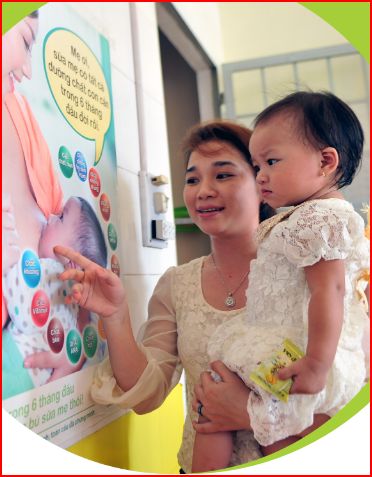
- Out-of-home: print ads on the outside of buses, billboards, and posters in health centres
- Online: a website, dedicated to infant and young child feeding, with information and TV spots; interactive online counseling; interactive mothers' forum; TV spots placed on Vietnamese websites that are most popular with women; a Facebook fan page; and a mobile app to connect young mothers and allow them to track baby's milestones, share photos, and access feeding recommendations
In the 45-second TV spot that can be viewed below, "No Water", organisers "packed a number of strategic messages that built on our formative research findings and used behavior change theory." In the TV spot, a 4-month-old baby and a 6-month-old baby talk to each other (children between 3 and 5 years of age actually deliver the conversation) about whether or not they drink water after breastfeeding to rinse their mouths. For instance, one of the babies says: "Mom, I don't need water. Don't worry that I'm thirsty or need to rinse my mouth. Leading health organizations recommend that you feed me only breastmilk for the first 6 months. Breastmilk has enough water and nutrients for me to grow up healthy and smart." The concept is based on choosing a specific small doable action to promote, which helps mothers reach the "ideal" behaviour. Every single line of the spot is based on research findings and theory (see page 11 of the report to view a diagram that explains this), such as the finding that Vietnamese mothers are heavily swayed by science and want to know global experts agree. The theory is that increasing their belief that people whose opinions they value want them to do the behaviour is one way of addressing social norms. So, as part of the creative solution, the spot references "leading health organizations" and "proven globally", while also displaying logos.
Evaluation data of this spot and other aspects of the campaign have found that:
- One year into the mass media campaign, the behaviour of exclusive breastfeeding up to 6 months of age had risen from 26% to 48%.
- About 18 months after the launch of the campaign, 85% of mothers interviewed reported exposure to an A&T breastfeeding message (through broadcast, out-of-home advertising, and/or online). In 2013, an estimated 800,000 Vietnamese mothers with children under 6 months saw at least one of the TV spots.
- Women who reported exposure to the campaign were more likely than their unexposed counterparts to have breastfed exclusively up to 6 months (the difference between exposed and unexposed ranges from 9 percentage points to 18).
- Exposure to mass media was associated with mothers' beliefs that exclusive breastfeeding for 6 months was the norm. Organisers asked mothers whether they agreed that people whose opinions they cared about thought that they should give breastmilk only - no water, no infant formula, no semi-solid food - for the baby's first 6 months: 68% of those exposed to the TV spots agreed, compared to 46% of mothers not exposed to the spots. Results were similar when mothers were asked if they believed that other mothers were giving only breastmilk: 66% of mothers who had seen the spots agreed, and 47% of those who had not been exposed agreed.
- Eighteen months into the mass media campaign, 85% of mothers exposed to the campaign were confident that their breastmilk alone offered all the nutrients baby needs for 6 months, compared with 72% of mothers not exposed to the campaign.
- The evaluation design allowed organisers to look at the mothers of children under 6 months of age who were exposed to the TV spots but not to A&T's face-to-face counseling intervention. Thirty-six percent of those mothers reported exclusive breastfeeding. It is estimated that exposure to the TV spot accounted for an additional 149,000 breastfed babies in 2012 and 138,000 more in 2013.
After detailing the entire process of working with babies and children as part of the TV spot, the report concludes with reflections on "learning from the competition", described here as a wise strategy when planning a social marketing campaign. In the case of breastfeeding, "the competition" is companies that produce infant formula - companies that, in Viet Nam, "had been filling the airwaves with daily doses of advertising....In addition, the products were highly visible in supermarkets, with numerous brands in colorful packaging, often the first display one saw on entering the store....We listened to mothers about the persuasive arguments that convinced them to use infant formula....Paying close attention to how our 'competition' was marketing their product helped us market breastmilk in an emotional and effective way. Even though we were outspent on advertising by 13 to 1, we managed to win back some of the 'market share,' significantly increasing rates of exclusive breastfeeding for the first 6 months..."
For further information, contact Nemat Hajeebhoy nhajeebhoy@fhi360.org
Alive & Thrive Newsletter, March 2014; and email from Luann Martin to The Communication Initiative on March 17 2014.
- Log in to post comments