










































The State of the World's Children 2013: Children with Disabilities
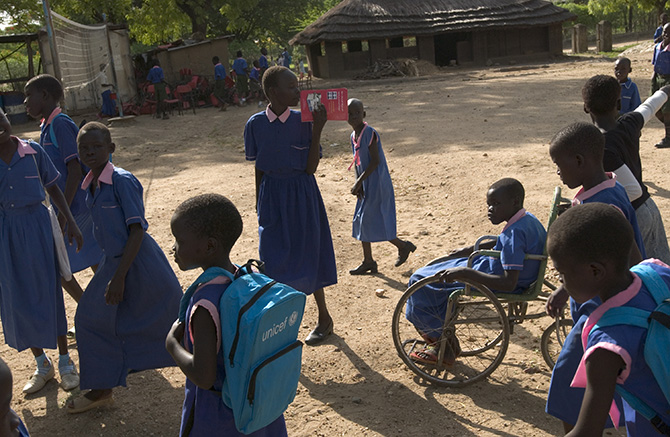
...[T]he inclusion of children with disabilities in society is possible - but it requires first a change of perception, a recognition that children with disabilities hold the same rights as others; that they can be agents of change and self-determination, not merely the beneficiaries of charity; that their voices must be heard and heeded in our policymaking and programmes." - Anthony Lake, Executive Director, UNICEF
From the United Nations Children's Fund (UNICEF), "The State of the World’s Children 2013: Children with Disabilities" examines the barriers - from inaccessible buildings to dismissive attitudes, from invisibility in official statistics to discrimination - that deprive children with disabilities of their rights and keep them from participating fully in society. The report also lays out some of the key elements of inclusive societies that respect and protect the rights of all children, regardless of disability, and progress in helping all children flourish and make their contribution to the world. It urges governments, their international partners, civil society, and employers to take concrete steps to advance the cause of inclusion - as a matter of equity and for the benefit of all.
It is noted that, in order to achieve this goal, international agencies and donors and their national and local partners should include children with disabilities in the objectives, targets, and monitoring indicators of all development programmes. To that end, the report includes a series of personal essays by young people with disabilities and some of the people who work with children and adolescents with disabilities - among them, parents, caregivers, and advocates. For example, Olga Montufar Contreras, the president of the Step by Step Foundation (a multicultural organisation that promotes the social mainstreaming of indigenous people with disabilities in Mexico), writes: "I grew up with physical disability, brought on by poliomyelitis, in an indigenous community...Even when the community's stigmas are overcome and we manage to attend school, our teachers face two obstacles: insufficient knowledge of indigenous languages and inadequate teacher training in inclusive education. This lack of training makes it more difficult to include children with disabilities."
According to the report, few countries have reliable information on how many of their citizens are children with disabilities, what disabilities they have, or how these disabilities affect their lives. As a result, few are capable of knowing what types and amounts of support these children and their families need - much less how best to respond. One of the report's chapters is therefore devoted to exploring challenges, progress, and opportunities in the area of data collection and analysis.
One portion of the report focuses on changing attitudes; an excerpt follows:
"Prejudice can be reduced through interaction, as demonstrated by activities that bring together children with and without disabilities. Social integration benefits everyone, and children who have experienced inclusion - in education, for example - can then be society's best teachers in reducing inequalities and building an inclusive society.
Inclusive media also have a key part to play. By including nuanced portrayals of children and adults with disabilities, media can send out positive messages that they are members of families and neighbourhoods and can also counter misrepresentations and stereotypes that reinforce social prejudices.
Similarly, participation in social activities helps to promote a positive view of disability. Sport, in particular, has helped overcome many societal prejudices. Seeing a child surmount the physical and psychological barriers to participation can be inspirational and can promote respect - although care must be taken not to make children with disabilities who do not perform such physical feats feel inferior to those who do.
Sport has also been helpful in campaigns to reduce stigma, and athletes with disabilities are often among the most recognized representatives of people with disabilities. Experiences in a number of countries have shown that access to sport and recreation is not only of direct benefit to children with disabilities, but also helps to improve their standing in the community as they are seen to participate alongside other children in activities valued by society."
Key recommendations include:
- Ratify and implement the Convention on the Rights of Persons with Disabilities (CRPD) and the Convention on the Rights of the Child (CRC).
- Fight discrimination and enhance the awareness of disability among the general public, decision-makers, and those who provide essential services for children and adolescents in such fields as health, education, and protection.
- Dismantle barriers to inclusion so that all children's environments - schools, health facilities, public transport, and so on - facilitate access and encourage the participation of children with disabilities alongside their peers.
- End the institutionalisation of children with disabilities, starting with a moratorium on new admissions. This should be accompanied by the promotion of and increased support for family-based care and community-based rehabilitation.
- Support families so they can meet the higher costs of living and lost opportunities to earn income associated with caring for children with disabilities.
- Move beyond minimum standards by involving children and adolescents with disabilities and their families in evaluating supports and services designed to meet their needs.
- Coordinate services across all sectors so as to address the full range of challenges facing children and adolescents with disabilities and their families.
- Involve children and adolescents with disabilities in making decisions that affect them - not just as beneficiaries, but as agents of change.
- Promote a concerted global research agenda on disability to generate the reliable and comparable data needed to guide planning and resource allocation and to place children with disabilities more clearly on the development agenda.
The hope is that this report will inform dialogue and spark action to create a world in which children with disabilities enjoy their rights on a par with other children, even in the most remote settings and the most deprived circumstances.
To access The State of the World's Children (SOWC) 2013: Children with Disabilities:
- Download the 164-page PDF version of the report in English.
- Click here in order to access various language and download options for the report.
- Visit the SOWC website for access to more information and access to photos and several videos, such as one featuring 8-year-old Meshak Batundi, living with polio in a camp for internally displaced persons near North Kivu's capital, Goma, Democratic Republic of the Congo.
CORE Group cgcommunity, May 30 2013. Image credit: ©UNICEF/Mariella Furrer
- Log in to post comments