










































Community Violence and Young Children: Making Space for Hope - Early Childhood Matters No. 119
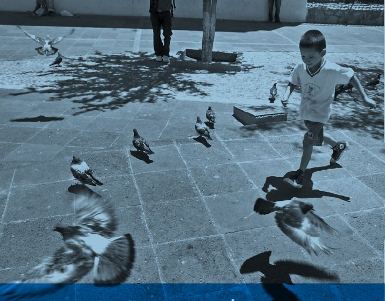
This edition of Early Childhood Matters looks at the effects of community violence on young children. Articles explore: the idea that violence should be thought of as a public health problem analogous to infectious disease; examine from a scientific perspective the impacts on children's social, emotional, and cognitive development of growing up in a violent community; share first-hand insights from children and caregivers; and explore various interventions, from the favelas of Recife, Brazil, to the inner cities of Chicago, Illinois, United States (US), and Glasgow, Scotland, which are offering a tangible sense of hope.
Some communication-related aspects of these articles include the following:
- Offering tangible hope of positive change - In this editorial, Michael J. Feigelson introduces this edition by calling attention to the stories of hope within the devastation caused by community violence.
- Community violence, toxic stress and developing brains - Nathan A Fox and Jack P. Shonkoff explain how prolonged exposure to fear in early childhood can impair the development of the pre-frontal cortex and future executive function.
- The impact of public violence on children: the current state of research - A summary of articles by Nancy G. Guerra and Carly Dierkhisiing, and by Holly Foster and Jeanne Brooks-Gunn that describe how exposure can be linked to both mental health problems in young children and physical health such as asthma.
- The effects of community violence on children’s cognitive performance and self-regulation - Patrick Sharkey finds significant effects on Chicago preschoolers’ cognition when a homicide had occurred in the last week within 1,500 feet of a child’s home.
- In their own words: how young children in Ciudad Juárez experience urban violence - Nashieli Ramírez Hernández's description from Ciudad Juárez, Mexico (near the US border,) looks at the problem through the eyes of young children themselves.
- ‘This isn’t what I dreamt about’: a mother’s experience in Mangueirinha, Brazil - This interview by Hermílio Santos gives an account of a direct experience with community violence from a mother’s point of view.
- Understanding gang violence in the favelas of Recife - This summary of a report by Rita da Silva and Kurt Shaw sets out some of the strategies that the Bernard van Leer Foundation hopes to test in Brazil and then share at a conference in Brazil of the most successful community violence prevention models in the region to infuse their partners on the ground with practical ideas for change.
- Preventing violence against children in fragile and conflict-affected settings: a 'child security index' - Helen Moestue and Robert Muggah explore the development of an index that can give voices like these a more systematic treatment, arguing that such an index would be a better barometer for success than simply counting shootings and killings.
- The impact of urban violence on Jamaican children: challenges and responses - Elizabeth Ward, Parris Lyew Ayee, and Deanna Ashley share that violence is contagious - exemplified by a mapping exercise.
- ‘We need to get back to the idea of viewing public service as a vocation’ - An interview with John Carnochan in which he explains how the Scottish police took the lead on a violence prevention strategy that has led to a 50% reduction in gang violence in Strathclyde, Scotland.
- The Uerê-Mello pedagogy: recuperating young children traumatised by public violence - Yvonne Bezerra de Mello describes a harm reduction strategy for children who have been witness to violence, implemented through 150 schools in Rio de Janeiro, Brazil, going into detail about the successful recuperation of three young children who experienced extreme levels of post-traumatic stress.
- ‘A lethal absence of hope’: making communities safer in Los Angeles - Susan Lee writes about a programme run by Mayor Antonio Villaraigosa that has helped reduce homicides by 33% in some of the most violent neighbourhoods of Los Angeles, California, US. She points out, from her experience with the Advancement Project in places with exceptionally high levels of community violence, that we need to stabilise the situation in order to make families’ lives easier. In her words, ‘before we can expect improved educational and health outcomes, the goal must be to achieve a basic level of safety so that children can learn and thrive.’
- Babies remember: restoring healthy development to young children exposed to trauma - Alicia F. Lieberman shows evidence from randomised controlled trials of how parent-child psychotherapy has improved child and maternal mental health after exposure to violence, evidence which has informed a Child Development -Community Policing Programme implemented in 16 US sites.
- Early intervention through curing communities of violence - Charles L. Ransford recounts the experience of Cure Violence, which has achieved reductions of between 16% and 56% in shootings and killings in Chicago and Baltimore and is now being replicated in South African and Iraq.
- Building a social economy and a culture of peace - Rodrigo Guerrero of Cali, Colombia, discusses VallenPaz, a strategy that returned 400 families who had been violently displaced to their homes and prevented any further displacement despite the ongoing conflict in the area.
English, Spanish
62
The Bernard van Leer Foundation website, November 29 2012. Image credit: Luis Aguilar/Bernard van Leer Foundation
- Log in to post comments