










































Newborn Care - Videos
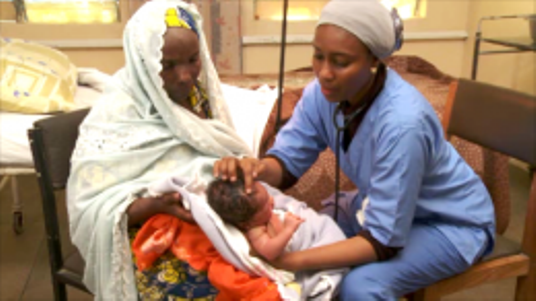
This video series is on newborn care - more than 30 brief, live action videos that cover newborn care clinical guidelines. They are made for the small screens of mobile phones and tablets, filmed on location in the developing world. The project has added films designed to help health workers follow World Health Organization (WHO) guidelines recommending simplified antibiotic regimens for seriously ill young babies in economically poor and remote areas when their families cannot access a hospital. From the project: "These Global Health Media Project films are made possible through the generosity of people in the Mad River Valley Vermont/USA and substantial pro bono support. Field support during filming in Kano Nigeria was provided by United States Agency for International Development (USAID)/Maternal and Child Health Integrated Program (MCHIP)."
The films are meant as complementary training tools, covering the key points of topics that can be visually conveyed. They are designed for use in pre-service and in-service education, as well as for review by health workers in their clinic settings.
According to the project, the content has been reviewed by newborn care experts - paediatricians and midwives with extensive experience in developing countries. Field-testing was done in focus groups with frontline health workers worldwide.
The newborn care series has been drawn primarily from the following international standards of care: Care of the Newborn Reference Manual, Save the Children, 2004; Managing Newborn Problems, WHO, 2003; and Integrated Management of Childhood Illnesses Chart Booklet, WHO, 2011.
The completed newborn care series will consist of about 30 videos. The films are voiced over to allow for narration in other languages. All versions are available for download on the project website, free-of-charge for those in resource-poor settings. The Global Health Media Project hopes to hear from users about whether they found the videos to be helpful and about any changes they would recommend to improve them.
Among the available titles are the following:
- Basic Skills
- Inserting a Gastric Tube
- Feeding with a Gastric Tube
- Inserting an IV
- Setting Up an IV Line
- Taking a Heel Blood Sample
- Referring a Sick Baby
- Newborn Physical Exam
- Breathing Problems
- Umbilical Infections
- Preparing Oral Medicines
- Preparing Injectable Medicines
- Danger Signs in Newborns (for health workers)
- Warning Signs in Newborns (for mothers and caregivers)
- Sepsis
- Home Visit for Mother and Newborn
- Referring a Sick Baby
- Giving an Intradermal Injection
- Jaundice
- The Cold Baby
- Thrush
- Skin Infection
- The Hot Baby
- Care of the Cord
- Umbilical Infections
- Taking a Venous Blood Sample
- Eye Infections
- Keeping the Baby Warm
And these on the WHO guidelines:
- Managing Severe Infection in Newborns
- Fast Breathing as Single Sign of Illness
- Critical Illnesses in Newborns
- Preparing and Giving Oral Amoxicillin
- Preparing Ampicillin and Gentamicin
- Giving an Intramuscular Injection
- Home Visit for the Newborn
- Chlorhexidine for Newborn Cord Care
For example, Newborn Physical Exam demonstrates a newborn physical exam in 3 parts: observation, vital signs, and the head-to-toe exam. It also shows normal variations and abnormal findings.
Email from Global Health Media Project to The Communication Initiative on July 24 2012 and May 19 and 22 2014, and the Global Health Media website newborn care page, July 13 2016.
- Log in to post comments