










































Red por Belen (the Belen Network)
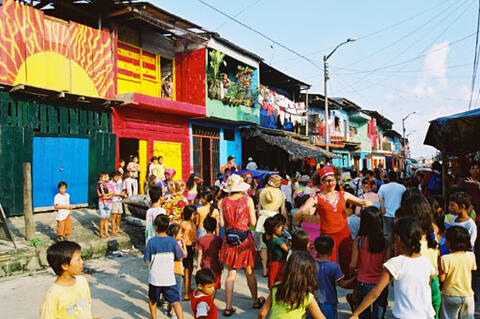
"As we worked and played this year in Belen it became clear that art, in the form of collaborative creative play improvisational theater), painting of houses and murals, music, dance and art education enables community participation in other spheres, specifically health education and cooperative problem solving to address community problems."
In collaboration with local citizens, governmental, and non-governmental organisations (NGOs), Red por Belen (the Belen Network) is committed to improve the health, education, and living conditions of children, families, and citizens of Belen, Iquitos, Peru, who are living in extreme economic poverty.
In August 2005, 30 clowns from Gesundheit! Institute (a United States (US)-based non-profit organization dedicated to healthcare education and reform, as well as international service and development) and Bolaroja Clown Doctors (a Peruvian hospital clown group with a focus on child advocacy) collaborated on a service mission to Iquitos, a city near the headwaters of the Amazon River. In April 2006, a small group of Gesundheit! and Bolaroja volunteers returned to Belen and met with a Belen public health nurse activist who had helped to bring about a meeting with 30 community leaders (public health nurses, teachers, school officials, elders, community leaders, and concerned citizens) to identify the problems facing Belen and their solutions. Gesundheit and Bolaroja decided to assist local volunteers in exploring low-cost collaborations to address Belen's needs.
In August 2006, 50 volunteers began what is the prototype for the ongoing project in Belen. Over a 10-day period, the volunteers painted 90 homes with vibrant colours and designs, doing so with the guidance and assistance of the inhabitants themselves, many of them teenagers. In addition to bringing schoolbooks, medical supplies, and other equipment, the volunteers clowned in hospitals, hospices, special needs facilities, nursing homes, and throughout Pueblo Libre.
The Belen Network connects with volunteers from both inside and outside Belen to develop activities and resources specifically addressing the needs and potentials of children, teenagers, and existing and potential community activists. Programmes include dancing, theatre, art, literacy, agriculture, music, empowerment workshops, healthcare, microeconomics, and more. Today, the initiative consists of:
- A health project, which includes an integrated public health educational outreach, mental health services, and medical clinics. Activities are designed to educate community members (for instance: disease prevention, hygiene, drug and alcohol abuse, violence, dental care, teen pregnancy), as well as to provide much-needed healthcare.
- A volunteer project, led by clown volunteers who engage Belen citizens in co-creating social contexts which are designed to be fun, creative, playful, friendly, loving, cooperative, caring, and thoughtful. According to organisers, the Belen experience demonstrates that change is best accomplished by assisting individuals within communities in following their own visions for what is needed by providing tools, resources, and friendship.
- An art project, where, in close collaboration with community members and Belen Network groups, volunteers paint murals and re-establish gardens in public spaces. During the process of reclaiming an ill-used and filthy public space, neighbours, families, and clowns work together to make this a friendly and beautiful place.
The Annual Belen Festival each August is an intensive volunteer experience in community activism combining health, education, and art. As many as 130 clown volunteers (artists, nurses, physicians, musicians, mental health professionals, educators, students, and activists) join with Red por Belen groups to support Belen's dreams for the future. The 10th Annual Belen Festival will take place August 5-16 2015. For more information, click here.
Children, Health, Water and Sanitation.
Iquitos (population: 425,000) is a city accessible only by air or by river. Belen (Spanish for "Bethlehem") exists at the edge of Iquitos, in the floodplain of the Itaya River (a tributary of the Amazon), and consists of 65,000 inhabitants. In Pueblo Libre, a section of Belen on the waterfront, an estimated 14,000 people, 30% under age 12, live in a busy river port, where charcoal, bananas, fish, and other goods are brought, mostly by canoe, to be distributed and sold throughout Belen. People there live in overcrowded conditions (90% of dwellings house 2 or more families, some homes as many as 5 families) and, in addition to dengue fever, water-borne illnesses, respiratory illnesses, tuberculosis, and HIV, there are problems associated with severe poverty such as alcoholism, crime, prostitution, unemployment, child abuse, and domestic violence. Literacy is estimated at 30%.
Bolaroja Clown Doctors, Gesundheit! Institute, Pan American Health Organization (PAHO), Universidad Peruana Cayetano Heredia, Airline Ambassadors, Selva Amazonica, La Restinga, Amazon Promise, and Doctors for Orphans.
"The Belen Project: A Collaborative Community Development Project for Belen, Iquitos, Peru", July 23 2012; Red por Belen (the Belen Network) website, December 4 2013; and emails from John Glick to The Communication Initiative on December 4 2013 and October 17 2014.
- Log in to post comments