










































Click Clever Click Safe Campaign
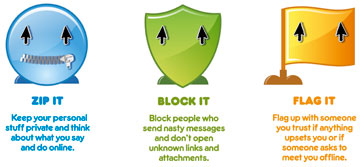
This campaign is based on the belief that parent-child communication is crucial to protecting children when they go online and use other new technologies. The code is meant to be used when parents talk to their children about safe behaviour on the internet. It is meant be clear and easy to recall:
- Zip it: Keep your personal stuff private and think about what you say and do online. Online friends are still strangers even if you have been talking to them for a long time.
- Block it: Block people who send nasty messages, and do not open unknown links and attachments.
- Flag it: Flag up with someone you trust if anything upsets you or if someone asks to meet you offline. If you are worried or unhappy about anything you see online, tell a parent or an adult you trust, and they can help you. If you want to talk to someone else, you can call ChildLine on 0800 1111. If a friend you have made online asks to meet you in the offline world, talk to your parents or a trusted adult about it.
The campaign website includes sections for both children and their parents, both of which provide further instructions for each part of the code. The children's portion also includes information on topics related to the various types of bullying - at school, on mobile phones, on social networks, on the internet and email, etc. - and provides help for those who are bullying or being bullied. The parents' section offers links to further resources, such as the UK Council for Child Internet Safety (UKCCIS)' internet safety "one stop shop". Further details are provided here on topics such as: preventing your child from downloading and file sharing illegally, internet terms and language, online gaming, and cyberbullying.
Children, Technology.
Ofcom e-bulletin Media Literacy - Feb 2010 [PDF]; campaign website, March 25 2010; and email from Claudia Rodrigues to The Communication Initiative on May 2 2012.
Comments

I'd like to hear more about the specifics
This is a good campaign, it's good that it is supported by organisations like ChildLine, and could be a really important training tool for children’s charities throughout the UK who work with children at risk of sexual exploitation via the internet.
- Log in to post comments