










































Creative Communication for Behaviour Change Information Sharing Session
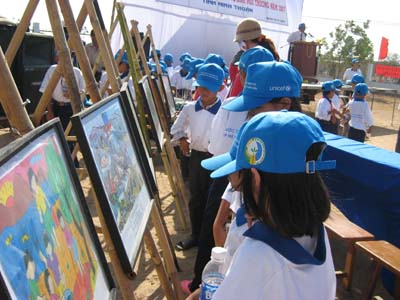
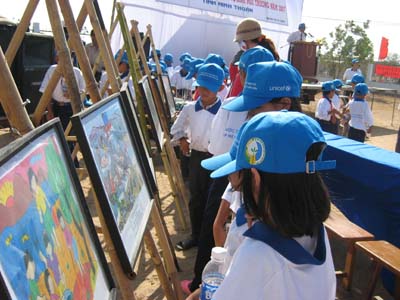
On November 10 2009, the United Nations Children's Fund (UNICEF) hosted an information sharing session for 36 people from 21 organisations interested in exploring creative communication for behaviour change in Vietnam. UNICEF was motivated to organise this gathering by the fact that recent years has seen various initiatives using creative, child-centred approaches involving art, music, theatre, games, dance, and the like in an effort to help children and young people realise and internalise key issues such as health, sanitation, education, protection, and the environment. The meeting's purpose was to foster the sharing of experiences and lesson learned among UN agencies and non-governmental organisations (NGOs) using creative communication for behaviour change - hopefully sparking possible collaboration and networking in the future.
First, each participant introduced himself or herself by telling a one-minute story about the "most creative" experience they had integrated into a project - among them: livelihood children's drawings and a booklet (Oxfam GB), a television series designed to foster HIV/AIDS prevention (BBC World Service Trust), video production (DigiSun), and environment and livelihood curriculum development through a creative process by Centre for Environment and Community Assets Development (CECAD).
Next, several presentations examined the use of creative strategies for behaviour change communication (BCC):
- Tran Luong is a Vietnamese contemporary visual artist who works on art and culture for development in Vietnam and other countries. His projects focus on social issues such as water, the environment, livelihoods, and empowerment of children. He has assisted local communities in conducting participatory workshops and in organising art exhibitions and street events. In his work, changing perspective is a critical process, and his workshop often includes exercises designed to guide participants in looking at/touching objects directly and indirectly. Luong explained that the trend of modern art is that the process and time of creating art is more important than the final product. The same insight applies to community-based events, as well. He expects that each community where he worked continues art and culture activities after the project finishes, and he tries to keep in touch with people by visiting them and/or sending books and materials.
- Dance 4 Life is an international initiative to involve young people in struggle against HIV and AIDS. In Vietnam, working under World Population Fund, it involves and empowers in-school youth (ages 13-19), including those in difficult circumstances, to take action themselves to push back HIV and AIDS. It aims to "re-brand" the approach to HIV and AIDS education through various activities: the power of dance, art context, an HIV short messaging service (SMS) quiz, and youth-driven awareness-raising and fundraising. Every year, Dance4life organises an international event that involves youth around the world performing the same dance at the same time.
- Tamara Plush, a participatory video expert, spoke about a community-based participatory video production she engaged in with children in Nepal, which she is now replicating as part of her work with Care International in Viet Nam. The objective of the Nepal project was to raise awareness, build capacity, and influence policy and advocacy on environmental issues. At the local level, video production sparked community dialogue around children's impact on climate change, and the need to empower them. This process led to the construction of a bridge where river crossing was the main issue. At the national level, this presenter claimed, video production contributed to a commitment from policymakers. The video produced by children was broadcast nationally, which helped to increase understanding among policy makers on the climate change issue and influenced the national strategic plan. At the global level, the video was shown at COP 14 and appeared on its internet site. It created an opportunity to discuss child rights and climate change.
- Green Zoom is a national NGO whose education for sustainable development (ESD) work promotes cultural diversity activities by using creative initiatives. Since its foundation in 2005 by volunteer students, Green Zoom has implemented several art and culture projects, such as:
- Photography Project on Hanoi Environment (2005), which used a photovoice approach and involved a multimedia exhibition;
- Tho Ha Village - In the Change project (2006-2007), which reflected changes in terms of architecture, culture, and the environment under the pressure of urbanisation in Tho Ha, an old pottery village in Northern Vietnam;
- Ha Long project (2007-2008), which used creative activities to show the life and environment of 12 children from the floating village of Vung Vieng in Ha Long Bay;
- My Message project, a multimedia project on traffic safety; and
- Art Talk, a new initiative that promotes open and friendly talk on various topics related to art.
- Save the Children Vietnam's HIV/AIDS team conducts child-focused HIV and AIDS prevention, care, and support through peer education and information, education, and communication (IEC) activities in the north Hai Phong City, Quang Ninh province, Ho Chi Minh City, and Ca Mau province. The community-based sessions take different forms such as mobile theatre, role playing, games, storytelling, and watching films. School-based peer education is held at class, club, or school events using methods such as drawing and writing competitions, roleplay, and games. According to this presenter, peer education seems to reach wider range of children, including the most vulnerable.
- The World Wildlife Foundation (WWF)'s Vietnam office is using environment education (EE) to provide opportunities for children to play and learn about the environment. For example, the Biodiversity Education project includes training activities (EE training courses, training of trainers (TOT) training courses), production of materials (books, guidelines, videos), and activities such as games, "green clubs", plays, and contests. These school-based EE activities are designed to be optional, flexible, and relaxing for students, and to transfer messages to learners in an easy manner. WWF also produces various publications and materials (books, curriculum, films, puppet shows, posters, booklets, etc.).
- The Center for Community Health Research and Development (CCRD) shared the experience of developing a Toolkit for Reducing HIV Stigma and Discrimination in Clinic Settings. This multi-country, multi-donor communication toolkit aims to foster behaviour change using creative methods. In order to develop the toolkit in 3 languages (Vietnamese, Khmer, and Thai), the team undertook the challenging process of creating content, translating it, pre-testing it, editing it, etc. What was envisioned as a 4-month project cycle extended to 1.5 years. The resulting toolkit is designed to be easy to use; an instructional DVD is provided in an effort to ensure that the training will be consistent. CCRD also developed a poster to remind clinic staff/counsellors of correct behaviour.
- UNICEF then discussed its own use of creative communication to foster child participation: the pilot initiative Creative Connections. Focusing on 4 key child development issues (education, water and sanitation, protection, and injury prevention) in schools and communities, the Creative Connections process and outputs are designed to build authentic child-based understanding of behaviour change communication (BCC) messages. Specifically, UNICEF is holding after-school workshops that are facilitated by trained teachers in 3 pilot secondary schools in Ninh Thuan. They are designed so that students generate the ideas, own these ideas, and determine how to present them using creativity, fun, and laughter. The final products can be anything from maps, drawings, sculptures, role-plays, music, photos, quizzes, to organising a contest or campaign. A school festival is expected to be held in December 2009.
These experiences led participants to discuss some challenges associated with implementing the creative approach at school. For instance, it can be difficult to change teachers' behaviour and teaching method, as well as the power relations between teachers and students. Based on a recent field visit to 3 pilot schools taking part in Creative Connections, Paul Zetter (who had made some remarks earlier in the meeting) cited evidence indicating that popular old teacher-led methods are still in use. One solution proposed to shake up deeply entrenched patterns was to provide TOT sessions not only to teachers but also to other community members, including young people. In some cases, it is more effective to work with other teachers. Experience from CECAD suggested filming the classroom interaction between teachers and students for monitoring purposes. A mixed approach of "bottom-up" and "top-down" was described as important. Often NGO work involves an exclusively bottom-up approach, but there are top-down Ministry of Education and Training (MOET) policies designed to foster a child-friendly school environment that encourages students' creativity; it might be useful to follow up with local authorities and teachers for further details on the MOET child-centred approach.
On the subject of challenges, the Green Zone presentation (described above) led participants to discuss the difficulty of measuring impact, considering that changes in behaviour are sometime difficult to monitor and evaluate. Participants agreed that qualitative methods, such as Most Significant Change (MSC) may be helpful.
Participants agreed that this type of information sharing should continue regularly (i.e. every quarter). They also suggested that a similar session be organised periodically at the national level. While still providing the venue, UNICEF invited NGOs to chair the next meeting. It was also suggested that the number of presentation be reduced and that, instead, the focus be on topics to present in more detail. At the sub-national level, UNICEF and NGOs work in same areas; participants pledged to find the ways and means for future collaboration and partnership.
For further information and contact details for each organisation that gave a presentation at the meeting, please see the contact details, below. Also, many of the PowerPoint presentations and other materials from the meeting are available at the
Creative Communication for Behaviour Change community website.
Email from Keisuke Taketani to The Communication Initiative on November 11 2009; and "Meeting Minutes: Creative Communication for Behaviour Change Information Sharing Session", sent via email from Keisuke Taketani to The Communication Initiative on November 22 2009.

- Log in to post comments