










































Software 'Gives Children a Voice'
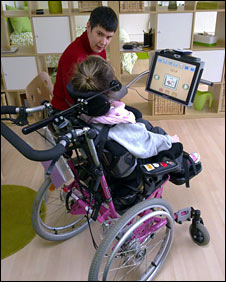
This BBC News article explores newly developed technology - software called "How was school today?" - whose purpose is to help children with disabilities such as cerebral palsy communicate faster. The system is the result of a project carried out by staff in Dundee University's School of Computing and Aberdeen University's Department of Computing Science, in collaboration with Capability Scotland, The Centre for Child Health (Tayside University Hospital Trust), and Communication Matters (ISAAC UK). The project was funded by the Engineering and Physical Sciences Research Council (EPSRC).
"How was school today?" uses sensors, swipe cards, and a recording device to gather information on what the child using the system has experienced at school that day. This can then be turned into a story by the computer - using what is called natural language generation - which the pupils can then share when they get home. In the words of one of the scientists, "The system is designed to support a more interactive narration, allowing children to easily talk about their school day and to quickly answer questions."
Sue Williams, head teacher at Capability Scotland's Corseford School in Kilbarchan, said: "In the week we used the system we found it very useful to pupils, teachers, therapists and parents alike. It allows children to take control of the conversation without having to rely on help from us."
Here is an excerpt from the project description on the University of Dundee, School of Computing website:
"Being able to tell stories about ourselves is a central part of the human experience and of social interaction. Most people do this naturally, for example while chatting with family members over the dinner table. But telling stories about oneself can be a real struggle for people with complex communication needs (CCN); they find it very difficult to create and articulate such stories. People with CCN (i.e. individuals with severe physical and communication impairments and possibly varying degrees of intellectual disability, e.g. due to cerebral palsy) rely on computer-generated synthetic speech. Speech generating devices are currently limited to short, pre-stored utterances or tedious preparation of text files which are output, word for word, via a speech synthesiser. Restrictions in speed and vocabulary can be a frustrating experience and are an impediment to spontaneous social conversation.
This project is a feasibility study to see if we can help children with CCN create stories about what they did in a day by developing a computer tool which produces a draft story based on knowledge of the user's planned daily activities (e.g. from a diary) and automatically-acquired sensor data; and also an editing and narration tool which lets the user edit the story into something which is his/hers and not just a computer output....Currently information about a child's school activities is provided to parents and carers via a home-school diary written by teachers or support workers, with little active input from the child herself. In this feasibility study we will develop and evaluate a tool which helps children create such stories themselves."
Posting to Young People's Media Network (YPMN) listserv on June 19 2009.
- Log in to post comments