










































Super Buddies

The aim of Super Buddies Club as an organisation is to:
- bring children together to share ideas, views, and experiences on issues affecting them and to empower them with life skills;
- instill positive living values among children and youth around issues such as abstinence and faithfulness;
- improve knowledge and attitudes on HIV/AIDS and other issues affecting children and youth through activities and the production of information, education, and communication (IEC) materials;
- promote a culture of reaching out to help other young people in need; and
- advocate for children's rights in order to create a conducive environment for children and youth to reach their full potential.
The Super Buddies Magazine, supported by the United Nations Children's Fund (UNICEF) and the United Nations Educational, Scientific and Cultural Organization (UNESCO), was initially launched in July 2003 following a needs assessment survey by the non-governmental organisation (NGO) Open Society Initiative for Southern Africa. The survey found that children needed a platform through which to voice their thoughts and concerns. The magazine, as it is currently run, is published bi-monthly with support from sponsors. Over 60,000 copies of the magazine are distributed per year for free to children in 40 schools and 9 communities where Super Buddies Clubs are active, in outreach events like road shows and debates. It is also sold at a minimum fee in outlets to children who are not able to receive it in other centres. The magazine uses a comic format with cartoon characters who answer questions on a variety of themes affecting young people in Swaziland such as HIV/AIDS and children's rights. The magazine also contains messages and letters written by children and encourages the formation of more clubs in schools and communities. Some of the children who are active in the production of the magazine have been trained on print media production by Super Buddies, "which has given birth to young journalists."
The Super Buddies Clubs are established and run by Miles Communication with the assistance of the Ministry of Education. There are 33 Super Buddies Clubs that are running in schools, both primary and high schools, and in communities across Swaziland. Over 6,000 active members of Super Buddies Club meet every week to discuss issues affecting them, including HIV/AIDS, abuse, peer pressure, and drug and alcohol abuse. The clubs do this with the guidance of Super Buddies Club field officers and teachers. Through road shows and outreach programmes, the clubs also conduct community peer education activities using drama, music, dance, poetry, and cultural activities. Community/school dialogues/debates are also held; as of October 2009, over 3,000 people had participated in these debates.
Over the 2008 school holidays, 15 members of the Super Buddies Club aged between 14 and 17 worked to write a script about how children's rights are violated through sexual abuse, causing many to turn to a life on the streets and be exposed to the HIV virus. Through theatre, the group tells the story of Anty, a teenage girl who lives on the streets to escape sexual abuse at the hands of her uncle. As the drama unfolds, the lonely and starving teenager is befriended by a younger group of children. As their friendship grows, Anty overcomes the shame she feels and shares her story. This act of courage gives the strength to another girl in the group to speak out about the abuse she is suffering at the hands of her father. Together the children help find a safe place for the girl. In the end, the abusive father is arrested and the girl is saved. The youth performed the play ("Anty, My Father Has Abused Me") at a child protection rally held in June 2009. More than 1,500 people attended the event, which was also covered by the national paper. After their performance, discussions followed on child rights and responsibilities.
To research the script's content, the 15 youth talked to street children to find out why they had left their homes. (These youth are themselves from economically poor backgrounds.) Some were AIDS orphans, and the majority had the responsibility of raising their brothers and sisters. "We learnt that many children who are in abusive situations are often threatened by the abusers or their relatives not to report the cases to the police," they wrote. "We put that component into our drama, to educate our parents and relatives during the Super Buddies dialogue, so that they would realise that abuse was a violation of our right to protection. We also made a point of including the scene where the children help the child who was sexually abused by her father. This was in order to show that children themselves can play a major role in fighting against abuse. As Super Buddies, we have been taught that our role is to help our peers in difficult situations. Since the dialogue included children who are not Super Buddies, we hope we have broadened the group of children that we reach."
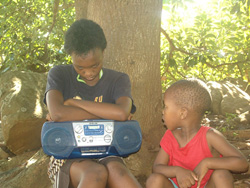
The Super Buddies' radio programme is called Ses'khona, which literally means "we're here" but, in the SiSwati language, it implies the arrival of a group that intends to stay and be heard. It began broadcasting in February 2009, and is aired every Saturday on the government radio station, SBIS-2. It is run by 4 presenters, 2 producers, and 2 technical directors, all aged between 12 and 14. Swazi children are now able to tune in to hear their contemporaries reporting the news, entertaining them, and discussing issues that matter to pre-adult listeners. According to organisers, "Ses'khona" works to support meaningful child participation in programmes involving children.
Also, in February 2009, with funding from Freedom to Create (formerly ArtAction) in Singapore, Super Buddies children began a new programme to educate one another on various issues of concern - HIV, gender, and child rights - using interviews and radio drama. Trained peer educators visit schools and communities nationwide to interview other children and to produce the radio drama. Future (2010) plans include:
- A resource centre to empower Swaziland's children with information on HIV prevention, child rights, and other issues of concern: This centre will centrally document - and improve access to - information through, in part, computers with internet access. Super Buddies peer educators, radio producers, and children will be able to access data and conduct meetings - using information, education, and communication (IEC) material, oval tables where they can sit and read, a television (TV) screen with a DVD player, and a mini high-fidelity (hi-fi) device so that children can, after club meetings on Saturdays, listen to the radio programme and discuss issues.
- Business skills programme: Super Buddies Club will undertake work to equip, orient, and elevate young people through business skills consultation experience. A series of workshops on livelihood skills will focus on baking, soap making, craft making, trench gardening, etc.
- National abstinence campaign: Working with Save the Children and Population Services International (PSI), Super Buddies Club will launch a national campaign on child protection - with emphasis on gender-based violence (GBV) against young women. Peer education sessions will focus on abstinence, with reproductive health experts engaged to assist in developing a training manual which explores abstinence for HIV prevention and GBV protection. Peer educators will be trained during the December/January holidays (2009), and the campaign will be launched early in 2010. It will be delivered through various platforms, such as school and community dialogues/debates that will cover all the regions, messages that will be translated into radio drama, national cultural events, the Super Buddies Magazine, and various promotional materials.
Children, Youth, HIV/AIDS, Reproductive Health, Rights.
Organisers say that a very high percentage of youth and children in Swaziland rely on radio for information, and there is a need to improve radio programming in both the SiSwati and English channels.
Swaziland is currently documented as leading in the world in HIV prevalence. According to the organisers, it is crucial to include children and young people in any prevention approach. They also believe that the peer-to-peer approach is key to the success of the programme.
Through Super Buddies' partnership with Freedom to Create, the organisation was given the opportunity to enter an international youth contest, the Freedom to Create Prize; Super Buddies was shortlisted to be among the top 5 finalists.
Ministry of Education and Training, Save the Children, Population Services International (PSI), Khulisa Umntfwana, Media Institute of Southern Africa, and regional HIV coordinating committees.
Emails from Siphiwe Nkambule to Soul Beat Africa on March 7 2008, and to The Communication Initiative on October 30 2009 and November 2 2009; Media Magic Digest, March 2008; IRIN News website on March 27 2009 and October 22 2009; Freedom to Create Prize website, November 2 2009; and email from Catherine Barr to The Communication Initiative on April 8 2010.
- Log in to post comments