










































Why Languages Matter: Meeting Millennium Development Goals Through Local Languages
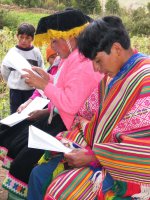
Published in the International Year of Languages (2008) by the Christian faith-based organisation SIL International (formerly Summer Institute of Linguistics), “Why Languages Matter” provides readers with stories about how literacy programmes in local languages are intending to achieve the Millennium Development Goals (MDGs). The 16-page brochure also highlights how partnerships can revitalise local languages. According to the brochure: "The MDGs focus the work of advocates, aid workers, governments, and non-governmental organisations (NGOs), as they partner with local communities. Language-based development plays a significant role in giving communities the tools to work out steps to meet these goals. Many of the [economically] poorest people speak mother tongues that are not national or international languages. Poverty, lack of access to primary education, inequality, and disease are daily challenges for them."
The document poses the following questions:
1. "Can the development of minority languages become key to helping people create their own way of successfully meeting the challenges in their lives?
2. Can writing systems for mother tongues and multilingual education become tools for people to build a better present and a better future?
3. Are the long-term results worth the investment of money and time?"
The document uses examples of local language development for each of the MDGs to show how "communities are discovering that by using their languages in new arenas of their lives, they can begin discovering solutions to the challenges stated in the MDGs." The examples include the following:
- MDG 1: Eradicate Extreme Poverty and Hunger - When a Democratic Republic of Congo village chief learned from his newly-developed literacy skills in the North Ngbandi language group that "soybeans are rich in protein, he encouraged everyone in his village to plant them. He later learned from another booklet about the components of a proper diet, and again encouraged his community to eat from each food group daily so they could improve their health through nutrition."
- MDG 2: Achieve Universal Primary Education - A bilingual primary school teacher in the village of Santa Maria Ocotán, Mexico, taught his students all of their subjects in "Tepehuan, although most of the teaching materials were in Spanish..... Another first grade teacher used only Spanish. At the end of the year, the test scores on the standardized government tests for the students taught in their mother tongue surpassed those for the students taught only in Spanish, even though the tests were in Spanish."
- MDG 3: Promote Gender Equality and Empower Women - A Quechua-speaking Peruvian, Margarita, studied at night to finish her primary education and beyond, ultimately earning a university degree in psychology. "Using that knowledge and her skills, Margarita founded a volunteer organization that provides social, psychological and educational help to hundreds of displaced and sometimes abused Quechua women and children - using the language they understand best."
- MDG 4: Reduce Child Mortality - When people of Benin learned to read in Waama, they gained access to basic health information in their own language. "Mothers learned the importance of going to health centers for prenatal check-ups and seeking treatment for illnesses. Many Waama lives are being saved because crucial health and wellness knowledge is now available in their mother tongue."
- MDG 5: Improve Maternal Health - The Soumraye people of Chad conduct a three-year literacy program in 37 villages. "During the first two years, students learn the Soumraye alphabet and gain basic literacy skills. In the third year, they concentrate on various reading materials that include booklets about clean water, planting trees, HIV/AIDS awareness and prevention, treating and preventing intestinal and respiratory illnesses and medicinal use of local plants. One mother who finished the three-year literacy cycle said, 'I am learning a lot through the health booklets in Soumraye, and I have successfully used local plants to treat some symptoms such as coughing and diarrhea.'"
- MDG 6: Combat HIV/AIDS, Malaria and Other Diseases - A DVD titled Get AIDS-Get Trouble dramatises how HIV/AIDS affects the family when one member contracts the disease. "Produced and performed in one of Papua New Guinea's trade languages, Melanesian Pidgin, the DVD has been translated into several local languages."
- MDG 7: Ensure Environmental Sustainability - During a mother-tongue-based development programme, a Papua, Indonesia, community member "learned that clearing the mangrove areas had resulted in soil erosion. Mangrove ecosystems - among the most productive and biologically complex ecosystems - support a wealth of life while providing a natural breakwater between land and sea. Armed with this information in his own language, he began the daunting process of replanting the mangroves in his community."
- MDG 8: Develop a Global Partnership for Development - Speakers of several closely-related languages of Vietnam now have a font that is usable on computers and the internet. "The new typeface reflects the traditional hand-written Tai Viet script that is used informally in several languages spoken in the northwest provinces of Vietnam and surrounding areas. Participants at a United Nations Educational, Scientific, and Cultural Organization (UNESCO)-sponsored workshop in Vietnam in 2006 developed a standardized encoding for the script with input from ethnolinguistic communities in Vietnam and immigrant populations in other countries. Funding came in part from the Script Encoding Initiative of the University of California at Berkeley, and the Unicode Consortium accepted the resulting encoding proposal."
UNESCO website accessed on October 6 2008; and email from Luci Tumas to The Communication Initiative on December 5 2008.
Comments

good
I am looking forward to reading the above mentioned text, that seems to address critical issues.
- Log in to post comments