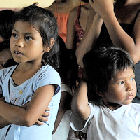
Village Phone Increases Schooling in Peru

According to this SciDev.Net article, researcher Diether Beuermann of the United States-based University of Maryland's Department of Economics has calculated the impact that access to a phone has on incomes - and therefore schooling - in rural Peru. He assessed the income of rural families and the proportion of time children spent working or at school in more than 6,500 villages between 1997 and 2007. The unpublished study was commissioned by the Economic and Social Research Consortium, a network of more than 40 Peruvian universities and research institutes, and carried out by the University of Maryland.
As stated here: "From 2001 a public-private partnership started to provide mobile phone coverage, or access to a village satellite phone for those who couldn't afford a mobile phone. The intervention reduced the national average distance to a phone from 60 kilometres to five. Farmers in villages that received phones early in the scheme saw a 15 per cent rise in earnings compared with those that received a phone later, because phones expanded their markets. Farmers' agricultural costs were reduced by about a fifth because they received better and timelier information using phones, such as weather forecasts that allowed them to make better decisions. This resulted in an 18 per cent overall increase in agricultural productivity.
This productivity increase had a direct impact on schooling. The time children spent working at markets and in the field was reduced by 14 per cent and nine per cent, respectively, leading to a 13 per cent increase in the number of children reporting going to school as their main activity."
Beuermann said the calculations account for reasons that might have caused the increase in schooling, including reductions in farmers' workload because they were able to know price trends, diminish their agricultural costs, and increase net incomes - resulting in less utilisation of children between six- and 13-years-old in agricultural work and highlighting the desire of parents to send children to school when family financial pressures are eased.
SciDev.Net Weekly Update , January 25 - February 1 2010. Image courtesy of Flickr/Emil Kepko