











































Videoactive Girls
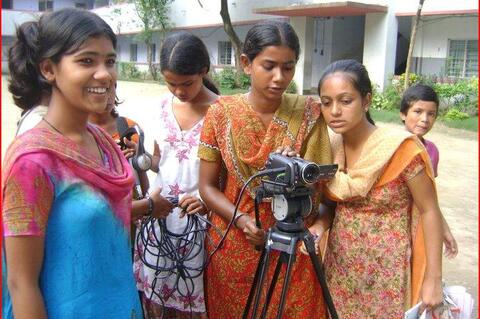
"Girls and women in many parts of the world are deprived of opportunities for education and advancement, especially in the realm of technology." Recognising this problem, in 2009, the Global Fund for Children (GFC) launched an experimental programme that provided young women with training in video production. Taking part were 4 GFC grantee partner organisations serving adolescent girls: Mahita and Kolkata Sanved in India, and Kudirat Initiative for Democracy and Girl Child Concerns in Nigeria - along with two regional technical partners: Video Volunteers (India) and Communicating for Change (Nigeria). The participating girls learned how to use media to amplify their voices and share their stories with a wider audience, while toolkits detailing the process were developed to help guide other community-based organisations in the future. By sharing these toolkits, GFC hopes other organisations will develop programmes that teach girls and young women how to harness the power of digital media.
The Videoactive Girls initiative focused on education in the art of digital storytelling, video production, and video-sharing skills, with the goal of helping the participating girls cultivate greater self-confidence and self-empowerment through the learning process. It used interpersonal communication and video to address the gap that exists in technology access and know-how amongst adolescent girls in the developing world. It is an advocacy initiative that involves partnerships amongst organisations located in India and Nigeria, as well as the United States (US).
In India, the role of VV was to train participating girls to use media as a tool to amplify their voices and share their stories with a wider audience. It focused on these three factors: how to learn the art of digital storytelling; developing video production and video-sharing skills; how to instill and cultivate greater self confidence and self-empowerment in each participant through the learning process. The project was located in two places: Kolkata Hyderabad. The girls had come from a difficult socio-economic background and had experienced several personal tragedies and traumas, so a training module was specifically designed to help restore the girls' self-confidence. "In Hyderabad, young burkha-clad girls interviewed local politicians at an educational event, revealing that adolescent girls can, and should, have a voice in education policy. In Kolkatta, alongside therapeutic dance, the girls produced videos that chronicled the passage of their lives from troubled times to strength and stability." Trainer Manish Kumar describes the training ethos in this way: "It is very common for teachers and trainers to do the talking. The trainer takes on the role of 'expert' and tries to 'transfer knowledge' to the learners. But in a participatory approach, the trainer considers himself a learner too and this increases participants’ motivation and helps them learn more effectively." The girls made several videos on issues like child marriage, gender bias, and the problems of working women.
In addition to the videos, what emerged were video storytelling toolkits; the concept of each is that: "By training adolescent girls in the art of video storytelling, organizations encourage them to tap into their creativity and develop skills that ordinarily they might not discover. Video storytelling is also a wonderful advocacy tool for organizations to create awareness about the realities of many adolescent girls. In addition, organizations can use a video storytelling project as a selling point for donors who are interested in funding their programs."
Girls, Rights.
According to organisers, "The emergence of girls' media in the developing world is of special significance. The context for its rise is the continued discrimination against girls in education and in the social, political, and economic spheres, coupled with limits on girls' ability to make their own choices and decisions....Girls' media projects are one way to help girls build confidence and to urge them to speak out. Girls who engage in media endeavors and develop these skills have a better chance of directing their own lives. Such initiatives are even more important in developing nations..."
Global Fund for Children (GFC), Mahita, Kolkata Sanved, Kudirat Initiative for Democracy, Girl Child Concerns, Video Volunteers, and Communicating for Change. This was a learning initiative of The Nike Foundation's Brain Trust of Practitioners.
VV Newsletter, August 2011; VV website, August 22 2011; Videoactive Girls website (currently inactive), August 22 2011.
- Log in to post comments