










































Vaccination Confidence and Parental Refusal/Delay of Early Childhood Vaccines
Harvard Medical School & Harvard Pilgrim Health Care Institute (Gilkey); University of Minnesota (McRee); University of North Carolina (Magnus); The Ohio State University (Reiter); Adult and Child Centered Outcomes Research and Dissemination Science (ACCORDS) Program, University of Colorado Denver (Dempsey); University of North Carolina (Brewer)
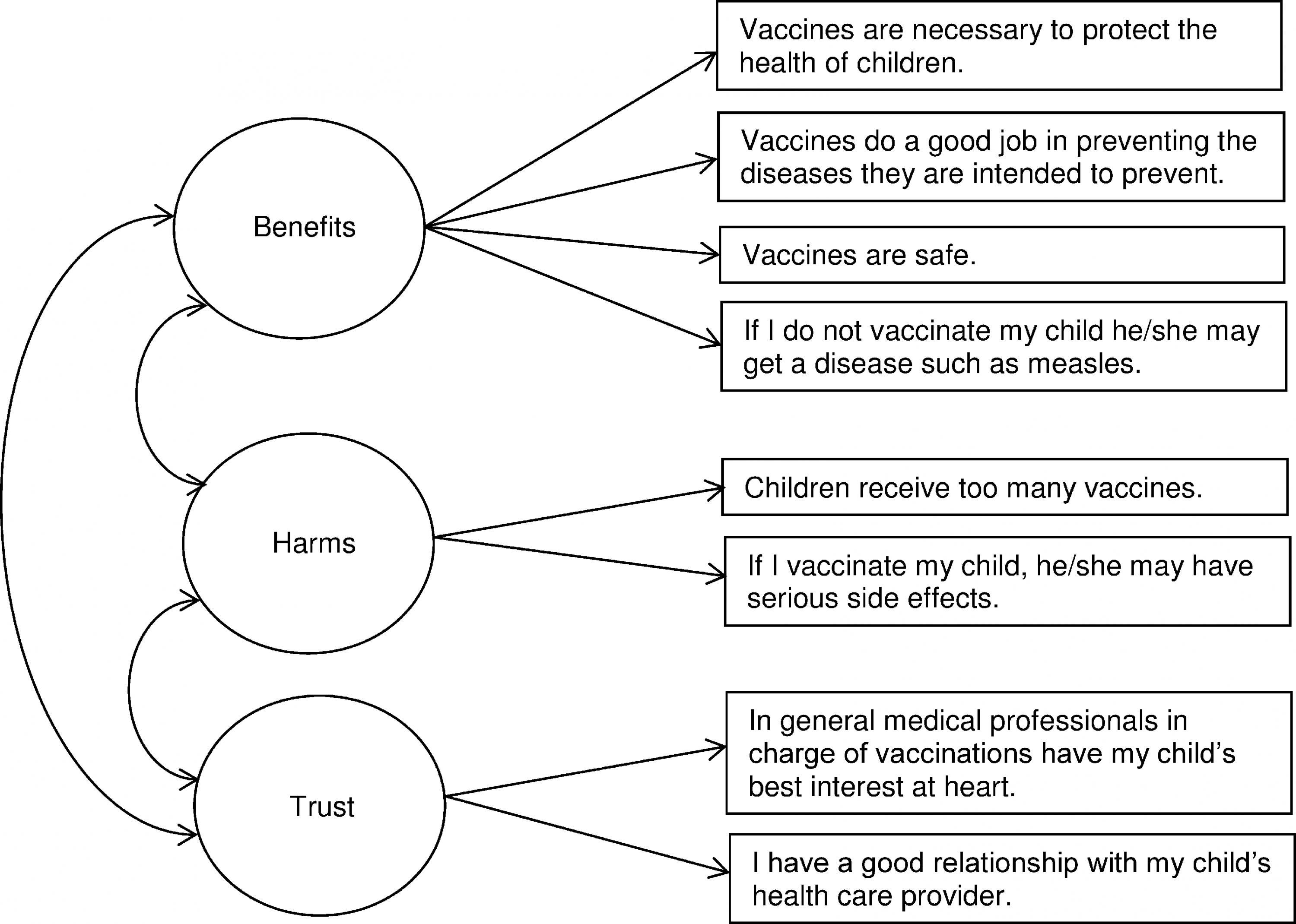
The Vaccination Confidence Scale is an 8-item, 3-factor scale that measures beliefs related to the perceived benefits of vaccination, the perceived harms of vaccination, and trust in vaccine providers. Originally created to assess parental beliefs related to adolescent vaccination, the scale was found in a prior study to be useful in understanding vaccine refusal and vaccination status for vaccines in the adolescent platform. In this second validation study of the scale, the researchers used data from a nationally representative sample of United States (US) parents to assess associations between vaccination confidence and vaccine refusal, vaccine delay, and vaccination status for vaccines administered in early childhood. The goal is to support ongoing efforts to understand and increase the public's vaccination confidence so as to reduce vaccine refusal and delay across the life course.
Figure 1 in the article displays the scale, which includes: Benefits, Harms, and Trust. The 8 items include: (i) vaccines are necessary to protect the health of children (benefits); (ii) vaccines do a good job in preventing the diseases they are intended to prevent (benefits); (iii) vaccines are safe (benefits); (iv) if I do not vaccinate my child, he/she may get a disease such as measles (benefits); (v) children receive too many vaccines (harms); (vi) if I vaccinate my child, he/she may have serious side effects (harms); (vii) in general, medical professionals in charge of vaccinations have my child's best interest at heart (trust); (viii) I have a good relationship with my child's health care provider (trust).
Data came from 9,354 parents who had participated in the 2011 National Immunization Survey (NIS). The scale consisted of factors assessing perceived benefits of vaccination (i.e., "Benefits", α = 0.78), perceived harms ("Harms", α = 0.56), and trust in healthcare providers ("Trust", α = 0.55). Parents reported on the immunisation history of a 19- to 35-month-old child in their households. Healthcare providers then verified children's vaccination status for vaccines including measles, mumps, and rubella (MMR), varicella, and seasonal flu. The researchers used separate multivariable logistic regression models to assess associations between parents' mean scores on the 8-item Vaccination Confidence Scale and vaccine refusal, vaccine delay, and vaccination status.
A substantial minority of parents reported a history of vaccine refusal (15%) or delay (27%). Vaccination confidence was consistently associated with behaviours related to early childhood vaccination. That is, vaccination confidence was positively associated with having received vaccines, including MMR (odds ratio [OR] = 1.53, 95% confidence interval [CI], 1.40-1.68), varicella (OR = 1.54, 95% CI, 1.42-1.66), and flu vaccines (OR = 1.32, 95% CI, 1.23-1.42). Mean scores on the Vaccination Confidence Scale were most strongly associated with measures of vaccine refusal, with each one-point increase in mean scale scores corresponding with a reduction in the odds of refusal ranging from 42% for any vaccine to 61% for MMR. Specifically, vaccination confidence was negatively associated with refusal of any vaccine (OR = 0.58, 95% CI, 0.54-0.63), as well as refusal of MMR, varicella, and flu vaccines specifically.
In addition to vaccine refusal, the researchers found that vaccination confidence was consistently associated with measures of vaccine delay and vaccination status. Each one-point increase in mean scale scores was associated with a reduction in the odds of delay, ranging from 19% for any vaccine (OR = 0.81, 95% CI, 0.76-0.86) to 33% for varicella vaccine.
When the researchers examined the performance of individual factors within the scale, they found that, across measures of refusal, delay, and vaccination status, the Benefits factor was most strongly associated with vaccination behaviour. The Harms factor was also associated with these measures, although somewhat less strongly. These findings are consistent with literature on the Health Belief Model, which documents the influence of perceived risks and benefits on vaccination behaviour. In contrast to Benefits and Harms, the Trust factor was associated with only 3 measures of vaccination behaviour, and in 2 instances, these associations were not in the expected direction. Given the extent to which prior research has emphasised the importance of the parent-provider relationship in parents' vaccine-related decision making, these findings could reflect shortcomings in the measure of trust. For example, the measure was specific to healthcare providers; trust in other entities, such as pharmaceutical companies or governmental bodies, may also be relevant, as well as trust in vaccines themselves.
In conclusion, this study "suggests considerable promise for using the Vaccination Confidence Scale as a brief measure of vaccination beliefs relevant to vaccine hesitancy. In this way, our scale can offer a measurement tool to support public health efforts to build parents' confidence in immunization programs so as to protect individuals and communities from vaccine preventable diseases."
PLoS ONE 11(7): e0159087. doi:10.1371/journal.pone.0159087
- Log in to post comments