










































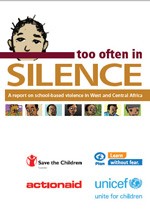
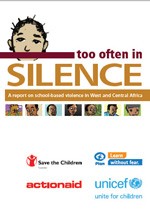
Too Often in Silence: A Report on School-based Violence in West and Central Africa
Education for Change Ltd.
This joint report by Plan, ActionAid, Save the Children Sweden, and the United Nations Children's Fund (UNICEF) looks at school-based violence, such as corporal punishment, sexual violence, and bullying, in West and Central Africa. Aimed at policymakers, education and child protection programmers, as well as educators, children, and communities, the report looks at the context and causes of violence in and around schools, its nature, and its impact on students - and, more broadly, on communities and nations. It also synthesises evidence on the prevalence, frequency, and intensity of school-based violence and proposes key actions to tackle the problem.
As stated in the report, school-based violence is not a problem confined to schools but is, rather, a complex, multifaceted societal issue. Schools are social spaces within which the power relationships, domination, and discrimination practices of the community and wider society are reflected. Violence against children in schools is linked to socio-cultural traditions, political agendas, the weaknesses of education systems, community practices, and global macroeconomics. Conditional aid flows, as well as internal efficiency in education expenditure, have an impact on national education systems and can result in insufficient recruitment of teachers and cuts in teacher training budgets.
According to the report, in West and Central Africa, children can be exposed to successive or concurrent forms of violence throughout their schooling. Evidence shows that corporal and degrading punishment is widespread in most countries of the region. Degrading by nature, corporal punishment encompasses: the use of sticks, whips, belts, or any other objects; blows to the head; slaps; boxing of ears; and enforcing uncomfortable positions such as kneeling. Verbal insults and threats are other forms of degrading punishment.
Sexual abuse (sexual violence perpetrated by taking advantage of a situation of superiority) and sexual exploitation (sexual abuse with resultant economic, social, or political gain) are also widespread forms of violence in and around schools across the region. Sexual abuse happens in schools (toilets, classrooms, staffrooms), on the way to/from school, and in teachers' houses. All available studies in the region confirm that sexual abuse is perpetrated mostly by men - be they teachers or school staff, other men from the community (young men, soldiers at check points, bus drivers, sugar daddies), or male students.
Studies suggest that other forms of violence are also prevalent in the region. Psychological violence is not systematically documented, but there are reports of threats and public shaming in school practices. Boys and girls are also affected by the phenomenon of bullying. Physical fights are often cited as the most common form of violence in schools, in particular at the primary level. Evidence from Togo, Liberia, and Ghana shows the prevalence of obligatory chores (boys working in teachers' farms or girls undertaking domestic chores in teachers' houses), which increase children's vulnerability to other forms of violence and reduce the time children can dedicate to learning, resting, or recreation.
The report also looks at the impact of school-based violence, stating that it denies children's education rights in West and Central Africa. It denies their right to access (or remain in) education, it negates their right to an education of quality, and it denies their right to respect and non-discrimination in school. This is illustrated by the levels of school drop-out that are directly linked to school violence, particularly among girls.
In addition, evidence from Nigeria, Senegal, and Benin shows that beaten children and child victims of sexual abuse tend to be absent from schools, participate less in class, and perform poorly. The denial of children's right to education impacts upon their current and future ability to participate socially and economically in their society. Limited employment opportunities, poor health, and illiteracy can be direct or indirect consequences of school-based violence.
Although countries in West and Central Africa have ratified international instruments that protect children's rights to non-violent education (United Nations (UN) Convention on Elimination of all forms of Discrimination Against Women, UN Convention on the Rights of the Child, African Charter on the Rights and Welfare of the Child), national provisions to fulfil these rights are often inadequate. This is due to both international and national constraints. Many countries in the region have suffered from the negative impact of regulations around aid flows, resulting in insufficient recruitment of qualified teachers to support quality education. More than a million primary school teachers are needed in Sub-Saharan Africa to reach the Education for All (EFA) goals by 2015. It is also due to national constraints such as the lack of political will to address the issue of school-based violence, the lack of legislation enforcement, and weak institutional and coordination capacities. Although Professional Codes of Conduct and school regulations and procedures are being developed at national and school level, poor dissemination and lack of awareness limit their potential impact on the reduction and response to school-based violence.
As stated in the report, schools are a unique entry point to holistically address the issue of violence against children. By bringing education and national child protection systems together, response to school-based violence and education outcomes can be dramatically improved.
The report offers the following recommendations which are communication related:
Recommendations for governments:
- enforce and harmonise legislation and policies for the protection of children and the prosecution of perpetrators, and improve cross-sectoral and cross-ministerial coordination to increase violence prevention and response; and
- increase the evidence base to inform policies by establishing a centralised mechanism to record, report, and monitor violence in and around all types of education institutions.
Recommendations for development agencies and non-governmental organisations:
- support and engage with all duty bearers to meet their obligations to prevent and protect children and communities from violence.
Recommendations for teacher corps, educational staff, and unions:
- engage in discussion and mobilisation on issues related to school-based violence, including prevention of and response to violence, and link these to related professional debates around recruitment practices of non professionals in schools (contract teachers), teacher training and professional development, and conditions of service; and
- take the lead on the consultation on and the establishment of professional codes of conduct that will protect both teachers and students.
Recommendations for schools:
- develop inclusive and non-discriminatory school regulations and procedures to address staff and students' conduct and outline school-based violence prevention and response mechanisms; and
- strengthen pastoral care systems and facilitate children's participation in the reduction of school-based violence.
Recommendations for families, youth, and children:
- participate in and promote dialogue, awareness-raising campaigns, and initiatives addressing the negative social attitudes that push education staff and communities to accept or minimise the importance of school-based violence;
- engage with religious and traditional leaders to promote the virtues of a nonviolent and non-discriminatory educational environment;
- support capacity development projects aimed at helping children and young people to advocate and take action against violence against children - both in and outside schools;
- participate in monitoring of violations of children's rights and promote existing response and assistance mechanisms within and outside schools.
For more information, contact:
Abdoulaziz Faye
Plan West Africa Regional Office
abdoulaziz.faye@plan-international.org
Plan International website on November 2 2010.
- Log in to post comments