










































Thinking Out-of-Box in Addressing Communication and Service Delivery Challenges: Use of a Traditional Communication Method for Improving Immunization Coverage in Remote Rural Hard-to-Reach Areas of India
Affiliation
John Snow Inc., or JSI (Hossain, Steinglass, Castro, Shimp); JSI India Private Limited, or JSI PL (Ganguli, Thakur, Bagchi, Bhargava)
Date
Summary
"We saw the crowd of mothers going to the vaccination sites with the sound of drum beating that we did not see before." - community leader of Rajpura block
Providing immunisation services and communication with caregivers has been challenging in Sirmaur, a largely mountainous, remote rural district in the state of Himachal Pradesh, India. As a result, children often missed the vaccination sessions and/or were not vaccinated on time as per the Universal Immunization Programme (UIP) recommended schedule. This paper describes the participatory development and implementation of a coordinated service delivery approach along with an alternative communication method - traditional drum beating - to reach caregivers in order to improve immunisation coverage.
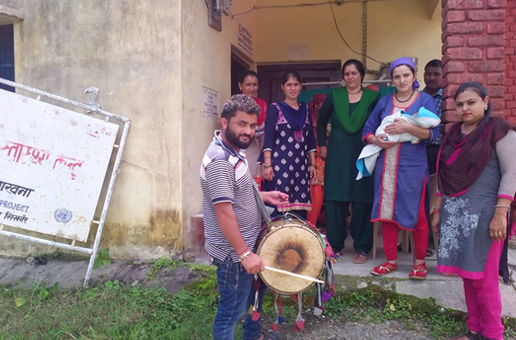
In consultation with the district health administration, a framework was designed and tailored to address barriers to immunisation services and was implemented with support of the local community leaders in two blocks of the Sirmaur district (Rajpura and Shillai). The framework included various stakeholders (vaccinators, community mobilisers, caregivers, and children) and their respective challenges/barriers in providing, communicating, and receiving immunisation services. A key strategy for addressing these barriers was use of a double-sided drum locally known as Dhol, which is an integral part of Indian culture used during religious rituals, local festivals, marriage, and other important community events. In the hilly areas, the sound of Dhol travels a long distance to all the scattered houses across the village.
As reported here, the initiative involved defined roles of all stakeholders responsible for the children's vaccination. For example, the health workers needed to update the routine immunisation micro-plans and tag drum beaters with each of the vaccination sites so that the drum beaters knew where to go and when for drum beating. The community mobilisers needed to reach the local community leaders to inform the people about the drum beating as a new method of informing people about the vaccination sessions. The local community leaders supported in selecting the drum beaters (9 drumbeaters in Rajpura and 6 drumbeaters in Shillai). The drumbeaters needed to beat the drum in the catchment areas of the vaccination sites one day before the session day and on the day of the vaccination session. (Each drummer received 700 Rupees (8.5 dollars) for each day of drum beating work.) When the caregivers heard drum beating, they needed to bring their children to the session sites for vaccination.
Analysis of immunisation data from baseline and end line surveys showed improvement in age-appropriate vaccination coverage for all vaccines in Rajpura (by 2.2% for Bacille Calmette-Guérin (BCG), 15.3% for Pentavalent 1, 14.9% for Pentavalent 2, 14.1% for Pentavalent 3, and 6.5% for Measles/MR). In Shillai, age-appropriate vaccination coverage improved for Pentavalent 1 (by 3.4%), Pentavalent 2 (by 5%) and Measles/MR (by 1.7%). In addition, dropout rates were reduced in both the blocks - in particular, in Rajpura, Pentavalent 1 to Measles dropout rate was reduced by 13.5%.
Analysis of exit interviews data indicated that more than 97% of caregivers in Rajpura and 100% in Shillai heard the drum beating, and almost 95% of caregivers in Rajpura and 98% in Shillai knew the purpose of drum beating. Both health workers and community leaders had positive perceptions of the drum beating initiative.
However, a key lesson learned from the initiative was that both access- and demand-side barriers need to be addressed for the desired improvement of age-appropriate immunisation coverage. In Shillai, there was lower coverage improvement and a reduction in dropout rates attributed to vacant positions of vaccinators that caused an issue with access to immunisation services to people.
In conclusion, drum beating was found to be "a useful alternative communication method to inform the caregivers residing in the remote hilly terrain, where the community mobilizers had challenges with in-person visits to send the caregivers to vaccination sites for vaccinating children. It was a perfect solution to overcome the barriers to reaching the caregivers through the usual house-to-house visits. It was locally available, culturally acceptable, easily implementable, and a highly effective communication method....It was affordable and the district was able to sustain using the method with their own resources and planned to scale it up in other blocks of Sirmaur district. It contributed to increasing age-appropriate vaccination coverage and reducing dropout rates. The use of a high-tech method of communication such as a mobile phone could be challenging in Sirmaur district due to connectivity, logistical, and financial issues."
Providing immunisation services and communication with caregivers has been challenging in Sirmaur, a largely mountainous, remote rural district in the state of Himachal Pradesh, India. As a result, children often missed the vaccination sessions and/or were not vaccinated on time as per the Universal Immunization Programme (UIP) recommended schedule. This paper describes the participatory development and implementation of a coordinated service delivery approach along with an alternative communication method - traditional drum beating - to reach caregivers in order to improve immunisation coverage.
In consultation with the district health administration, a framework was designed and tailored to address barriers to immunisation services and was implemented with support of the local community leaders in two blocks of the Sirmaur district (Rajpura and Shillai). The framework included various stakeholders (vaccinators, community mobilisers, caregivers, and children) and their respective challenges/barriers in providing, communicating, and receiving immunisation services. A key strategy for addressing these barriers was use of a double-sided drum locally known as Dhol, which is an integral part of Indian culture used during religious rituals, local festivals, marriage, and other important community events. In the hilly areas, the sound of Dhol travels a long distance to all the scattered houses across the village.
As reported here, the initiative involved defined roles of all stakeholders responsible for the children's vaccination. For example, the health workers needed to update the routine immunisation micro-plans and tag drum beaters with each of the vaccination sites so that the drum beaters knew where to go and when for drum beating. The community mobilisers needed to reach the local community leaders to inform the people about the drum beating as a new method of informing people about the vaccination sessions. The local community leaders supported in selecting the drum beaters (9 drumbeaters in Rajpura and 6 drumbeaters in Shillai). The drumbeaters needed to beat the drum in the catchment areas of the vaccination sites one day before the session day and on the day of the vaccination session. (Each drummer received 700 Rupees (8.5 dollars) for each day of drum beating work.) When the caregivers heard drum beating, they needed to bring their children to the session sites for vaccination.
Analysis of immunisation data from baseline and end line surveys showed improvement in age-appropriate vaccination coverage for all vaccines in Rajpura (by 2.2% for Bacille Calmette-Guérin (BCG), 15.3% for Pentavalent 1, 14.9% for Pentavalent 2, 14.1% for Pentavalent 3, and 6.5% for Measles/MR). In Shillai, age-appropriate vaccination coverage improved for Pentavalent 1 (by 3.4%), Pentavalent 2 (by 5%) and Measles/MR (by 1.7%). In addition, dropout rates were reduced in both the blocks - in particular, in Rajpura, Pentavalent 1 to Measles dropout rate was reduced by 13.5%.
Analysis of exit interviews data indicated that more than 97% of caregivers in Rajpura and 100% in Shillai heard the drum beating, and almost 95% of caregivers in Rajpura and 98% in Shillai knew the purpose of drum beating. Both health workers and community leaders had positive perceptions of the drum beating initiative.
However, a key lesson learned from the initiative was that both access- and demand-side barriers need to be addressed for the desired improvement of age-appropriate immunisation coverage. In Shillai, there was lower coverage improvement and a reduction in dropout rates attributed to vacant positions of vaccinators that caused an issue with access to immunisation services to people.
In conclusion, drum beating was found to be "a useful alternative communication method to inform the caregivers residing in the remote hilly terrain, where the community mobilizers had challenges with in-person visits to send the caregivers to vaccination sites for vaccinating children. It was a perfect solution to overcome the barriers to reaching the caregivers through the usual house-to-house visits. It was locally available, culturally acceptable, easily implementable, and a highly effective communication method....It was affordable and the district was able to sustain using the method with their own resources and planned to scale it up in other blocks of Sirmaur district. It contributed to increasing age-appropriate vaccination coverage and reducing dropout rates. The use of a high-tech method of communication such as a mobile phone could be challenging in Sirmaur district due to connectivity, logistical, and financial issues."
Source
World Journal of Vaccines 13, 1-12. https://doi.org/10.4236/wjv.2023.131001. Image credit: JSI
- Log in to post comments