










































Thematic Review: Community Based Awareness, Attitudes and Behaviour
"This paper [from Girls' Education Challenge] gives an overview of the evidence around the influence of community attitudes, including the GEC baseline findings..., and maps the approaches used by GEC projects to influence attitudes and behaviours in support of girls' education."
The Girls’ Education Challenge (GEC) was set up to support improved attendance and learning for marginalised girls as well as develop an evidence base on what works in girls' education. The paper is part of a series of thematic reviews "produced by the Fund Manager of the Girls’ Education Challenge, an alliance led by PwC, working with organisations including FHI 360, Nathan Associates and Social Development Direct." [See the end of the summary for more overall evidence on girls' education.]
The primary barrier to children being in school was found to be poverty; thus, attitudes affecting girls' education are related to a "perceived or actual low return for the family" rather than a lack of support for girls’ education. Gender-specific barriers stem from norms and attitudes in the home and the community held by parents/guardians, family members, and other community members. Therefore, working on attitudes of support is the purpose of social change for individuals, households, peers, networks, the community, and institutions.
The paper examines GEC projects that raised awareness and identified hindering attitudes and behaviours, including prioritisation of boys' education, low aspirations for girls, traditional beliefs that limit girls' educational eligibility, and exclusion of particular groups such as disabled girls. "Projects have sought to achieve change through a range of interventions including media activities; working with faith-based groups and traditional leaders; involving men and boys; holding community meetings; providing adult literacy interventions; conducting household-level visits and support; and implementing activities involving women’s and parents’ groups."
There are several key considerations for practitioners and policy makers in light of the literature and GEC findings; projects implementing community interventions should target the most prevalent and relevant attitudes and behaviours rather than generic ones, and projects should be prepared to adapt activities where required, recognising that norms are affected by changes in context and power dynamics.
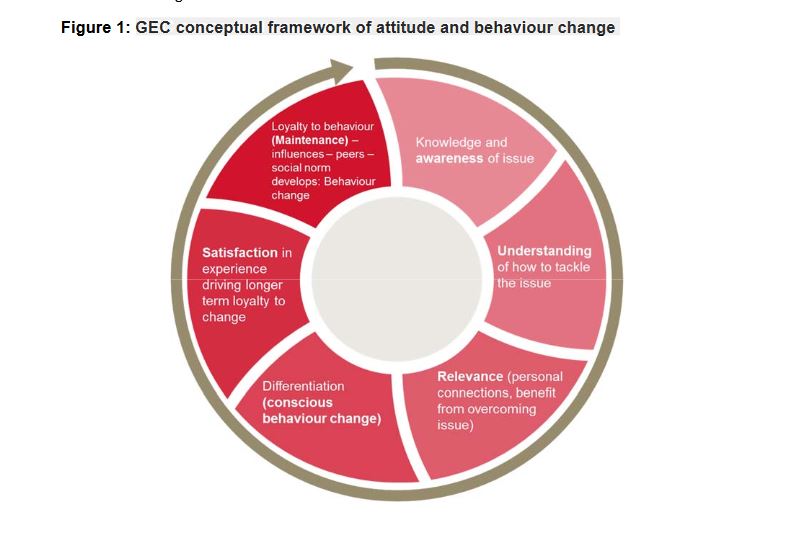
GEC conceptual framework of attitude and behaviour change related to an issue such as girls' education, pictured above and on page 8 of the document, includes the stages of: awareness, understanding, relevance, differentiation, satisfaction, and maintenance. Media methods, including radio and television dramas featuring sympathetic characters who provide new factual information on the issue, as well as community dialogue-based events to create spaces for reflection about key issues, are cited as best practices, especially when coupled with community mobilisation. Community meetings, especially with community change agents,that include dialogue about how others have changed their attitudes, increase understanding about the negative impacts of existing norms and can "address fears around engaging in a new practice, and support communities in bringing about collective change." Programmes on gender equality involving boys and men as 'gatekeepers' have not been sufficiently evaluated. Engagement with faith communities has not been well documented. Mothers' attitudes towards their children’s education improve when literacy is available to adults as a community-wide project. Literacy studies help parents engage in school committee activities, which supports their children's education. Household visits by school or community staff or volunteers help with engagement in children's education. More research is needed on engagement levels and attitude change.
Of 31 GEC community engagement projects, two were in fragile states of Afghanistan and Somalia. Key findings include the following:
- Attitude and behaviour change interventions and improved attendance and learning, though more research is needed to establish direct causal links.
- Effective strategies used multiple components and worked in the communities at different levels.
- "Specific measures of behaviours and attitudes are key to link activities to outcomes."
Four lessons are:
- "A shift in community perceptions is needed to promote gender equality in education as well as increasing support for better quality of education overall."
- "Working with key stakeholders as champions early on can increase buy-in for interventions, with promising results."
- "Attitudes and behaviours related to girls’ education were more complex than anticipated ."
- "Adaptive programming is important in order to respond to emerging challenges."
"Overall across a number of GEC projects, evidence was found of communities' motivation, investment and commitment to educate their children, for example donating land, raising funds for bursaries and increasing their workload to pay for school fees. In general, GEC projects have not found communities are opposed to the principle of girls’ education, but that their support interacts with other norms that can make it harder for girls to attend school and learn. In particular, there is a perceived (or actual) low return for the family as the investment is sometimes considered to be lost when girls get married."
C4D Network website, May 5 2019.