










































Soul Buddyz - Tomorrow Is Ours: Evaluation Report 2008
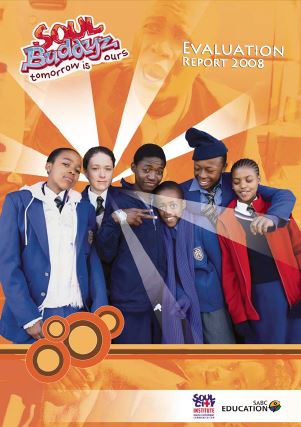
This report presents an independent evaluation of Soul Buddyz, a multi-media intervention designed for children aged 8 to 14 in South Africa. An initiative of the Soul City Institute for Health and Development Communication (IHDC), in partnership with the South African Broadcasting Corporation (SABC), Soul Buddyz aims to focus on the promotion of children's well-being through the provision of health information and skills to lead healthy lives, especially those which relate to HIV and AIDS and sexuality. According to the evaluation, conducted in 2006, Soul Buddyz was successful in achieving its primary intended outcome most relevant to HIV and AIDS, which was decreasing the stigma related to the disease and increasing knowledge of basic facts.
Components of the Soul Buddyz intervention include: a television drama, "Soul Buddyz Television"; a radio intervention, "Soul Buddyz Radio", consisting of drama and interactive talk between children and adults; and a "Lifeskills Booklet" for Grade 7. In addition, there is a face-to-face intervention called Soul Buddyz Clubs, which is implemented in primary schools in collaboration with the Department of Education. The intervention also includes a reality television programme, "Buddyz on the Move", which showcases Soul Buddyz Club activities. Complementary materials and messaging for parents and caregivers of children are also part of the intervention.
Interviews were conducted with a sample of 1,500 children aged 8-15 across the country, in a nationally representative sample. The evaluation aimed to provide answers to the following key questions: How many young people were exposed to the various components of the Soul Buddyz intervention? For example, how many watched the Soul Buddyz television programme, and what was the profile of the audience? Was the intervention effective in achieving its aims related to HIV and AIDS?
The research included both urban and rural areas. Children were interviewed and asked about their knowledge, attitudes, and behaviours, regardless of whether they had been exposed to Soul Buddyz or not. Through comparing attitudes and behaviours between those who had been exposed with those who were not, changes attributable to Soul Buddyz could be measured. Data were analysed using propensity score analysis, which in effect creates a randomised control trial statistically controlling for variables which may also be related to outcomes such as age, education, and place of dwelling.
The findings indicate that Soul Buddyz has achieved its aim of continuing to be an initiative that is popular amongst all race groups and across all ages of children. Some 82% of children in the 8-15 age group reported having watched Soul Buddyz TV. Some 63% reported having watched Buddyz on the Move. Soul Buddyz Radio achieved lower reach, with 32% of children in the 8-15 year age group reporting having listened (although, evaluators stress, this is still substantial, given that fewer children listen to radio). Approximately 45% of children have heard of Soul Buddyz Clubs, while 6% of children reported ever being members. The Grade 7 Lifeskills Booklet, designed to be a user-friendly information and activity resource for Grade 7 learners in South Africa, was reportedly used by close to 50% of children in the intended age group.
The research showed that Soul Buddyz appears to appeal to both boys and girls with no significant differences in reach. Reach of Soul Buddyz is good in both rural and urban areas, but higher among urban children. According to the report, it is highly significant that all racial groups in South Africa watched Soul Buddyz. Some 84% of Black African children and 83% of Asian children had watched Soul Buddyz TV, compared to 75% and 76% of Coloured and White children, respectively. To have established a series that appeals across race groups is, according to evaluators, a significant achievement in South Africa.
Among those who had ever watched Soul Buddyz, some 56% of children had watched 9 or more of the 13 episodes that were screened. As a percentage of the population, some 42% of the total national population of 8-15 year olds watched more than two-thirds of the episodes that were broadcast. This indicates significant audience loyalty to the programme.
The evaluation showed that Soul Buddyz was successful in fostering positive attitudes towards people living with HIV and AIDS. For example:
- Some 62% of those exposed to Soul Buddyz TV, compared to 44% of those in the matched control group, disagreed with the statement that "it would be foolish to marry a person who is HIV positive" - an 18% attributable difference.
- Exposure to Soul Buddyz TV was associated with an 18% increase in willingness to disclose the HIV-positive status of a family member; 57% of those exposed disagreed that they would keep the HIV positive status of their family a secret, compared to 39% in the matched control group.
- Some 88% of those who were exposed to Soul Buddyz TV, compared to 77% in the matched control group, indicated their willingness to be friends with someone who is HIV-positive.
Despite the fact that many children already knew some of the basic facts about how HIV is transmitted and how to protect oneself from infection, the research shows that Soul Buddyz was successful in achieving measurable increases in knowledge on the measures surveyed.
- 84% of children who watched Soul Buddyz Television agreed with the statement "people with HIV can look healthy", compared to 79% in the matched control group - a 5-percentage-point difference attributable to the impact of the Series.
- 89% of children who had read the Grade 7 Booklet disagreed with the statement "you can get HIV by sharing food/cups and plates with someone living with HIV", compared to 72% in the matched control group - a 17% difference attributable to this booklet.
- 93% of children who had read the Grade 7 Booklet agreed that "it is true that HIV can be prevented by using condoms", compared to 76% in the matched control group - a 16% difference attributable to this intervention.
- 75% of children who read the Grade 7 Booklet agreed that you can reduce the risk of HIV by having fewer sexual partners, compared to 61% in the matched control group - a 14% difference.
Across all the knowledge items, exposure to the Grade 7 Booklet was consistently more strongly associated with improvements in knowledge than the other Soul Buddyz interventions. According to the report, this attests to the importance of this intervention in supporting the other components of Soul Buddyz.
The report also shows that the Soul Buddyz interventions were successful in increasing knowledge of antiretrovirals (ARVs) amongst children - this is important, evaluators note, to allay children's unnecessary fears about the drugs and to help them have realistic expectations about treatment, as more families have access to these drugs.
- 74% of children exposed to Soul Buddyz Television said that they had heard of ARVs, compared to 57% in a matched control group - a 17% attributable difference.
- 86% of children exposed to the Grade 7 Booklet were able to correctly say that there is no cure for AIDS, compared to 80% of those in a matched control group - a 6% attributable increase.
Soul City website on October 15 2008.