










































The Right to Learn: Community Participation in Improving Learning
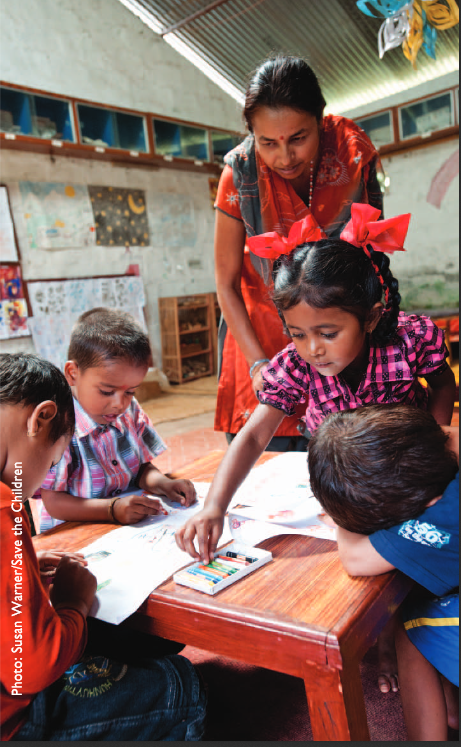
Save the Children
"Changing our education systems and engendering a paradigm shift is not the work of the education ministry or even the government alone; it involves every one of us - parents, teachers, students, and civil society." - Dr. Ngozi Okonjo-Iweala, Co-ordinating Minister for the Economy and Minister of Finance, Federal Republic of Nigeria
Drawing on case studies from national civil society organisations across 7 countries and original research from "Young Lives" in Andhra Pradesh, India, this report "demonstrates how communities, and in particular parents, have the potential to drive change and improve learning outcomes for their children". Contributions from 5 civil society organisations highlight "effective approaches to empower parents and communities to demand change in the face of poor quality schooling and poor learning outcomes." The report comes on the heels of the 2015 deadline for the Millennium Development Goals (MDGs) and the Education for All (EFA) targets, yet "250 million children - or around 40 percent of all primary school age children in the world - either never enroll in school, fail to make it to the fourth year of their education or, if they do manage this, are not learning to read even basic sentences..." A key guiding principle behind this report is that the "impact of education cannot be measured in the number of students enrolled, or the number of hours in a classroom. It must be measured in the mastery of knowledge and skills that are relevant to the lives of students."
While Save the Children notes that parents and other caregivers are the focus of this report, the organisation also recognises the "important role of other local stakeholders, such as teachers and students, in increasing accountability for quality education for all."
Chapter 1 draws on findings from interviews with 30 parents of children aged 9-10 in 3 areas of in Andhra Pradesh, India, where gains in enrollment have been met with declining levels of learning. It "highlights the unique role those so closely connected to the school can play in transforming the learning experience for their children." One conclusion: "it is essential that parents are encouraged and supported to channel the dissatisfaction they often feel towards education providers into demanding change in those aspects of provision that matter most, such as learning outcomes and teaching quality, including teacher accountability. Local level accountability can play a critically important role in driving improvements in education provision." Chapter 2 uses the findings from those interviews to illustrate some of the barriers parents experience in holding education providers to account. One suggestion is to ensure that parents know they have the right to monitor schools against a set of minimum standards with regards to quality.
Chapters 3-7 are written by local civil society organisations that are working with parents and other stakeholders to increase accountability for learning opportunities and outcomes. They include: from Southern Africa (Equal Education), Eastern Africa (Uwezo), India (Annual Status of Education Report (ASER)-India), Pakistan (ASER-Pakistan), and Brazil (Ação Educativa in Brazil). For example: "The Uwezo initiative aims to draw public attention to educational challenges by researching and reporting on actual learning levels of children living in East Africa. Inspired by the Annual Status of Education Report established by Pratham, one of India's biggest NGOs [non-governmental organisations], the Uwezo approach is simple. Uwezo conducts annual household assessments of basic literacy and numeracy levels in Kenya, Tanzania, and Uganda. The tests are based on the Class [Grade] 2 curriculum expectations of each country. Every year, Uwezo partners with over 350 local organizations to mobilize and train over 22,000 citizens to conduct the survey. In 2012, the Uwezo army of citizen volunteers assessed a total of 343,104 children in 124,627 households across 362 districts in East Africa. The annual assessments collect data that, once analyzed and shared, is used to promote countrywide conversations and debates about learning. It is the hope of Uwezo that these conversations and debates will eventually spur citizens to act in order to improve the quality of education in their local communities."
Text boxes throughout those chapters stress communication strategies such as the participation of children. For instance, Ação Educativa notes that it values the input of students in the process of collecting indicators under the Quality Indicators in Education. The organisation has developed particular strategies to ensure their participation, including: facilitating conversations during school time; working with students both individually and in groups, drawing on the key themes and areas of concern to ensure every student can participate; and using resources to help students communicate day-to-day issues at school. Ação Educativa has also used drama forms, such as role play and short theatrical sketches, to foster student participation.
Chapter 8 draws on these examples to identify a number of lessons for enhancing accountability of governments and schools to parents. Common themes from the case studies include:
- Foster the engagement and participation of ordinary citizens, including the most marginalised - "The campaigns supported by Equal Education demonstrate how collective action from all stakeholders can have greater impact on the rate and level of change. The following examples [see text boxes beginning on page 36] demonstrate, through country examples of work done by Save the Children staff and partners in India, Nigeria, and Nepal, how to encourage and foster the participation of multiple stakeholders".
- Agree on minimum standards - "Human rights frameworks provide a useful starting point...".
- Collect and communicate local data "to genuinely inform and empower" - "Firstly, engaging communities, including the most marginalized, in data collection is critical to building community ownership of the issues. Secondly, information on its own is insufficient: the organizations highlighted in this report are assiduous in their analysis and presentation of the data....Thirdly, the more accurate and transparent the data collection processes and communication the more likely communities and government officials will engage, thus strengthening the impact of civil society actions. Fourthly, the collection and use of data should be linked to a clear strategy for achieving change. Local civil society organizations play an important role in working with parents and communities to elaborate and monitor such strategies."
- Empower communities to create their own solutions to local issues and acknowledge their roles in improving learning - For example, "ASER-India noticed that illiterate parents, in particular, had difficulty in seeing how they could make a difference. After careful research and through lessons learned, ASER began to break down the barriers felt by illiterate mothers. Parents were encouraged to become more engaged in their children's learning through a variety of activities such as looking through notebooks, 'reading' picture books and cards, and going to school to ask the teachers how they can help at home."
- Link local accountability to national system reform - For example, "Ação Educativa has worked to ensure its Quality Indicators of Education complement the national indicators [by] encouraging buy in and support from national level implementers and those with decision-making power."
The report concludes with a set of recommendations, such as calling on United Nations (UN) Member States to advance an equitable learning goal in the post-2015 development agenda that provides a framework for national-level targets and minimum standards for learning against which governments and education providers can be held to account. In doing so, one key suggestion is the following: "As the Open Working Group begins drafting a post-2015 goal framework and intergovernmental negotiations progress, UN Member States should ensure citizen voices from the Global South - especially civil society - inform the process..."
Save the Children's Resource Centre, accessed December 12 2014. Image credit: Susan Warner/Save the Children