










































Radio Instruction to Strengthen Education (RISE) Project
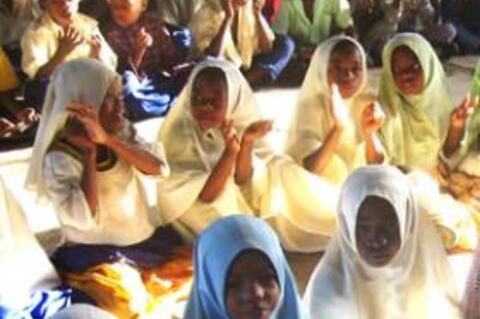
The Mambo Elimu IRI curriculum included 400 radio lessons for grades 1-4 in Swahili, mathematics, English, science, social studies, and life skills. These were broadcast daily in order to provide an accelerated programme. The Tucheze Tujinfunze IRI curriculum included 78 radio lessons for pre-primary and 99 lessons for Standard 1 in Swahili, mathematics, ecology, and essential life skills. These were broadcast three times a week. Along with the lessons and daily broadcasts, EDC provided solar-powered radios, blackboards, print materials, and trainings for mentors.
A typical day at a Mambo Elimu centre began with the radio programme introducing the day's activities to an average of 40 children. Each radio segment offered a mix of stories, games, activities, and songs presented by an engaging cast of characters. In addition to the learning activities for students, each programme provided support and training for an onsite mentor by outlining the learning objectives for the day. Mentors were guided through the active, child-centred learning methods, which were often new to them. After each broadcast, the mentor turned to a printed guide to lead the children through additional lessons and practice periods. The lessons were designed to provide an active, group-learning approach that emphasised gender equity. In addition, efforts were made to feature locally developed materials. The lessons lasted up to three hours in total. For the younger children attending Tucheze Tujifunze, classes averaged 25 students. The day was shorter, and centres were provided with "Play to Learn" kits that included locally developed educational materials and stories.
In seven districts, RISE expanded the reach of Mambo Elimu to reach children who previously did not have access to school. RISE established 100 Mambo Elimu Community Learning Centers and provided materials and training to 100 mentors to facilitate the accelerated 4-year programme of primary education over the course of two calendar years, thus enabling these children to join their peers in formal primary school for Grade 5. The programme reaches 4,500 children annually.
Education, Health, HIV/AIDS, Early Childhood Development, Children, Youth.
In Tanzania, half the population is living in extreme poverty. Rural areas are particularly hard hit, with up to 5 million children out of school.
According to 2005 exam scores from districts where Mambo Elimu was piloted from 2002-2006, children who participated in the non-formal, radio-based education programmes performed as well as students in the state-run public school system. Between 82% and 87% of the Mambo Elimu students passed the standard national exams, which is comparable to public school students' scores. When children complete the lessons through fourth grade, the community assists them with the transition to the formal school system or a vocational programme.
The Mambo Elimu programme was transferred to the Tanzanian government in 2006. Districts now manage Mambo Elimu Community Learning Centres, while the Tanzania Broadcasting Services and the Ministry of Education and Vocational Training collaborate to broadcast the radio series.
In Zanzibar, Tucheze Tujifunze expanded beyond pre-primary. As of May 2008, Grade one was under production, and a series for grade two was also being planned for broadcast, reaching under-served children in some of the economically poorest and most isolated communities. One hundred twenty-five new Tucheze Tujifunze Community Learning Centres in Zanzibar and an additional 100 Mambo Elimu Community Learning Centres on the Tanzanian mainland have received training, radios, and learning materials. Together, the new learning centres in Zanzibar and on the mainland intended to reach an additional 15,000 children. With 650 additional Tanzanian primary schools also receiving radios, an estimated 400,000 primary students will be able to take part in the programmes.
May 2015 update:
"With the project concluded, the governments have continued to deliver improved learning.
Zanzibar: In three districts, 9,300 children in non-formal, community-led preschool and Standard One learning centers receive math, Kiswahili, English and life skills lessons through Interactive Radio Instruction programs annually. The program trained 372 mentors, previously untrained teachers who lead quality lessons with the support of 276 locally produced IRI programs and educational play materials. The learning centers afford access to early education for children who would otherwise would likely have waited until about age 9 to enter school.
Early primary classroom teachers use IRI to reinforce government curriculum competencies and enrich learning environments for an additional 240 teachers and 10,800 children. The program reaches a total of 20,100 children.
Mainland Tanzania: The Mambo Elimu programme was transferred to the Tanzanian government in 2011. The Adult and Non Formal Education Division of the Ministry of Education and Vocational Training (MOEVT) and districts now manage Mambo Elimu Community Learning Centres, who continue accessing the audio series through solar powered mp3 technology."
The United States Agency for International Development (USAID), the Ministries of Education and Vocational Training (Tanzania and Zanzibar), Radio Tanzania, Radio Zanzibar, Freeplay Foundation.
EDC website on Sept 6 2006, April 11 2008, and May 19 2015; emails from Suzanne Simard to Soul Beat Africa on May 4 2007 and January 5 2008; and emails from Suzanne Simard to The Communication Initiative on May 20 2008 and June 1 2015.
Comments

This programme proved that distance learning is the best and cost effective, time effective and practical as formal system. Since the programme serves the marginalized youth, I suggest that it should be extended to cover the whole country and if possible shared among east African countries.
Masonga Mkoli
- Log in to post comments