










































Protecting the Rights of Children: The Role of the Media
Internews
"The research finds that a wide range of factors currently inhibit media in the three countries sampled from playing a more substantive role in promoting awareness of child rights, as well as in helping children realize their rights and in holding government accountable."
From Internews Europe, this report summarises research in Kenya, India, and Brazil "to understand how to harness the power of traditional media (TV, newspapers, and radio) and new media (Internet and mobile phones) to amplify the voices of advocates and children, improve media coverage and transform child protection." Through primary and secondary research, local researchers sought to "understand current media practices and how media intersect with youth and advocates' voices to form an 'information ecosystem' that can hinder or help child rights protection."
Part I, conducted in August 2013, focused on existing media platforms and audiences in order to identify and evaluate "the media platforms that children and youth, parents and child rights organisations, and decision- and policy-makers generally use for information sharing, education and entertainment." Part II, September 2013, assessed the media's treatment of child rights through focus groups and interviews with media professionals, including media owners and journalists. Part III, October 2013, engaged civil society organisations (CSOs) in focus groups and individual interviews "to understand how media is currently used by civil society to present information and influence the discourse on child rights; and to outline how civil society can be better supported to network with media...." Government policies were reviewed through desk research and individual interviews with government officials. And a media content analysis was done on news coverage, information, and child programming. The results of the research are presented by country.
Internews Europe recommendations address these issues "identified across the board in all three countries":
- Lack of children’s voices: exclusion of children's voices from the public debate on child rights.
- Lack of coverage: absence of "meaningful, realistic, and socially relevant" media coverage on child rights issues.
- Lack of professionalism: from journalism school to newsrooms, lack of recognition of reporting on child rights and children’s issues as a specialised field.
- Lack of media-CSO cooperation: a "high level of mistrust between the media and child rights advocates."
- Lack of rules: ethical guidelines on reporting child rights that are "little known and poorly implemented...."
Recommendations include:
1. "Create more youth journalists by training youth to produce radio programmes or run radio stations, and creating youth media bureaus/centres." Journalism and child rights clubs in schools could be trained to produce media content such as newspaper articles, and audio and visual content for radio and TV. Broadening the outreach to attract an audience for those already children already trained in journalism would deliver the voice of child-journalists beyond niche print and online platforms (such as CSO publications, newspapers’ own child supplements, small websites, or YouTube channels). Radio is recommended in Kenya; Hindi and regional language newspapers are recommended in India.
2. "Establish incentives for journalists to specialize in child rights, including:" child rights reporting modules at journalism schools, online (or classroom) professional training courses, fellowships for reporters who wish to investigate child rights violations and find it difficult to get funded for this by their own media outlets, and awards for best reporting on child rights issues.
3. "Improve CSO-media networking through workshops, networks, field visits and training": CSOs noted that increasing their own media literacy levels and those of children/youth could amplify the voices of children in the media. "It would increase their understanding of how media works, and enhance their use of platforms for advocacy and empowerment. Local CSOs running child programmes on community radio would particularly benefit from such training. It could improve their capacity on child media content production and child programming, thereby increasing the number and quality of programmes featuring child voices." Elements of intervention might be: training, field visits, and workshops by journalists; regular dialogue meetings between media and CSOs; and "the creation of institutional networks with concrete benefits to all members."
A series of child-journalist and reporter/mentoring sessions through CSOs was another recommended strategy. "CSOs also recommended the use of numerous Kenyan youth theatre groups to focus plays on child rights, and have the plays filmed/recorded and produced for radio, TV, and online platforms."
4. "Establish and monitor guidelines for reporting child rights": The joint establishment and monitoring of ethical guidelines for reporting on child rights authored by CSOs and media, based upon existing documents, and then joint monitoring of implementation, might reduce adversity from journalists.
Also recommended as useful are: capacity building for improving the use of digital/new media platforms for communicating child rights issues and the combination of media literacy training and feedback from youth audiences to journalists.
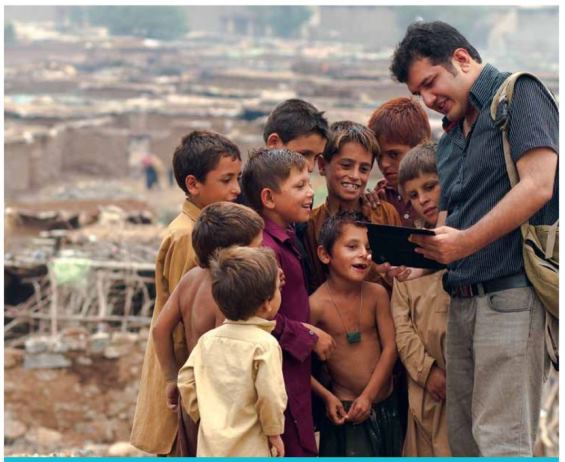
Internews website, August 4 2014. Image credit/caption: ©Internews Europe/Imran Babu - A journalist takes part in Internews training on a project to improve dialogue between citizens, media and local authorities in Pakistan, 2012.