










































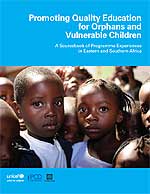
Promoting Quality Education for Orphans and Vulnerable Children: A Sourcebook of Programme Experiences in Eastern and Southern Africa
Image
SummaryText
This report, published by United Nations Girls' Education Initiative (UNGEI), documents 12 case studies in Kenya, Rwanda, Swaziland, Uganda, Tanzania, and Zambia that represent a wide range of approaches to address the educational rights and needs of orphans and vulnerable children (OVC). The cases cover an array of interventions in terms of scope, medium of delivery, and beneficiaries. According to the publishers, as the HIV and AIDS epidemic becomes increasingly complex, and as the personal and social consequences rise, the ways in which societies respond to ensure children's right to quality education must become more integrated, nuanced, and dynamic.
This Sourcebook is designed to be relevant to anyone who is seeking to launch or improve work that enables OVC to access quality education. By recording grounded experiences of interventions, it is designed to inform decision-making by those working towards the same goal, including education practitioners in formal and non-formal venues, programme managers and planners, and government policymakers. According to the publishers, the case studies highlight current innovations, draw lessons from them, and together point to future good practice.
Major lessons learned include the need for a holistic, rights-based approach and strong coordination between programme efforts and upstream policy. The document states that "as inspiring and promising as these programmes may be, the educational response to the HIV pandemic cannot be left to the will of individuals or small organisations. The response must be multi-sectoral and large scale if it is to surpass the scale of the epidemic itself." In order to accelerate momentum towards the goal of getting all children in schools of acceptable quality, responses must be gender-sensitive and systemic, and must have rigorous monitoring and evaluation mechanisms built in from the outset.
The publication points out that HIV/AIDS prevalence will also dampen the demand for schooling unless education systems can successfully accommodate the socio-emotional needs of affected children who live with the impact of the disease in their families and the additional health needs of children who are living with HIV themselves. The studies show that good interventions can be piloted and then mainstreamed throughout the country, or they can begin with upstream policy decisions. Unlike other social systems, education is in a unique position to serve not only as a protective net for these children but, done well, also as an instrument of prevention.
This Sourcebook is designed to be relevant to anyone who is seeking to launch or improve work that enables OVC to access quality education. By recording grounded experiences of interventions, it is designed to inform decision-making by those working towards the same goal, including education practitioners in formal and non-formal venues, programme managers and planners, and government policymakers. According to the publishers, the case studies highlight current innovations, draw lessons from them, and together point to future good practice.
Major lessons learned include the need for a holistic, rights-based approach and strong coordination between programme efforts and upstream policy. The document states that "as inspiring and promising as these programmes may be, the educational response to the HIV pandemic cannot be left to the will of individuals or small organisations. The response must be multi-sectoral and large scale if it is to surpass the scale of the epidemic itself." In order to accelerate momentum towards the goal of getting all children in schools of acceptable quality, responses must be gender-sensitive and systemic, and must have rigorous monitoring and evaluation mechanisms built in from the outset.
The publication points out that HIV/AIDS prevalence will also dampen the demand for schooling unless education systems can successfully accommodate the socio-emotional needs of affected children who live with the impact of the disease in their families and the additional health needs of children who are living with HIV themselves. The studies show that good interventions can be piloted and then mainstreamed throughout the country, or they can begin with upstream policy decisions. Unlike other social systems, education is in a unique position to serve not only as a protective net for these children but, done well, also as an instrument of prevention.
Publication Date
Languages
English
Number of Pages
149
Source
United Nations Girls' Education Initiative website on March 17 2010.
