










































Project Troubador
Originally founded to simply give people living in the developing world a more human and less media-based understanding of America and Americans, over the last 15 years, Project Troubador has broadened its focus to assist development initiatives and grassroots non-governmental organisations (NGOs) seeking to communicate specific information. Performances are free of charge and - as much as possible - are presented on an intimate scale in public locations where it is natural and comfortable for people to gather. On a primary level, they are intended to be enjoyable and entertaining. Laughter and song are used in an effort to allow those assembled to gain a comfort level with the performers in their midst. Once a climate of mutual trust exists, the musicians and actors introduce a representative of the partner organisation who has a more permanent presence in the community and suggest that both the performers and that organisation have "something we would like all of you to consider". Using only mime and movement with a musical underpinning, a short dramatisation illuminating a common problem or the perils of a certain behaviour ensues. At a critical point, the action "freezes" and the representative from the partner organisation queries the audience on what is happening and what might happen next.
That person seeks to initiate a dialogue with the audience which can lead to an open discussion of the targeted issue. Specific information aimed at clarifying misunderstandings and/or producing a desired behaviour is presented. At the conclusion of these discussions, the audience is encouraged to expand this dialogue with family and friends, and any information on how, when, and where they can find the representative of the partner organisation is reiterated. The performance concludes the way it began, with participatory music making and dancing, etc. that is intended to cement the warmth of the intercultural moment.
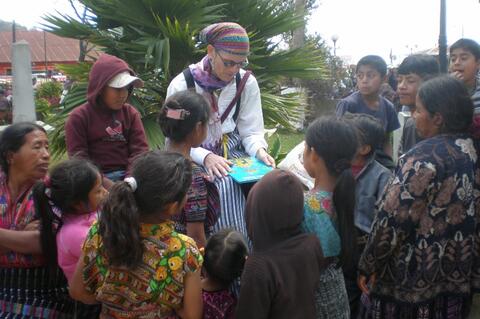
Project Troubador has employed this approach to address HIV/AIDS prevention, rain forest preservation, literacy, the building of wells, maternal-child health, and family planning. Partnering NGOs have come in all shapes and sizes, from large international efforts to small rural initiatives. In the Dominican Republic, Project Troubador conducted a series of HIV/AIDS prevention and education programmes with local HIV/AIDS educators focusing on prevention with youth in schools, universities, and sugarcane camps. In Cameroon, Project Troubador joined forces with Kongadzem, a women's tribal social action group, to address the same topic. In collaboration with Centre Afrika Obota in Benin, they performed in villages throughout the country delivering HIV prevention messages. In 2003, they returned to produce a collaborative single about "protecting oneself" (J'ai Mes Raisons) with local pop musicians and Beninian school children. During a 2009 tour in Guatemala, the troupe "enjoyed impromptu stilt performances around villages and in town squares, mostly announcing new books in the library, but also just blowing bubbles, juggling and playing with the crowds that we inevitably attracted. Sometimes in schools, libraries and community centers, we led activities such as making origami peace cranes, or drawing, or teaching English, but we always worked in the message of literacy. Our favorite work was performing skits from the books that we left in schools and libraries we visited. Most often we did a skit based on 'Tikki Tikki Tembo,' a Chinese story about a first born son who nearly drowned because his rescuing brother couldn't say his overly long name fast enough, which is why Chinese names are short now." In addition to illuminating and promoting discussion surrounding an issue, by organising shows in collaboration with local community action groups and NGOs in host countries, Project Troubador aims to help strengthen the relationship between these organisations and the people they serve.
HIV/AIDS, Health, Cultural Diversity.
According to Project Troubador, music, dance, and humour are powerful universal vehicles of communication; however, there is little opportunity for cross-cultural sharing to take place on a person- to-person level around the world. "...Project Troubador helps diffuse stereotypes and prejudices created through television, commercialism, economics and politics and helps link people from vastly different backgrounds on a powerful level."
Reflecting on the 2009 Central American trip mentioned above, one member of the troupe explains, "There's no question that these performances sparked an interest in books. After our first performance we were stopped in the street by two young girls who had seen us perform the day before. One of us was carrying the book and they excitedly asked if they could see it. Captivated, they turned each page and reconstructed the story based and based on the pictures pointed out at which moments each character had acted out their part." Another member noted that - beyond the literacy mission - living and traveling in close proximity with local people afforded an opportunity to share stories and observations about life and to develop relationships that bridge cultures.
Project Troubador website; and emails from Eliot Osborn to The Communication Initiative on February 1 2007 and March 8 2009.
Comments

- Log in to post comments