











































Pre-teen Vaccine Campaign

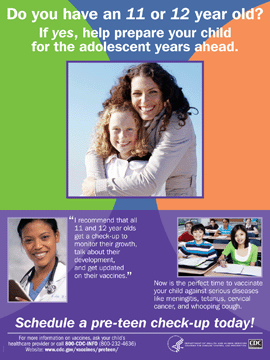
This initiative uses information and communication technology and mass media to share materials designed to raise awareness that immunisation is not just important for babies, and to spur action so that disparities in access to this preventive health service are reduced. The 4 pre-teen vaccines include: i) the flu vaccine; ii) MCV4, which protects against meningitis and its complications; iii) Tdap, which is a booster against tetanus, diphtheria, and pertussis or "whooping cough"; iv) and for girls, the HPV vaccine, which protects against the types of human papillomavirus (HPV) that most commonly cause cervical cancer.
The campaign website provides downloadable educational materials - fact sheets and posters - in English and Spanish for parents and health care providers about preteen vaccines and the preteen check-up. A pre-teen vaccine e-card (in English) is also available. Materials designed specifically for African American, Caucasian, Hispanic, and Native American populations are offered, with materials for Asian American parents in Vietnamese and Korean in the process of being prepared (as of September 2009).
The campaign also includes outreach to mainstream and ethnic media, as well as the creation of partnerships with national and state organisations that reach parents, and healthcare providers. Specifically, in August 2008, the CDC announced that new public service announcements (PSAs) intended to reach the parents of pre-teens had been created and were being made available to broadcast organisations. The television and radio spots urge the parents of 11- and 12-year-olds to vaccinate their kids. Available in both English and Spanish and at lengths of 60, 30, and 15 seconds, the PSAs are available for download and broadcast here.
Immunisation and Vaccines.
"Many parents do not realize that some childhood vaccines, such as those for tetanus and whooping cough, wear off over time and, as they get older, young people are at risk of exposure to different diseases at school, camp or in other new situations," said Dr. Anne Schuchat, Director of CDC's National Center for Immunization and Respiratory Diseases.
The recommended 11- or 12-year-old check-up is endorsed by the American Academy for Pediatrics, and the American Academy of Family Physicians in addition to CDC. "The preteen check-up is a great time to talk with your child's healthcare provider about your child's development, nutrition, safety, and vaccination status," said Dr. Schuchat.
Immunization Action Coalition (IAC) Express #820, August 31 2009; campaign website, September 1 2009; and emails from Aparna Ramakrishnan to The Communication Initiative on September 2 2009.

- Log in to post comments