










































Polio Outbreak in the Middle East: War in Syria Opens the Door to an Old Enemy
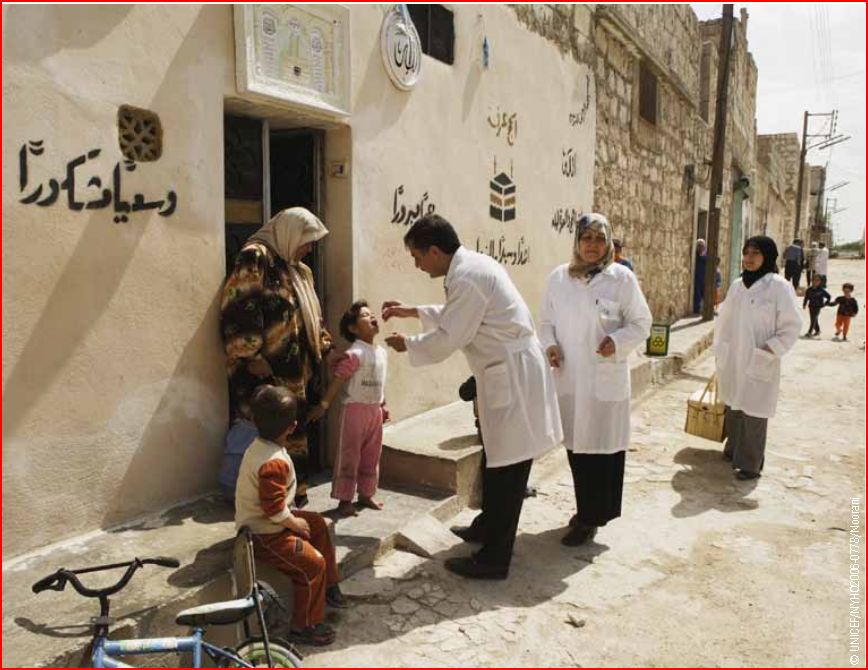
"'In the beginning people felt afraid. They started to ask us who we are,' says Muhammed, a local volunteer working to immunise children against polio in Syria's Al-Hasakah governate, where heavy fighting has taken place. 'I have taken the vaccine myself in front of the families, just to show them it is safe.'"
This report from the World Health Organization (WHO) and United Nations Children's Fund (UNICEF) stresses that it is volunteers, social mobilisers, and polio vaccinators who are on the front lines of a humanitarian crisis exacerbated by the Syrian Civil War. Polio vaccination coverage has dramatically declined in Syria from an average of 99% to 52%, with 36 confirmed polio cases and 765,000 Syrian children under the age of 5 in hard-to-reach areas. Driving home the need for decisive action to address the return of polio to Syria after 14 years, WHO's Director-General declared on May 5 2014 that the international spread of polio is a Public Health Emergency of International Concern, the second time WHO has ever issued such a declaration. "The international spread of polio during what is normally the low-transmission season, including within the Middle East, is an extraordinary event that constitutes a major public health risk to other countries and requires a concerted international response."
Inside Syria, despite heavy fighting in many areas and challenges of access, 7 vaccination rounds took place between December 2013 and June 2014 through close cooperation with local partners and volunteers. They "all have one goal - to protect the children by getting two drops of polio vaccine into their mouths during each and every campaign, averting the risk of life-long disability and death." UNICEF, WHO, Ministries of Health, and other partners have launched regional and national public awareness campaigns to reach parents with the message that it is crucial for children under the age of 5 to take the vaccine multiple times. The goal is to raise awareness on polio and foster participation in these vaccination rounds, which are being held in schools and health centres, on public buses, and at the doorsteps of Syrian homes. (Due to the fact that more than 3 million children are internally displaced and about 1.5 million children are refugees in neighbouring countries, medical teams and vaccinators are travelling from one tent to another in refugee camps and informal settlements, providing vaccines in schools, hospitals, and medical centres, as well as at border points and at airports.) There has also been a training component: WHO facilitated the revision of micro-plans, the training of vaccinators, and the training and deployment of 445 independent monitors to conduct monitoring after every campaign.
An example of a communication challenge vaccinators face: "When aid convoys have managed to enter besieged areas they have carried polio vaccine as a priority item. However, even when children are physically accessible, they may not receive the vaccine due to the ongoing violence. Syria does not have recent experience of polio and caregivers sometimes hesitate before taking their children to get vaccinated, do not prioritize polio vaccination among the other survival challenges they face, or do not realize the importance of ensuring children receive multiple doses of the vaccine."
In Syria, there will be two national mass polio campaigns in October and November 2014 and a sub-national mass polio campaign in August 2014.
Click here for the 12-page report in English in PDF format.
Click here for the 12-page report in Arabic in PDF format.
ReliefWeb, July 31 2014.
- Log in to post comments