










































Our School and Girls Education South Sudan (GESS)
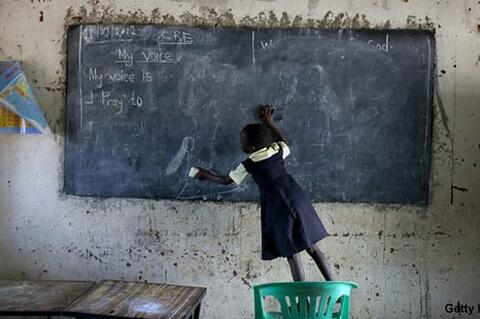
Our School is a series of 15-minute factual radio programmes, broadcast in South Sudan through BBC Media Action, that is designed to highlight the benefits of girls staying in school. The radio programme forms part of the Girls Education South Sudan (GESS project), a major initiative designed to increase the number of girls enrolling in school and completing their education, as well as improving learning outcomes at both primary and secondary levels of education. GESS was launched in 2014 and is expected to run until 2018.
“Few girls in South Sudan finish their full eight years of school. Poverty, insecurity, poor quality education and cultural traditions that discriminate against girls, conspire to keep them from completing their schooling. Whilst financial support for girls and professional support for teachers is provided elsewhere in the GESS programme, the Our School programme addresses the negative cultural attitudes towards girls’ education.”
In particular, it seeks to contribute to the enrolment, retention and improved learning outcome of girls by:
- Inspiring girls to complete their education;
- Encouraging individuals at the community and household level to take actions that are supportive of girls’ education;
- Providing information to girls and their families about new initiatives which will help them stay in school;
- Providing knowledge and understanding to schools about innovations in the school environment which support improved learning outcomes;
- Providing encouragement to parents to get involved in supporting their children at school; and
- Inspiring courage in individuals to make decisions that are not common practice, but that support girls staying on in school.
The magazine-style radio programmes are produced by a South Sudanese team of producers, who are based in seven out of South Sudan’s ten states, each producing locally-tailored episodes in the appropriate local language and including local voices. The programme follows the lives of girls and their families as they struggle and resolve the challenges of going to school. These on-air role models act as positive examples, encouraging listeners to adopt certain behaviours over time. Each programme targets specific knowledge, attitudes and behaviours identified as being supportive of girls’ education. At the same time it also highlights a practice or attitude that hinders girls’ education. This includes, for example, leaving girls to walk to school on their own – and face harassment - or loading them up with too much housework when they come home. By means of interviews with girls, their families and teachers, Our School shows how these factors can affect a girl’s education. There are also accompanying Public Service Announcement (PSAs), which are 30-60 seconds snaps that seek to provide information to girls, families and schools.
The project includes community mobilisation and outreach activities which include listener groups, street theatre and debates, which mirror the themes set out in each radio programme. These activities extend the reach of the social and behavioural change output to communities where there is no radio coverage and/or communities that speak a different language from the broadcasts, to reinforce attitudes and behaviours featured in the programme. Since March 2014, 175 listening groups have been set up across the country, many listening to the programme on a weekly basis.
BBC Media Action has also endeavoured to adapt the programmes to meet the demands of those forced out of school in their home states due to the conflict in December 2013 which left 1.3 million people displaced. New episodes have featured stories of children who have fled conflict and are now being welcomed at schools in other states, despite being without report cards or certificates. The programmes have also shown how children from different states are learning from each other. A programme is being producing from one of the IDP (Internally Displaced People) camps in Juba, the country’s capital; this programme encourages children to remain interested in education and also encourages parents to remember the value of education.
The first round of user testing, carried out in 2014, revealed that parents who listened to Our School saw they had a role in supporting their children in their studies after school. Mothers were most receptive and immediately understood that too much domestic work could have an impact on their daughter’s ability to study. In one group in Eastern Equatoria, parents listening to the “journey to school” episode, decided their children would walk to school together in a group – an idea sparked by the radio programme.
Radio programmes can be listened to here.
Click here for more information on the GESS Programme.
Education, Gender, Children
According to UNICEF: "There are pervasive gender disparities in education in South Sudan. For every 10 boys enrolled in primary school, there are just seven girls. At secondary level the number of girls compared to boys is twice as many. Overall rates for primary school completion across the country remain low at around 10 percent, with girls constituting the majority of dropouts."
The Ministry of General Education and Instruction (MoGEI) leads the GESS programme supported by implementing partners who provide technical advice. Implemeting partners are: BBC Media Action, BMB Mott McDonald, Charlie Goldsmith Associates, Winrock International. The intiative is funded by UKAID.
Broadcast partners: Jonglei FM, Radio Good News, Radio Emmanuel, Radio Nehemia, Radio Bakhita (CRN) Radio Eastern (CRN) Voice of Kajo Keji, Yambio FM, Radio Anisa, Voice of Hope, Weer Bei Radio, Kuajok FM and Don Bosco.
The BBC Media Action website, Girls' Education South Sudan (GESS) website, and UNICEF website, September 4 2015, and BBC Media Action website, Girls' Education South Sudan (GESS) website on January 24 2018.
- Log in to post comments