











































Online Video Educating Youth about Human Trafficking
According to IOM, this online video is based on true stories from interviews conducted by IOM while assisting actual victims in South Africa. Since the internet is sometimes used by human traffickers as a way to recruit youth, IOM decided to use an online and animated video to warn the same age groups that the traffickers often target people online.
The animated video recounts the story of a group of young children who meet a trafficker on their way to school. They have to decide whether to follow him when he promises them a better life. In class, the children are taught about internal and cross-border trafficking using case studies involving forced child labour and domestic servitude, and this knowledge helps them avoid becoming victims of trafficking. The animation uses very few words, focusing instead on pictorial representations to get the message across. When the English language is used, phrases are designed to be simple and succinct. At the end of the video, a detailed explanation of human trafficking appears in English.
Editor's note: See below to view the animation on YouTube. People can also request the video for free dissemination or broadcast by contacting IOM (see contact details below).
Human Trafficking, Children, Youth.
According to the IOM, South Africa is a key focus of this campaign due to the fact that the country is "a source, transit and destination for victims of trafficking. The relative socio-economic stability of South Africa in the Southern African region makes it a prime destination for people in search of economic opportunities. At the same time, there is a high demand for cheap labour and sex services in the country. These factors make it an attractive destination for traffickers, who often exploit the willingness of people to travel to South Africa in search of better opportunities to lure them into exploitation."
IOM also states that there is also a prevalence for "internal trafficking" in South Africa, "where vulnerable people living in impoverished communities in the rural areas and informal settlements are trafficked to major urban centers...for exploitation in forced labor or sexual slavery."
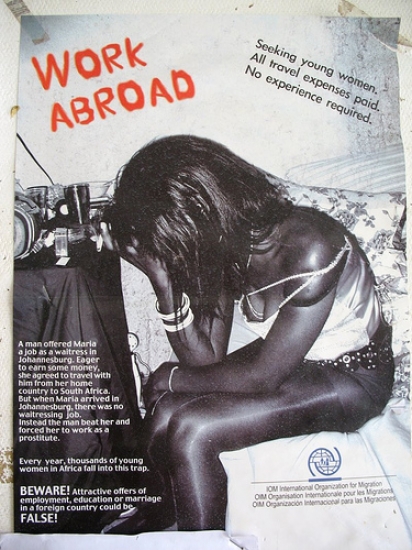
According to IOM, victims of human trafficking are among the most vulnerable to violent abuse, as they are usually recruited through deception or force, transported to an unfamiliar location, and exploited through forced labour, removal of body part(s), or sexual slavery - among others. Children make up one-fifth of the number of victims of trafficking that IOM assists in Southern Africa.
IOM’s Southern African Counter-Trafficking Assistance Programme (SACTAP)
Global Health Council website and IOM website - both accessed on on February 18 2010; and Media Global website, January 6 2011.
- Log in to post comments