










































Maziko: Nutrition Foundations for Mothers and Children
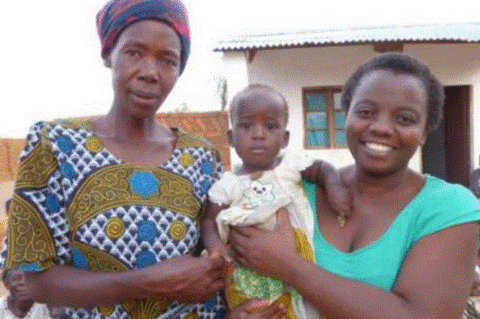
Launched in January 2012, the Maziko Nutrition Foundations for Mothers and Children project works to reduce maternal and child malnutrition by delivering education at both the household and community levels while encouraging women’s social and economic empowerment. The project takes an integrated approach to preventing and treating malnutrition by using interpersonal communication, radio, and information and communication technologies to encourage behaviour change in the areas of feeding practices, agricultural production, water, sanitation and hygiene, while also focusing on access to programmes at the district and community level. Maziko, named from the local word for "foundation", is led by Care Canada in collaboration with Farm Radio Trust, and supported by the Department of Foreign Affairs, Trade and Development Canada.
This project seeks to benefit more than 236,000 women, girls, and boys in two districts (Kasungu and Ntchisi) where stunting and malnutrition are widespread. The project seeks to build the capacity of communities and health workers to reduce malnutrition rates and maternal and childhood illnesses and contribute to human and economic development. This is done through community engagement and dialogue, education about traditional practices and behaviours that negatively impact health and nutrition, and through empowering women by improving their knowledge of healthy practices and promoting their decision-making power regarding household income and health decisions.
The Maziko project has been designed to strengthen multi-sectoral structures, in order to provide a foundation for improved nutrition. It is intended to enhance systematic community engagement by working through existing community agents, traditional leadership, and volunteers. The Maziko Project uses a model of behaviour change that Care Canada says has been proven to reach large numbers of households while also strengthening the community-based referral to health services. As part of Maziko, CARE has undertaken the following.:
- Identified social change agents in each community. These individuals are community role models who exemplify positive behaviours. They helped CARE engage, motivate, and mobilise their communities.
- Increased the skills and knowledge of local health workers with training in such areas as breastfeeding and food preparation. The health workers share that training with mothers and caregivers.
- Worked with farmers and agricultural trainers to increase their knowledge on producing nutritious foods and transfer this knowledge to care groups, with an emphasis on mothers and caregivers. A care group is a collection of local volunteers who help teach women and men about nutrition and good hygiene practices.
- Encouraged agricultural workers supporting community gardens to increase their ability to produce and process nutritious foods. They will then support small-scale farmers, 80 per cent of whom are women, to grow and process foods higher in nutrient value.
- Improved hygiene practices at the household level by increasing access to knowledge of diarrhoea prevention through proper food preparation, water handling and treatment, including when to seek medical attention. Families will be supported to construct sanitation structures and protect their drinking water sources.
- Assisted mother-to-mother care groups to provide women with a system of mutual support and a forum to learn about and discuss good practices for health and nutrition.
- Employed a widely-recognised village savings and loans association model to improve incomes for women so they can afford proper nutrition and health care.
- Engaged religious leaders and community groups to foster and encourage behavioural changes in their communities and ensure those changes are sustained after the project ends.
To engage communities around sanitation issues, Care Canada uses a Community-led Total Sanitation (CLTS) process, designed to build health awareness and plan water and sanitation interventions in communities. Through the use of a simple mapping exercise, project facilitators help to raise awareness about common diseases (that affect both adults and children) caused by a lack of clean drinking water and proper sanitation. Facilitators also work with community leaders to impart knowledge about protecting water sources and constructing sanitation facilities using locally-available materials. After strengthening such skills within the community, the project team – made up of CARE field officers and community promoters along with government health surveillance assistants (HSAs) – monitors each community's response and assists with technical details where needed.
As part of the project, Farm Radio Trust (FRT) is integrating radio and ICTs to increase awareness, knowledge, and nutritional good practices that affect men, children under five years, and pregnant and lactating women through provision of participatory radio and ICT based communication services. It is envisaged that this initiative will contribute to the overall goal of the Maziko project of improved nutritional status as men and women gain knowledge and are empowered to make informed positive choices on the nutritional wellbeing of their families.
Maternal and Child Health, Malnutrition
Malawi is experiencing a decreasing food supply, higher food prices, and scarcity of seeds and fertilizer. Shortages are affecting the health of the people and nutritional information and education is becoming increasingly more important. The under-five mortality rate is 92 child deaths per 1,000 live births. (UNICEF, 2010) Health resources are limited to two doctors and 38 nurses per 100,000 people. The vacancy rate for nurses is 74 per cent. (WHO, 2011). Acute malnutrition is a serious problem in Malawi with 17% of children under five underweight and 41% stunted. (WHO, 2010) Child malnutrition is directly related to maternal nutrition during pregnancy and the feeding practices of children during the first five years of life.
CARE Canada, Farm radio Trust, Mponela AIDS Information and Counselling Centre (MAICC), Malawi Enterprise Development Zone (MALEZA), The Canadian International Development Agency (CIDA), Department of Foreign Affairs, Trade and Development Canada.