










































Makkala Panchayats: Institutionalization of Children’s Participation in Local Decision-Making
Institute for Housing and Urban Development Studies, Erasmus University
This 9-paper reports on a children's initiative begun in 1995 in Karnataka, India - now adopted by the state government for replication - to involve children in regular local public decision-making and governance. Started by the non-governmental organisation (NGO) Concerned for Working Children (CWC) and Bhima Sangha, a union of child workers, it set up elected children’s councils - makkala panchayats (literally, 'children’s local councils') - in several villages to address children’s issues and successfully lobbied for action to improve children’s social and physical environments, using education, empowerment, and political persuasion.
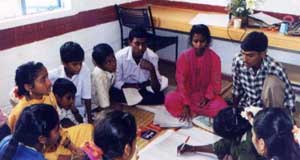
From the article: "Makkala panchayats, conceived as a parallel government of children working closely with village councils, were introduced in Karnataka... as a pilot project.... Makkala panchayats are children's councils comprised of representatives who are elected by all the children in the panchayat between 6 and 18 years of age. The uniqueness of the makkala panchayat is its democratic and proportional representation system. There is a representative for each interest group: working children, school-going children, children with disabilities, and so on."
An example of the action of these councils is one of the issues taken on by the makkala panchayat of the village of Nandrolli: alcoholism. Children overcame a lack of statistical information on alcohol consumption by collecting alcohol containers found on the streets and estimating the cost of consumption to the village. They approached their taluk panchayat, a higher level of rural self-governance, and presented the information at a village Independence Day celebration. As stated here, "There was a nearly unanimous public demand that the authorities take the matter seriously. As a first step, the sale of alcohol through all unlicensed means was to be prohibited. It was decided that the panchayat would issue ban notices immediately. This was effective: many of the unlicensed vendors were shut down."
The Karnataka government’s panchayati raj (local government) ministry institutionalised the makkala panchayat initiative by issuing an order in 2007 making it mandatory for all panchayats within the state to provide children a platform to put their concerns forward directly to elected representatives at special children’s gram sabhas (annual meetings). The order also makes it mandatory for panchayats to report back on actions taken to address issues raised by the children. Makkala panchayati members have developed rules concerning elections, procedures for holding their meetings at the ward level and the village level, and procedures for conducting gram sabhas at the village-cluster level. Their protocol includes guidelines regarding their reservation policy for different marginalised groups, criteria for the selection of a president, and the term of the makkala panchayat. In addition, the protocol provides a framework for children to monitor their own elected members, their Makkala Mitra (children's friend - an adult with supporting functions), and the functioning of their gram panchayat (adult local council).
The challenges of scaling up this initiative to suit the state government mandate required intensive and systematic capacity building of both children and adults through workshops. The article cites the critical nature of adult preparation: "Gram panchayat members and government officials involved in enabling the special children’s gram sabhas should be provided with information regarding children’s rights and the ways to address violations of these rights... The CWC now intends to train gram panchayat presidents, secretaries, presidents of school development bodies, and headmasters of schools as part of the initiative." In addition, there is a need to for greater emphasis on bringing special needs children into the makkala panchayats and the children’s gram sabhas. Financial resources need to be allocated for following up on the issues raised by children, particularly in light of the government requirement of adult follow-up. The article recommends that funds be allocated directly for use by the children's councils.
The CWC strategy for empowering children addressed three main areas: obtaining of strength or power through democratic, inclusive organisation and leadership; the ownership and tactful use of information; and the access to and use of financial, human, and material resources. As stated here, they "allowed the children to form organizations based on their needs, commonality of their issues and concerns, and their comfort level in working with one another...A lesson to be drawn from this is that the role of the NGO needs to be redefined as that of a catalyst and partner in development, in order to transfer information, training and resources, as well as monitor and evaluate the process, without taking the role of a leader that steers the process in any particular direction. Such a role would also ensure that the model is easily replicable even without the presence of a strong NGO."
Children, Youth and Environments 2008, Issue 18(2): pages 197-205.
Comments

- Log in to post comments