










































Kilimani Sesame
According to the organisers, Kilimani Sesame's television, radio, and print educational content is organised into three main curriculum areas:
- Literacy: developing children's listening, speaking, reading, and writing skills.
- Mathematics: developing children's understanding of numbers, shapes, patterns, measurement, calculation, and problem solving.
- Life Skills: providing children with an opportunity to develop skills they need to survive in their daily lives.
One of the primary goals of the programme is to provide families with basic information about methods to best prevent, recognise, and treat malaria. Age-appropriate messages are presented in a way that is designed to help children develop a sense of resilience and self-confidence. For example, in the original live action film "The Mosquito Net," viewers meet Upendo, a young girl who has a mosquito net with holes in it. She explains the differences between a treated and an untreated net, and then travels with her older sister to purchase a new treated net to be safe from mosquitoes and prevent malaria.
The Kilimani Sesame television show is augmented by original episodes produced for radio, which include issue-based songs. In each radio programme, a lead character encounters a difficulty or question that needs an answer which he or she takes "on air" to the children in the audience. The show was developed with Tanzanian educators and child development and health experts.
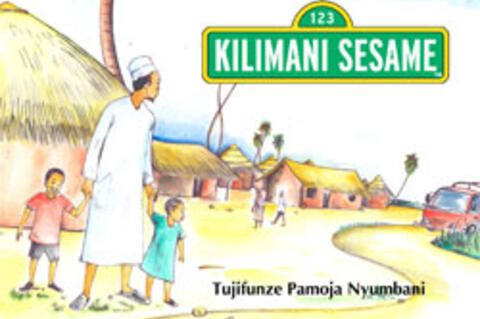
The Kilimani Sesame outreach team created a bilingual caregivers guide called Learning Together at Home/ Tujifunze Pamoja Nyumbani. The guide provides educators and caregivers with information and engaging activities for building literary, mathematics, and life skills. Additional outreach materials include three bilingual storybooks. In the storybook The Safe Net, the Muppet Neno (a version of Elmo) doesn't like sleeping under a mosquito net, but his Kilimani Sesame friends Lulu and Kami show him that it is very important to do so. As Mama Heri shows him how to carefully tuck the ends of his mosquito net under his mattress, she sings to him, "I'm going to sleep inside my insecticide treated net. Mr. Mosquito won’t bite me inside my insecticide treated net. I'm going to dream inside my insecticide treated net. It's going to keep me safe until morning comes."
Sesame Workshop has recently embarked on the second stage of this project. In partnership with Malaria No More and Mattel, the Workshop has begun a malaria education and prevention initiative which will include the distribution of insecticide treated bed-nets, the Kilimani Sesame book, The Safe Net, the creation of a new malaria education poster, and the production of 4 television and 4 radio PSAs. Each PSA will feature a character from Kilimani Sesame in conjunction with local heroes/celebrities and will focus on malaria education/prevention messages that will reach children and their families through national broadcast.
Children, Health, Malaria
In Tanzania, one person, nearly always a child, dies of malaria every five minutes. The most cost-effective way to prevent malaria transmission is to sleep under a pesticide-treated mosquito net hung in the proper way, yet only 16% of Tanzanian children under age five sleep under a treated mosquito net.
Prior to launching the programme, researchers identified a critical need to produce and distribute age- and culturally-appropriate material to Tanzanian children between the ages of three and six. They found that, especially for the 80% of the country's population that live in rural areas, there is basically no educational media available to young boys and girls.
Kilimani Sesame has partnered with a variety of organisations to ensure wide reach and deep impact. With the help of partners, outreach materials are able to potentially reach over 400,000 children and 2,500 caregivers over the course of a year, while television and radio broadcast reaches an estimated 800,000 children and over 1,000,000 caregivers a year.
In 2009, Sesame Workshop commissioned the Bloomberg School of Public Health at Johns Hopkins University to conduct an evaluation of the educational impact of Kilimani Sesame among 223 children and their parents across rural and urban locales in Tanzania. Analyses found that:
- Children performed significantly better on tests of malaria and general health knowledge after exposure to the Kilimani Sesame intervention, compared to their performance before exposure.
- Children's knowledge about malaria prevention and transmission improved after exposure to Kilimani Sesame; children with greater exposure gained more, even after controlling for baseline knowledge and other factors.
- Children's general health knowledge improved after exposure to Kilimani Sesame; those with greater exposure gained more. This measure assessed factors such as children's recognition of a medical provider,
awareness of healthy foods and behaviours, and knowledge of what to do when ill or in an emergency situation. - Children who were the most engaged with Kilimani Sesame showed the greatest improvement in malaria knowledge, general health, knowledge, and health behaviours - as well as in knowledge about HIV/AIDS and their
attitudes towards people with HIV/AIDS.
Sesame Workshop, United States Agency for International Development (USAID), Jane Goodall Institute Tanzania/Roots and Shoots Program, Malaria No More, Mattel, Pact Tanzania, Children and Youth Development Initiative, Government of the United Republic of Tanzania's Ministries of Education for Zanzibar and Mainland Tanzania, and the Tanzania Broadcasting Company (TBC).
Sesame Workshop website; Sesame Workshop (Press Release) on January 19 2010; email from June Lee to The Communication Initiative on March 2 2010; and "Sesame Workshop Takes on Malaria", sent from Jenna Cambria to The Communication Initiative on June 5 2012.
Comments

Kilimani Sesame - Tanzania
This is a useful overview of the Tanzania Kilimani Sesame project. I am particularly impressed by the cultural specificity of the program, and was pleased to read today (July 1, 2010) that a Johns Hopkins study has found Kilimani Sesame to have had a positive impact. (full disclosure: I used to work with Sesame Workshop)
- Log in to post comments