










































Innovations in Mobile Birth Registration: Insights from Tigo Tanzania and Telenor Pakistan
"The ability to prove one’s identity is essential to securing a number of life-enhancing services such as healthcare, education, financial services, connectivity and social protections."
This GSMA report addresses the need of an estimated 1.5 billion people worldwide to obtain an official form of identification through mobile communication. Evidence of birth registration is linked to proof of age (affecting protection from child labour, early marriage, and forced military service) and the ability to: obtain "national identity documents, vote in elections, gain formal employment, own property, or access formal financial services." Two case studies, Millicom Group’s Tigo Tanzania and Telenor Pakistan "demonstrate how mobile technology is being used to improve the means and efficiency by which birth data is collected, accessed, verified and stored."
Barriers to the Civil Registration and Vital Statistics (CRVS) process includes fragmentation and decentralisation and lack of standardisation. In some countries, the parents must prove their marriage; in others, the infant must be registered by the father; in others, there are late fees or a religion must be declared; and, in other, orphans or refugees cannot be registered. Where birth registration is still not essential for accessing primary and secondary education, primary or emergency health, or social payments, there is less early incentive, so demand is low." Targeted public awareness campaigns can be an effective way to increase demand for certificates in these situations, particularly when they are conducted with support from trusted community members, such as religious leaders, teachers and front-line health workers."
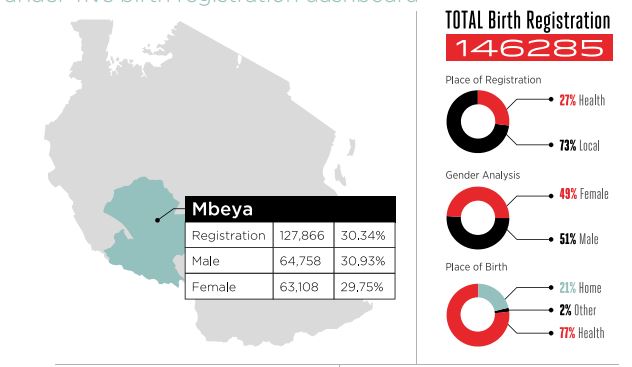
In the case of Tigo Tanzania, the "Registration Insolvency and Trusteeship Agency (RITA) mandates and governs Tanzania’s vital registration system, which includes the registration of births, marriages and deaths, with registration offices at the village and district levels. The registration system is a continuously updated, secure database." In the pilot locations, RITA eliminated the processing fee to allow parents to register their child and obtain a hand-written birth certificate free of charge, which could be done at the time of a clinic visit for vaccination. Tigo Tanzania developed user-centred design mobile applications that could allow registrars to collect birth registration data and remotely upload it to a centralised system through the provision of free mobile handsets, data and SMS texting. UNICEF provided solar chargers to keep the phones powered. The phones stored and sent information when connectivity allowed. Improvements allowed for remotely wiping data from stolen phones, and "Android devices make data collection faster and easier due to its bigger screen, full keyboard, and dropdown menus." Next steps include embedding the process in legislation and capacity building to ensure readiness to scale up nationwide. It has also increased the visibility of Tigo Tanzania and has catalysed a launch of programmes by Tigo Tanzania and Tigo Ghana.
In the case of Telenor Pakistan, a 2012 study showed bottlenecks in the process such that UNICEF, Telenor, and the Local Government Departments of the Provincial Governments of Punjab and Sindh developed a new approach: "the use of community-based 'gatekeepers' to act as either mobile or stationary birth reporting facilitators. Nikah (marriage) registrars were chosen as mobile gatekeepers in Punjab, primarily due to their existing status as government-authorized marriage contractors.... Lady Health Workers, who provide maternal and child health advisory services, especially in rural areas, were chosen as mobile gatekeepers in Dhabeji, Sindh. And finally, Telenor agents, or ‘Sahoolat Ghars’, were introduced in Gharo as stationary gatekeepers. Sahoolat Ghars were chosen due to the fact that they were already proficient with relevant administrative procedures, such as issuing mobile phone SIM cards, handling cash transactions and verifying NADRA [National Database and Registration Authority]'s National Identity Card information." This has reduced a three visit process to one visit within the community. Results included a four-fold increase in registration where Lady Health Workers were involved and an eight hundred per cent increase in the number of registered female births. Partners plan to expand the mobile birth registration pilot to the entire districts of Thatta in Sindh, and Pakpattan in Punjab using SMS messages will be used to broadcast public service messages highlighting the importance of birth registration for children. "The partners also plan to make each of the gatekeeper models more effective by improving how their services are communicated to the general public and by offering more sustainable, performance-based incentives....The next phase of the partnership will allow Telenor to work with the GSMA to investigate whether their role as intermediaries can provide additional revenue streams through data, disbursements and links with other value-adding services, including maternal and child health advisory services provided via text message, and customized SMS alerts to remind parents of their child’s immunisation milestones"
The report concludes with the following lessons learned:
- "The multisector approach used in these projects worked in large part because each partner’s strategic objectives were aligned: it contributed to the governments’ national development strategies, UNICEF’s wider goal to strengthen the realization of a number of pertinent child rights, and the operators’ ambition to use technology to empower and improve living standards in local communities." In addition, roles among organisations were clearly defined, a strategic structure was agreed upon and buy-in of stakeholders was encouraged.
- By addressing barriers of cost, accessibility, and impact, mobile carriers enhanced ministry systems and maximised impact - especially using the strategy of selecting to pilot areas of good mobile connectivity for effective and consistent management.
- Recognizing human and technical limitations, "[p]rojects should include a capacity-building component to ensure new registrars have the skills and knowledge they need to carry out their roles, and the application should be designed to be both easy-to-use and interoperable", ensuring use across multiple platforms.
- Applications are enhanced by including registration of marriage, divorce, and death, as well as support of the collection of data related to other health outcomes.
- In order to go to scale, project stakeholders need to embed systems into law.
- Initiatives, which may begin as non-profit, must be elevated to commercial space to ensure sustainability.
GSMA website, September 28 2017.
- Log in to post comments