










































Get Them to 5 Alive!
Launched in September 2012 and running until 2015, the Get Them to 5 Alive! campaign is working to raise awareness of the scale of child mortality and the leading causes of child deaths in Kenya - namely, neonatal causes, diarrhoea, pneumonia, and malaria. It also seeks to educate people about basic interventions to help reduce under-five deaths from preventable causes and illnesses. The communication campaign is intended to serve as an umbrella messaging platform on child and maternal health in the country and includes programme work, policy, and advocacy, as well as public awareness activities to raise awareness on child and maternal mortality in Kenya. The campaign was initiated by Save the Children in partnership with World Vision Kenya and the Ministry of Public Health and Sanitation.
The campaign calls on everyone to play their role to prevent child mortality and is an opportunity to engage Kenyans through interactive forums to demand their health rights from local leaders as defined in the Bill of Rights in Kenya's Constitution, 2010. The campaign is also calling for collaborative efforts by the government, stakeholders, the private sector, and the general public to take up individual and collective roles in the fight against child mortality in the country. According to the campaign organisers, strengthening the national health systems by the government and increasing health workers and community health workers will go a long way to help prevent child deaths.
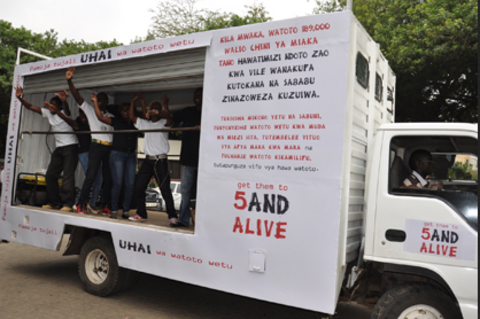
The campaign is designed to be implemented in three phases. The first phase was centred on a nationwide road show. The 'Caravan' began its tour of eight regions around the county with a trip through Nairobi's suburbs. The road show is designed to sensitise the public on the scale of the deaths and the basic interventions that can help prevent the deaths. This includes good feeding, hygiene, and disease prevention practices. The '5 And Alive' Caravan pitched tents in a number of towns, including: Mombasa, Kisumu, Eldoret, Machakos, Meru, and Nakuru among others. Animators drew young people, with music and dance performed on a stage which forms part of the caravan.
At the launch of the campaign, it was stressed that the campaign would actively advocate for utilisation of health services by Kenyans and that health care is a basic right as enshrined in the country's Constitution. A further message: Each person should have access to health care services. The campaign also aims to educate the public, promoting simple actions such as hand-washing with soap, sleeping under treated bed nets, good nutrition, exclusive breastfeeding for a baby's first six months of life, vitamin A, child delivery by skilled attendant, and visiting health centres, which can all have a great impact in reducing child mortality.
World Vision and Save the Children are also advocating for the government to increase the number of skilled personnel and community health workers and develop a fair remuneration package. There should also be a deliberate effort to ensure that skilled personnel are equitably distributed, including to the most remote areas. In addition, budgetary allocation should include provision of reliable drug supplies at all levels of the health system.
Child mortality, Health
According to the campaign website, 189,000 children below the age of five die every year in Kenya, mainly due to preventable causes such as diarrhoea, pneumonia, malaria, and childbirth-related causes. According to the Kenya constitution 2010, the continued deaths of children below five years under preventable circumstances is a direct violation of their right to health as defined in the bill of rights. Lack of awareness among community members on their right to access quality health care has discouraged uptake, leading to many home deliveries with no skilled personnel and low immunisation coverage leading to the death of children from preventable causes.
Every One website, World Vision website, and CARMMA website on June 8 2013.
- Log in to post comments