FotoPelaPaz Youth Media Project

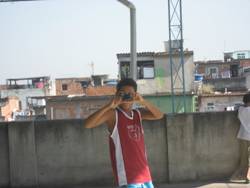
In Nova Holanda, four GPIA students and Pontifícia Universidade Católica do Rio de Janeiro (PUC-Rio) students collaborated with a local non-governmental organisation (NGO), Luta Pela Paz, to create an 8-week photography project with 12 participants between the ages of 12 to 16. Participants learned basic photography skills and then focused on how young people can use a camera as a powerful tool for self-representation and social change. Participants explored their own community and surroundings through the lens of a camera and gained skills (from basic skills such as focusing and zooming to more advanced camera skills). Further, the participants took part in a process of self-reflection in which they had the opportunity to present their photographs to the group, explain their meaning and importance, and share their favorite photographs with their community, their country, and the world through posting their original photographs online.
Two websites were built - one to demonstrate the process of the 2-month course (click here to access it) and one to showcase the photographs taken by the participating children and youth during the course (click here). These websites include more information on the project, profiles of participants, an introductory video to the project, and description of the community, as well as a portfolio of photos for each participant.
Children, Youth, Rights.
Complexo da Mare has a population of 125,000 people, which is divided by 2 rival drug factions, and movement between rival territories is limited for local inhabitants. Historically, favelas in Rio de Janeiro, according to organisers, "have been notable for the almost complete absence of the state characterized by little infrastructure, few public services and almost no political representation. This state neglect has been compounded by the stigmatization of the favela population in the Brazilian mainstream media..."
According to organisers, youth media "has grown in parallel with new media technologies and youth activism of the past decades and is already recognized as an innovative tool for social justice and human rights by the United Nations and community-based organizations around the world and is becoming an increasingly popular strategy for a diverse range of youth programs....[I]n relation to the youth of Nova Holanda and the Complexo do Mare more generally, a primary focus has been on the power of youth media projects to put the tools of new media in the hands of populations of young people who remain alienated from information and communication technologies in their daily lives and who are consistently misrepresented by the mainstream media whose focus on images and narratives of violence and drug-trafficking serves to create a negative and general stereotype that does not represent the depth and reality of the lives of these youth."
New School's Graduate Program in International Affairs (GPIA), Pontifícia Universidade Católica do Rio de Janeiro (PUC-Rio), Luta Pela Paz.
Latest News from Equity for Children, October 12 2010; and "Using Photography as a Tool for Promoting Human Rights", September 24 2010.