










































Child Reporters Reporting on Children's Issues
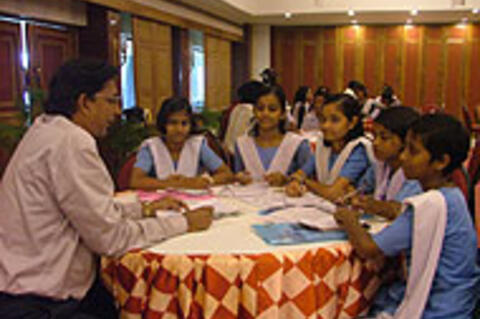
The project is based on the concept of child participation. A core premise is that children and adolescents have the right to express themselves freely and to have their views taken into account in all matters affecting them; that right must be respected and promoted. In addition, organisers hold that children and young people are often much better placed than external duty-bearers to take the lead in assessing and analysing their own situation, and coming up with possible solutions. The Collector and the District Magistrate of Koraput has commented that "Children are able to see everything in stark reality, without the biases and prejudices which all human beings acquire with age." A particular challenge, UNICEF observes, lies in ensuring genuine participation of children from marginalised groups or families who are economically poor, or children in difficult circumstances; Koraput is remote, rural, and disadvantaged in many ways.
In that context, UNICEF launched this participatory, village-based programme. Discussions were first held in February 2005 with the district administration, district team and local partners. The 10 participating schools were selected in consultation with the block development officers and the district education functionaries. In each school, a writing competition was held among the students and the best 10 selected. Care was taken to maintain gender equity in the selection process. Each village school with its 10 children constitutes a team that is led by a local teacher from the village school.
Face-to-face training sessions are used to build participating children's capacity to communicate about the issues affecting them, through journalism. Initially, two types of orientation workshops were conducted: One focused on the broad issues of development in Orissa and how Ankur (the name of the village-based planning initiative in Orissa) aims to make a difference. The other trained children to observe, question, relate, and draw inferences - that is, to report. Since that initial orientation, every month facilitators and reporters have visited each village to hold re-energising/reinforcing visits and discussions with the child reporter teams. Facilitators interact with the young reporters to learn what they have observed/written and to explore avenues for improvement.
The involvement and openness of those with whom the child reporters interact is one key to the process. Each child was provided with a badge stating "Ankur child reporter". The block and district administration were also made aware that these child reporters should be allowed access to all government service providers and other stakeholders in the course of their reporting assignment. The badges were signed by the collector and district magistrate and the UNICEF state representative to give them this authentic access.
Each child is also provided with a thick diary, writing materials, and a small bag. The children note their daily observations and thoughts in detail. They also write about what they see in their villages with respect to health, water and sanitation, poverty, education and other village development issues. The assignment: to fill one page on a daily basis. At the end of the month, the dairies are collected and the best writings selected for inclusion in a monthly newsletter, titled Ankurodgam. "The roof of our school leaks in the rainy season. There is no toilet or playground in our school. We face problems", writes an 8-year old tribal girl named Anupama. One thousand copies of the bulletin are circulated to top decision makers, including those at the state and district level, members of the media, and key non-governmental organisation (NGO) representatives. In this way, they provide a source of feedback for governmental, non-governmental, and international agencies on their developmental activities (facilities, messages, campaign styles).
The children also make special presentations of their writings at various forums of decision makers. For example, 10 child reporters traveled to the state capital to make a presentation before the Government of India, Government of Orissa, and UNICEF officials during the Mid Term Review of Child Environment programme. The child reporters presented about the water and sanitation and environment situation in their villages. In addition, two of the child reporters (both girls and one of them tribal) represented India at the International Conference on Children in Beijing hosted by Soo Ching Ling Foundation and UNICEF - China. They gave two presentations, one on media and children and one on gender discrimination in their area.
In addition to written and interpersonal modes of communication, the child reporters draw on the audio-visual medium. From among the 10 teams, 2 groups from each block (5 per group, totaling 20) are selected to receive basic training on audio visual equipment so that they might document the village-based planning process. Specifically, the children are provided with a handy cam along with a cameraperson. They either direct the cameraperson to record what they indicate or, under supervision, operate the camera themselves. Then the group cuts the film with help of an editor/operator. In this way, the 4 groups document 4 micro planning exercises in 4 villages. For example, some of the child reporters accompanied UNICEF volunteers on a project to conduct micro planning in a remote village in Dasamantapur Block, Tarlaghat. The children stayed there for 5 days, documenting the entire process along with their independent findings, both in writing and by directing a video cameraman.
The internet is also being used as a tool to foster communication by and among the child reporters and other children. In July 2006, the young reporters launched an interactive weblog with the following purpose (in their words): "We want to talk and communicate share our thoughts with the children and everyone world over on our observations and learn from theirs". For example, one of the first few postings reads, "Getting drinking water in our village is a big problem....The village needs some more tube wells, as the tube wells are far from the houses and the water from the tube well in the school is not good."
The participation of community members and schools in the child reporters' work has been a key strategy as the project has developed. For instance, in order to stimulate a broader portion of Koraput's citizens to participate in improving society - as the child reporters have done - a People's Group for Children's Development (PGCD) with a secretariat at Koraput Farmers' Association was formed as part of this initiative. The process is being expanded to the entire district, with 300 schools and at least 1,500 child reporters getting involved, representing all parts of the district. To begin, 248 Model Cluster Schools of the government were selected; these schools take part in the Programme on Girls' Education. Only girls from these schools, of which at least 60% belong to the marginalised Scheduled Tribe community, will take part. To cite another example, to foster the publication of more of the child reporters' writings, a block-level magazine will be published and displayed in the display boards of all the schools. Selected writings will then appear in the district-level magazine once every two months to be distributed all over the state among officials, decision makers and intellectuals. Finally, to strengthen the involvement of the child reporters with their village and locality, organisers will form Village Knowledge Banks in each of the villages where child reporters live. The children will explore, document and preserve local know-how in the Knowledge Bank and take responsibility for maintaining it with care for the future. Part of the aim of this process is to equip teachers with a tool to stimulate children's interest in education.
Children, Rights.
Koraput is one of 30 districts of Orissa; its population of 1.1 million is mostly tribal. Nearly all of the 25 or so types of tribes have their own dialect and customs; the habitations themselves are difficult to reach, and some only by narrow paths. Koraput is amongst the economically poorest and has some of the lowest development indicators in Orissa. According to the 2001 census, Koraput's literacy rate stands at 47.58% (male) and 24.81% (female); further, 79% of deliveries are carried out by untrained personnel.
UNICEF cites the following indicators of programme impact:
- Schoolteachers said that the child reporters have improved with regard to: attendance, handwriting, interest in studies, outlook, knowledge about the outside world, speaking skills, inquisitiveness, and confidence. More children in the schools are interested in becoming child reporters after seeing the work that their journalist/peers are doing.
- District authorities are reading the child reporters' bulletin; some have remarked that it serves as a monitoring tool, giving them a first-hand account of the effect of their schemes and work at the village level. They are also using the report as a reference to take corrective actions.
- Media persons in the district feel that this has been an extremely successful project in highlighting the situation of children and women, and of village development in general. They are also developing their own stories based on the child reporters' bulletin.
- Impressed by the children's efforts, the Governor of Orissa said, "The novel concept of involving children to observe, react and report on their surrounding is commendable because what the children do is based on truthfulness and honesty. The process will not only inculcate in the children a spirit of fearlessness and truthfulness, but will also help them grow as responsible and concerned citizens."
- The collector and district magistrate of Koraput (head of the district) has asked UNICEF to expand the child reporters' initiative from two blocks to the whole of Koraput (14 blocks). The district administration of Dhenkanal replicated the process there, providing children with training and orientation to produce their monthly bulletin, Kalika. Thus, as of May 2006, there were a total of 200 child reporters in Orissa, 100 from Koraput and 100 from Dhenkanal.
UNICEF, Koraput Farmers' Association, the district administration of Koraput.
Emails from Lalatendu Acharya to The Communication Initiative on September 11 2005 and November 20 2005, and emails from Santakar Chelapila to The Communication Initiative on May 18 2006 and July 22 2006.
Comments
